“It is in the shelter of each other that the people live.”
— Irish proverb
If we don’t shelter one another, we are lost. If we don’t shelter one another none of us has a home; none of us has heart, has peace, has rest. If we don’t shelter one another, we are alone, alienated, adrift.
Believing this to be true, struggling to understand community and what it meant to care for one another, I wrote the prose poem below some years ago, wrote it in the voice of a woman who had the experience described:
My apartment has a view of the city skyline
A street lady keeps coming to visit me. She’s looking for her son, leaves me notes. I called the police. They said to call if she comes again. She hasn’t come again, but when she does come, she tries to get in.
Of course, she can’t get in.
She only rattles the door.
Would you have responded differently to the woman’s visitor? What would you have said or done?
Tomorrow, in the spirit of these questions, I’ll bring you a guest post, written by my dear friend and fellow writer, Mindy Shannon Phelps. Mindy’s post will further address this issue of “sheltering”–offering another voice of witness.
Hope you will come back tomorrow and listen to Mindy. Let’s help her feel welcome!
My partner Sara and I are beginning to lose touch—
Lose touch with what it means to be an even remotely “normal” American couple. Some might say that’s not such a bad thing, but I promise you, we have gotten so far from the center of the bell curve, we can’t find the bell any more. We can’t even hear it ringing in the distance.
So–in light of this loss, today, I bring you the top 10 ways you too can be the most un-American of American couples:
#10. Station armed guards outside your house.
This is sure to eliminate any and all illusions of privacy.
(If you are new to the blog, my partner Sara and I live in Haiti where threats to security are common. Click here to read a post about this.)
#9. Argue frequently about how you will generate electricity.
Sara and I have been known to have some of our hottest arguments around just how long we can safely run our generator, especially on days when we have no or very little electricity from the city. I don’t like to be hot. Heat makes me irritable, bitchy, and stressed. So during the hottest nights here in Haiti, I’ve wanted to keep the air conditioning on, or at the very least, a fan running—neither of which are possible without electricity or our generator running.
(To read an entire post dedicated to Haiti’s infrastructure issues click here.)
#8. Do without television.
Instead watch DVDs of “30-Something” for evening entertainment. I knew things were getting bad when over the weekend Sara and I watched back to back episodes of the show’s first season and felt like we were enjoying a special treat, hovering around Sara’s laptop like kids in front of Saturday morning cartoons.
“Oh, boy!” we exclaimed elbowing one another. “Isn’t this great!” We would have broken out the popcorn, if we had a microwave to pop it in.
#7. Go to bed before dinner.
Not out of passion, but because you’ve become dreadfully boring and tire easily.
#6. Have no hot water in your kitchen sink.
Not to mention no dish-washer.
#5. Develop an active fear of kidnapping.
On average—there’s a kidnapping a day in Port-au-Prince—usually of foreigners, often of ex-pats working for NGOs on earthquake reconstruction. And in fact, a number of these kidnappings actually happen in Petion-ville, where we live, since most NGOs have set up their operations from this location.
Many ex-pats are kidnapped from their cars. To alleviate that risk we drive with seatbelts on, windows up, doors locked. It’s harder to be pulled from a vehicle that way.
#4. Stage incidents of international canine trafficking.
I know most folks don’t traipse the planet, canine companions in tow, but Sara and I, for whatever reason, see fit to move our mutts to whichever corner of the globe is hosting the latest in earth-shaking disasters.
For example, it was challenging to take a 40 pound, blonde terrier to Vietnam, where the meat of medium sized, light skinned canines is still considered a delicacy. And though it ended well, concluded with Ralph arriving uneaten in Hanoi, it proved so crazy-making along the way, we “sanely” decided to bring him here to Haiti this past summer.
However, that trip proved less eventful—except for his traveling companions on the flight from Miami to Port-au-Prince—the 10,000 chicks he still hasn’t stopped chirping about.
(For an entire post on pet-transport mishaps click here.)
#3. Appreciate the difference between “trash” and “stash.”
Sara has “placement issues”—a problem she blames on her training as an architect and which she insists I knew about prior to our partnering and simply can not change. Bottom line—Sara likes to arrange things: drawers, cupboards, closets, the contents of the refrigerator, mayonnaise, mustard, ketchup arranged in tidy rows—like items lined up together—like soldiers—an army of condiments ready for edible action. If an object doesn’t fall neatly into rank, the solution for Sara is simple—throw it in the trash.
I, on the other hand, tend to collect things—and not the kinds of things most would consider collectables, but which I gather in the name of “potential art”—items I prefer to call “collagables”—buttons, beads, ribbons, rocks, shells, business cards, bottle caps, maps, matchboxes, newspaper clippings, play bills, and, among other things, sales receipts—in my mind the most under-rated and readily available of all the collagables—a free gift with each purchase, so to speak.
Sara insists my stash is trash!
#2. Agree on only one thing.
That there are too many white people in America.
On one of our recent trips back to the US what stood out to both of us most, even though our home is in an ethically-mixed neighborhood, was the overwhelming huge number of Caucasian in the city where we live. At one point Sara turned to me in the grocery store produce isle and asked: “What do you notice about being home?” My response was immediate, “There are so many white people in America! I had forgotten.” It surprised us how quickly we both had become conditioned to what seems an appropriate ethnic mix. We had made a shift that we noticed only when coming “home.” If this can happen for us, it can happen for others. Come join us. Make the switch.
#1. Be denied the right to marry.
This one I think speaks for itself, but if not please watch this video:
Sara reminds me, that though we don’t have the right to marry in Kentucky, we at least now have an openly gay mayor in Lexington, so that’s a step in the right direction. (To read about Jim Gray click here.)
However, Sara also insists that, by far, the weirdest thing about us as couple is that I asked her to brainstorm with me about “what makes us weird as a couple.” I’m not exactly sure what’s so weird about that, but Sara says my not recognizing the strangeness of that request makes it even weirder. I don’t know. You be the judge.
At any rate, remember that “normal” is a difficult to define category. I appreciate that. But if you recall the 1960s television sitcom, “The Odd Couple,” you’ll see that I’m not talking so much about individual issues that separate us from the crowd. I’m looking at the entire constellation of individual quirks that combine to make a couple what most others would consider strange. I’m looking at the “Odd Couple” factor, if you will.
Felix Unger and Oscar Madison epitomized for a generation of Americans just what it meant to be uniquely coupled in the 1960s.
But If Felix and Oscar were the not-so-average pair of heterosexual bachelors in the 60s, I would argue that Sara and I are the same for this decade’s no-where-near-single lesbian couple—a uniqueness not related in the least to the reality of sexual preference.
In fact, Sara and I give whole new meaning to the notion of “odd couple”—sexual orientation not withstanding.
We may be weird–
But we do want to wed!
What sets you and your partner apart from the crowd? What makes a couple “weird” in the country you call home? Do gay and lesbian couple have the right to wed where you live?
This story is about the heartless and dishonest action taken by a company that claims to not only be “America’s largest and most reliable wireless network,” but also the one “more people trust.”
Clearly, America’s trust is ill-founded. And I am about to show you why.
My partner Sara and I live in Haiti, where Sara directs the recovery operation for one of the world’s largest and most well-known international aid organizations. I live in Port-au-Prince with her and blog about Haiti’s need for more relief, more aid, more care, more prayer. Sara does the work. I spread the word.
On the weekend of February 4th, Sara and I were in Miami for a long weekend away from the stress and strife, the grit and grime that is Port-au-Prince. But before hitting the beach and soaking up the sun, we wanted to upgrade our phones and renew our Verizon Wireless contract.
Up until that Friday I had an unlimited international data plan for my mobile phone—something that was essential to my functioning in Haiti, where access to both electricity and wireless is limited. I needed to upgrade my phone because I blog and the WordPress software I need was not available on the model of Blackberry I owned. Sara also needed an equipment upgrade, since her BlackBerry had stopped working several months before.
Frustrated that our access to electricity in Haiti had not improved even a year after the earthquake, we stopped at a North Miami Verizon Wireless store on our way in from the airport. We were eager; we were enthusiastic as we burst through the door and were greeted by a Verizon employee with, “Would you like to buy a Droid today?”
“No,” I sighed. “Really, I’d prefer another Blackberry, perhaps the Storm.”
The Verizon representative was willing to show me the Blackberry but eager to point out how difficult it was to type from the touch screen. He suggested I try. I did. Indeed, it was difficult.
“Really,” he offered. “The Droid 2 keyboard is more user-friendly and easier to operate.”
To make a long story short—
I tried the Droid. I love the Droid. Sara tried it. She loved it. We were sold.
We were in the store for close to two hours. We explained our circumstances to our now friend from Jamaica, who understood our frustration, as he too had grown up on a Caribbean island. We discussed my need to blog from my phone. He even loaded the WordPress software for me and moved the icon to my home page for easy access.
He empathized. He insisted the Droid was truly the answer to our data needs in Haiti. He referred to the unlimited access to email and internet we would enjoy. Things would be better.
Two hours later we left the North Miami Verizon Wireless store 2 Droids richer and $600 poorer—
Since, when we got back to Haiti the following Monday evening, we discovered we had no unlimited international data package. The phones were useless to us. We spent $600 and, in doing so, lost the very feature that made the phones useful to us, in fact, essential to us.
We had been duped.
So the first thing Tuesday morning, I called Verizon to have the problem resolved. I spoke with a “customer service” representative. I spoke with 2 managers.
Finally, manager Lenora empathized with our situation and agreed to submit a claim to the “Inactive Pricing Committee. “
Now, 7 expensive phone calls to US “Customer Service” later (Verizon refuses to remove the roaming charges associated with those calls), I learned this morning that Verizon has denied our claim, because we bought Droids and the unlimited data package had only been available on Blackberries.
If only we would return our phones to the nearest Verizon store and trade them for Blackberries then the committee MIGHT be able to reconsider our claim.
Maybe the “customer service” representative offered we could mail our phones back to the US.
Yeah, right—mail 2 VERY expensive phones from a country that doesn’t have a national mail service.
Yeah, right—mail them safely from a country where we can’t even trust our own gardener not to steal our tools—not because he’s a dishonest thief, but because he is that desperate to feed his family and might be able to trade the hammer on the street for a handful of rice, a cup of beans.
We won’t be using these phones for economic gain. Really, I‘d be a lot more comfortable blogging from the US, and Sara would be more relaxed if she weren’t trying to house the 1.3 million homeless Haitians living in Port-au-Prince.
We don’t make nearly enough money to pay the $70 per month for the 7 GB of data per phone that won’t come close to meeting our needs.
International aid work doesn’t pay well. Blogging about Haiti pays nothing.
Bottom line—
Verizon refuses to restore the unlimited international data plan we had until February 4th, when a Verizon representative dishonestly persuaded us to buy Droids rather than the Blackberries our unlimited access to data depended on.
Verizon has essentially crippled us in our ability to function in Haiti.
Verizon may be the wireless company most Americans trust, but God forbid, the Haitian people place a similar trust in corporate America’s willingness to meet their needs.
Verizon insists there’s really nothing more they can do.
Verizon Wireless is the devil!
(If you are willing, please pass along this story of corporate greed at the expense of the planet’s poor. Please help me hold Verizon accountable.)
I’m preparing a post for next week about why Sara and I are weird as a couple. (And the fact of the matter is, we are way, way weird.) However, that new piece won’t mean as much if you haven’t read the one I’m re-posting below.
I wrote what appears here only a few days into the life of this blog, so few of you will likely have seen it in its original incarnation. It was called “Top 10 Reasons I’m Pretty Much a Freak.” Hope it entertains you over the weekend.
Let’s face it. I’m not normal. My partner Sara has always said I was weird—actually her word was “eccentric”—but you get the picture.
At any rate, amid all the seriousness I face living in Haiti, I’ve decided to lighten things up here today by offering you the top ten reasons Sara still insists I’m what you could call—well—“quirky:”
#10. Left to my own devices, I eat mostly from what my friend Milana and I call the “white food group.” Edible items in this category include: baguettes, bagels, butter, cream cheese, sour cream, lots and lots of sugar—sugar cookies, cakes, unimaginable amounts of pie crust—and if I were a drinker, which I am not—wine!
#9. I’m a double fisted drinker. Not with wine, of course, but with hot and cold beverages, mostly hot tea, Lipton (though since we’ve come to Haiti, coffee has become an option), and Pepsi Max, when I can find it—(Coke Zero, otherwise). Now, for me, this only works in one direction. Namely, if I drink something hot, I have to have the cold cola to accompany it. However, chilled drinks can stand alone—not always needing the hot accompaniment.
#8. I tend to collect things—and not the kinds of things most would consider collectables, but which I gather in the name of “potential art”—items I prefer to call “collagables”—buttons, beads, ribbons, rocks, shells, business cards, bottle caps, maps, matchboxes, newspaper clippings, play bills, and, among other things, sales receipts—in my mind the most under-rated and readily available of all the collagables—a free gift with each purchase, so to speak.
#6. I never use a top sheet. Don’t believe in them. Never have.
#5. I pretty much live with a saint— We’ll call her Saint Sara the Orderly. (And I have saintly siblings, but I’ll leave that for a later post.) Sara has “placement issues”—a problem she blames on her training as an architect and which she insists I knew about prior to our partnering and simply can not change, as they are, in fact, evidence of her Saintly origins—rituals of the Order, so to speak. Bottom line—Sara likes to arrange things: drawers, cupboards, closets, the contents of the refrigerator, mayonnaise, mustard, ketchup arranged in tidy rows—like items lined up together—like soldiers—an army of condiments ready for edible action. Need I say more.
#4. My partner does disaster response. She’s a disaster response expert. Now there aren’t a lot of these people on the planet (though there are quite a few of them in Haiti these days). I believe (and you are free to disagree), that’s it’s the relative scarcity of this species that makes disasters so, well, “disastrous.” In all seriousness, I’m grateful that Sara does this kind of work. It helps make meaning in our lives. And though that “meaning” often means traveling a lot, we’re not exactly heading to what most would call “vacation destinations.”
#3. My mother wears clothes pins as fashion accessories. Actually, at age 72 she uses them as a mnemonic device, so let’s not get all uptight about this one. However, for further discussion of this semi-strange sartorial habit, I refer you to a post from several days ago called, “Airing Family Secrets Via Haute Couture.”
#2. I taught at Oral Roberts University. This may speak for itself—except that I might mention having arrived on campus in 1986, just after Oral sequestered himself in the Prayer Tower for a number of weeks, claiming God was going to “bring him home” if believers didn’t donate 6 million dollars. I know some of you may be too young to remember this, but it’s true. He did it. I was there. And the play the drama department performed that semester just happened to be—“Death of a Salesman”—I kid you not!
#1. My father was in the mafia–pretty much, that’s what it boils down to—Enough said.
Now, none of these items in and of themselves makes one weird—not even two or three. It’s the global picture I’m getting at.
And I haven’t even included here the biggest reason I’m a weirdo. But, let’s face it folks, we don’t know one another well enough yet for me to share all my secrets. It seems though the picture’s becoming clearer—
I said I wasn’t going to post today–that drunkenness and lounging on a Florida beach would interfere.
But I had to share the video below.
Whether you support gay marriage or not, whether you support the rights of Iowa lesbians to form civil unions or not, please watch this video of Zach Wahls, a 19-year-old University of Iowa student, who spoke out against legislation that would outlaw civil unions for gay couples in his state.
Zach, with a rhetorical prowess rivaling that of Barack Obama, shares his experience as the child of a lesbian couple. The video speaks for itself. Please watch.
You might also like to read an article in the Huffington Post (click here) about Zach’s brilliant defense, his defense of something that shouldn’t need defending–a right that is priceless to gay and lesbian couples–one heterosexual couples take for granted.
I may have told a well-intended lie, an honest lie, of sorts, saying that I wouldn’t post today. But in the US we are only now reversing “Don’t ask, Don’t tell”–a law that requires gays and lesbians serving in our military to lie about their sexual orientations–to lie about their very identities.
We are only now allowing women like me to write openly about their partner’s service to the planet’s poor. Fifty years ago I’d never dared.
We are only now allowing gay couples to walk the main streets of America hand-in-hand with the ones they love, often the ones they’ve committed to for life–to stand strong and proud and committed.
Committed to America, committed to one another, committed to love.
Sara and I are planning a weekend trip to Miami and hoping that Haitian streets remain quiet this week, ahead of our planned departure on Friday. However, recent developments in the news, some even in the past several hours, hint that peace in Port-au-Prince could be short-lived. Let’s keep all selfish, Lesbian fingers crossed that we gals get gone from Haiti before politics throw an exile-returning monkey wrench into our scheme for peace.
Over the weekend we learned specifically that the Haitian Electoral Council will announce on Wednesday the winners in Haiti’s first round of presidential elections—“winners” being the two candidates with the most votes, who will run-off on March 20th.
The American government, in an effort to persuade Haiti to accept the election outcome supported by the OAS (Organization of American States), revoked the US visas of 12 top political leaders from Haitian President Preval’s Inite party. An OAS investigation found massive fraud in November 28th’s election and recommended that Preval’s hand-picked candidate, Jude Celestin, be eliminated from the run-off. Bowing to this pressure late last week, Preval’s party withdrew its support of Celestin, but Celestin himself has refused to concede defeat and remove himself from the process.
However, any potential unrest from Wednesday’s electoral announcement could be complicated further by what Haitian President Preval and his council of ministers decided to do on Monday afternoon—grant former President Aristide a diplomatic passport, so he can return to Haiti.
Clearly, the Obama administration was concerned enough about Haiti’s ability to transfer power away from Preval, whose term ends on February 7th, that it sent US Secretary of State Hillary Clinton to Port-au-Prince on Sunday to meet with the current president and the three presidential candidates fighting for top spots on March 20th’s ballot. I suspect the US is concerned that Haiti not devolve into the same kind of political unrest we’ve seen recently in Tunisia and Egypt. US interests in the region depend on peace being maintained in its own hemisphere, especially in a place just 600 miles south of Miami and too close to Cuba for comfort, a goal that Aristide’s return could threaten.
Cuba also came into play on Monday afternoon, as rumors spread that Aristide had already left South Africa, where he’s lived in exile since 2004, and had returned in the Caribbean, in preparation for his arrival Port-au-Prince. Some reports had him in Venezuela, others in Cuba. However, Aristide’s attorney has since confirmed that the former president has not yet left South Africa.
Aristide maintains a huge following among Haiti’s poor, and his Lavalas party was not allowed to participate in November’s election.
Today’s New York Times has a story that nicely assesses the Aristide situation, outlining the potential complications.
Clearly, political tensions here in Haiti seem to be heating up Selfish as it sounds (and admittedly it is selfish), Sara and I hope things don’t boil over before our weekend escape to South Florida. Though not returning home to Kentucky, we’re looking forward to the comforts of American television (minus Super-Bowl Sunday), foods as heart attack-inducing as McDonald’s Big Mac and fries, and some quiet time to enjoy South Beach and play our part, as gratuitous American consumers, shopping till greed and guilt get the best of us or our wallets are emptied—a little retail therapy to lift our spirits and boost the lagging US economy.
Somebody’s got to do it; might as well be this pair of globe-trotting, dog-loving lesbians, who need a little personal peace, as well.
(Apologies for the Super Bowl snub; we expats like our football better in the form of World Cup action.)
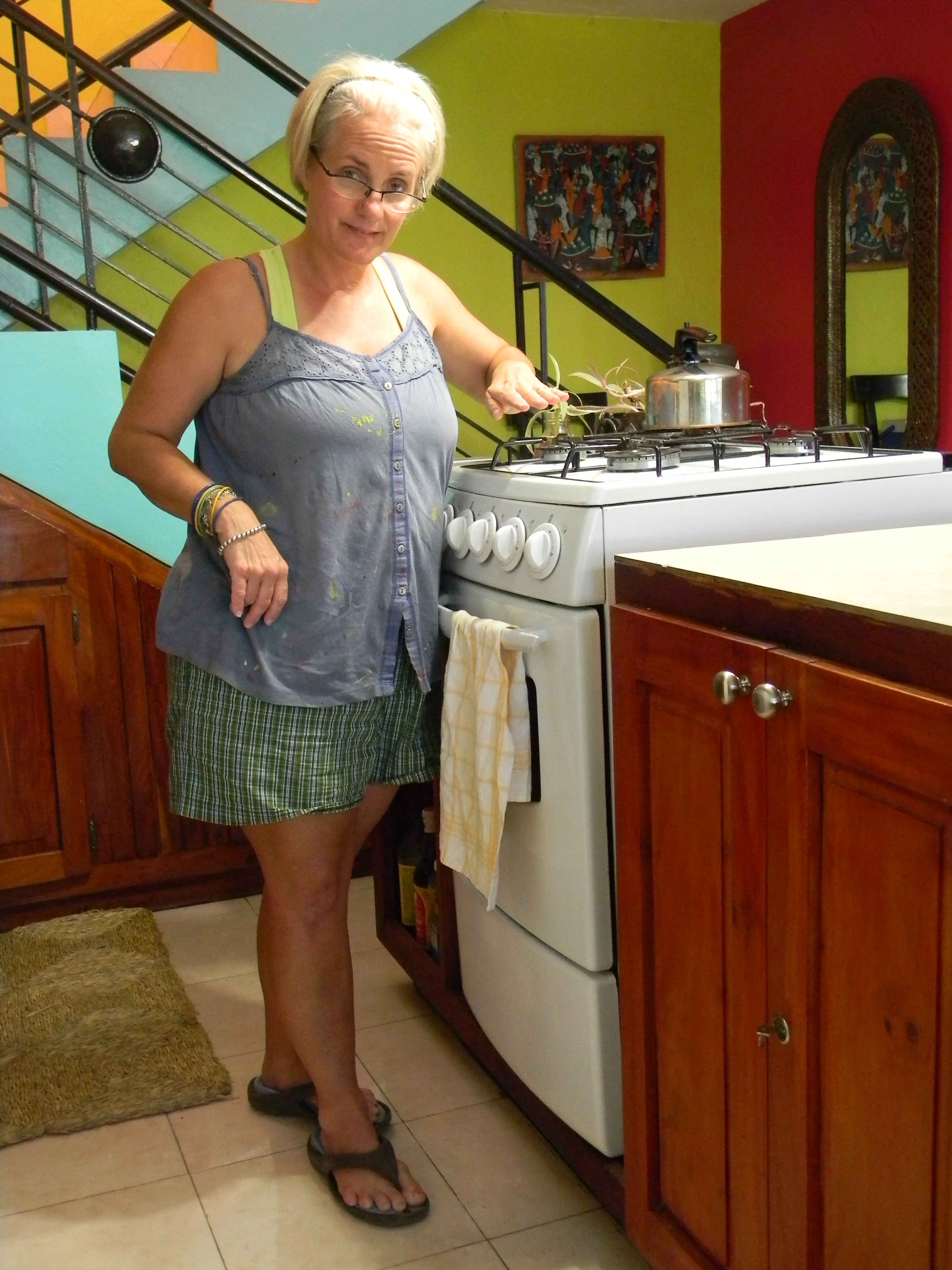
Like many Americans, I love HGTV (Home and Garden Television). When I go home to the US, I can’t wait to watch kitchens upgraded, bathrooms remodeled, landscapes transformed.
Whether I’m cooking with the ease of Lean Cuisine, laundering with the convenience of Kenmore, or cleaning with the miracle of Mop & Glo, I appreciate the perky background chatter of “Divine Design” (to learn more about the show click here) and “Design on a Dime” (to learn more about the show click here).
I enjoy segments on how to install bamboo flooring at a diagonal as much the next surface-obsessed, granite-loving, domestic goddess in North America. Even when I’m at our house in Haiti, I complain about our stove, our oven, our cook-top.
It’s so small:
So tall:
—so not the stainless steel I have at home in the States.
But—(and this is a big BUT)
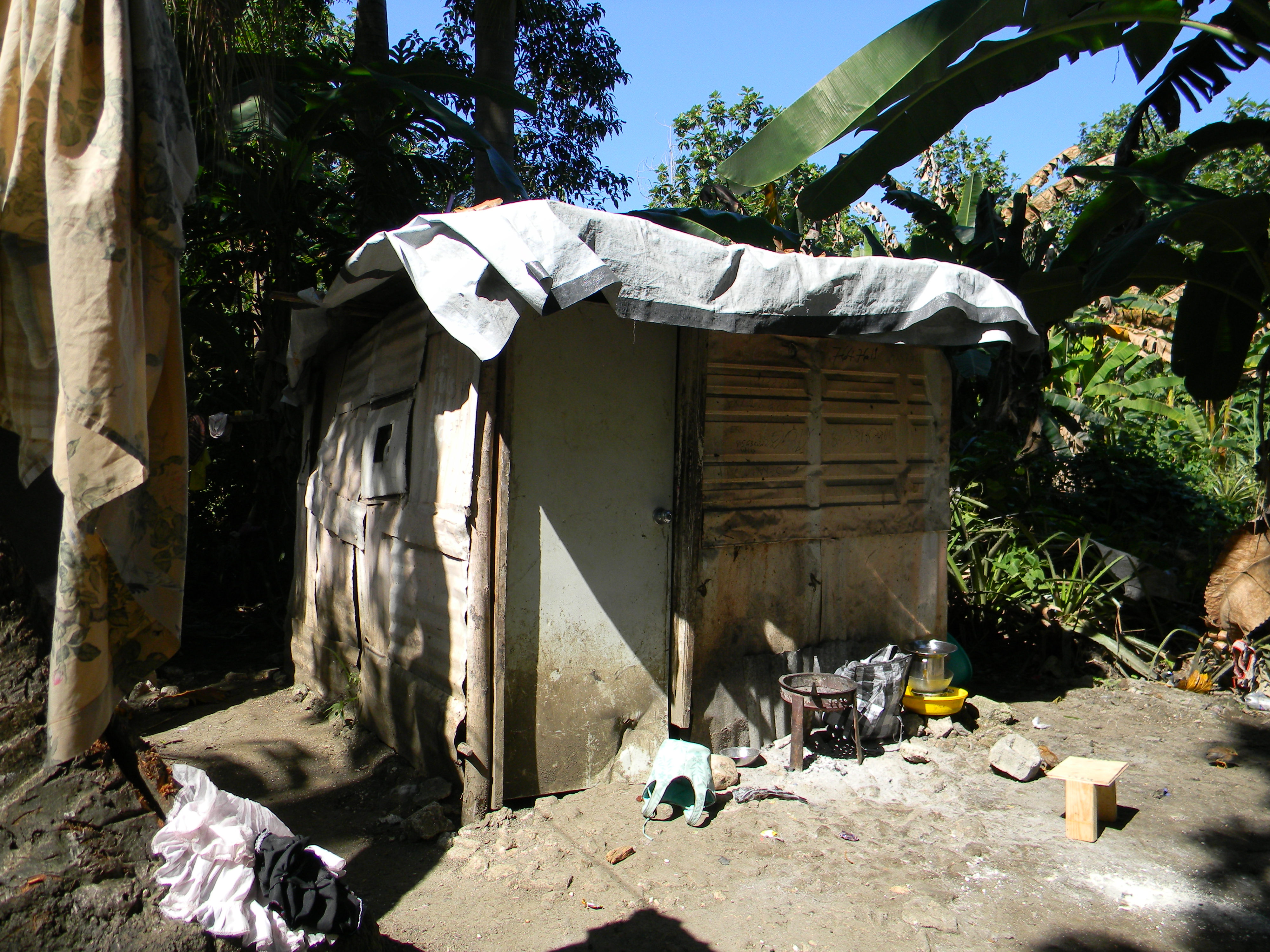
This past week I went with Sara to Leogane, a coastal town about 30 kilometers west of Port-au-Prince, close to the epicenter of the January 12th earthquake. A United Nations assessment team deemed Leogane “the worst-affected area” in Haiti, with 80 – 90% of buildings damaged and nearly all concrete structures destroyed.
Just outside of Leogane I visited a community called Nolivos—
Where the houses look like this:
a "Desperate Space?"
(To learn more about the show, “Desperate Spaces,” click here.)
The washing machines look like this:
doing laundry for a family of 7 children
The kitchens look like this:
a "Sizzling Outdoor Kitchen?"
(To learn more about the show, “Sizzling Outdoor Kitchens,” click here.)
The sinks look like this:
the community well
And the stoves look like this:
a "Kitchen Impossible?"
(To learn more about the show, “Kitchen Impossible,” click here.)
Watching a woman cook dinner for seven on a stove of sticks and stones, I wondered whether Vern Yip would be willing to bring a “Deserving Design” to this mother or another mother in the Port-au-Prince slum of Cite Soleil. (To watch an episode of “Deserving Design” click here.)
I wondered whether David Bromstad would splash some color a little south of Miami. (To watch an episode of “Color Splash: Miami” click here.)
I thought:
Haiti needs to be HGTV’d!(To learn more about the show, “HGTV’d,” click here.)
Really, really rubbing me the wrong way and getting this Confused and Befuddled Foreigner all up in arms and ready to kick some Duvalier ass.
Oops! Did I just say that with my outside voice, my typing voice, my public, face-to-the-world voice? Did I just threaten to kick ex-dictator-dying-to-be-dictator-again ass?
I’m what my grandmother would call “all riled up,” and “in a tizzy” over some Haitian’s seemingly laissez-faire attitude toward Baby Doc–
The attitude of at least two upper-middle class Haitian’s I talked with this week.
But what strikes me as odd is that both of these acquaintances shared a frighteningly similar perspective—one that scared the pro-democracy socks off of my oh-so middle-class American sensibilities.
Obviously it’s important not to generalize from this small sample, but what amazed me was that both said the same thing—something I thought I wouldn’t hear—especially from well-informed and well-educated Haitians.
Both were pro-Duvalier.
I encountered a Duvalierist, two of them.
Both were not just neutral, both clearly supported someone who makes Saddam Hussein look like a Sunday school teacher.
Both said life was better during the Duvalier Era. The streets were safer. There was better infrastructure, more electricity, the lights stayed on longer at night.
“Okay,” I said, “but what about the oppression, the arrests, the torture, the killings?”
“That’s exaggerated,” both claimed, both in separate conversations. Neither knew the other.
“Okay?” I said, half rhetorical question, half affirmation that I had heard them—heard the words at least.
I was dumb-founded. I literally couldn’t come up with something to say.
I still don’t know what to say, how to write about this, how to think.
But the stunned silence I’ve felt inside myself since those conversations has been telling. I’m thinking, as I suspect most well-informed North Americans like me might, “So the numbers are inflated. Then what’s a more accurate estimate? Some say 30,000 Haitians lost their lives. What would have been an okay number to have imprisoned, tortured, killed?”
Quite frankly I’m more than just confused. I’m irritated.
Angry.
Yes, I’m angered that people think this way. But I’m more angered by my own ignorance, my own naivety, my own not knowing how to talk or write about it.
How could I assume so wrongly?
Am I wrong to believe democracy is always best? Are there indeed places on the planet where it won’t work?
I’ve long thought the Bush mandate to “export democracy” expressed many of the faulty assumptions Americans have toward the rest of the world. I’ve known that Thomas Jefferson, one of America’s founding fathers, insisted Democracy depended on an educated citizenry—that the uneducated and ill-informed are poorly equipped to think about, let alone make decisions about good government.
But how does that apply here in a country where so few have gone to school, so many remain illiterate? If education is the key—then which education, what kind, who decides?
I beginning to believe I am indeed in a place where other rules apply. Life’s lived differently, and I don’t have the How-To Manual.
For so long Europeans and Americans have imposed their perspectives on Port-au-Prince. Since the days of Columbus and the original “colonizing,” the conquerors have been wrong—
A mere 35 seconds nearly sealed the fate of Haiti.
At 4:53 pm on January 12, 2010 an earthquake lasting just over half a minute devastated Port-au-Prince, killing close to a quarter million, injuring hundreds of thousands more, and leaving, still one year later, more than a million homeless in and around the Haitian capital. The earthquake may have leveled Port-au-Prince in half a minute, but cholera continues to kill Haitians by the thousands. Every 35 seconds more are sickened. More die needless deaths.
It’s not a pretty picture. There’s nothing pretty about Port-au-Prince.
And as an outsider, clearly, I know nothing about the real suffering of the Haitian people. I know nothing of a mother housing a family of 14 children in a tent the size of a suburban bathroom, nothing of another mother trying to quiet a baby crying in the dark, while torrential rain turns the ground beneath her tiny tarp to liquid mud.
How can I, a privileged white woman from a wealthy nation, speak of Haitian pain with any real authority?
The fact of the matter is I can’t. I have no right. I have no knowledge of not enough food to eat or no clean water to drink. I can only speak of what I see—
And what I see—every 35 seconds—is a city still in ruin. I see the weary but not teary eyes of human beings too stunned to grieve even colossal losses.
I may indeed presume too much, but I am here in Haiti on this historic day and I will take 35 seconds to pray for Haiti—
To pray for peace in the mountains that circle Port-au-Prince this morning.
Please take 35 seconds to share this prayer with me. Take 35 seconds and pray for peace in Haiti.
I will be heading back to Haiti Saturday, after 3 weeks in the US—21 days so far since my American Airlines flight landed in Miami and I had my first night in several months with an uninterrupted supply of electricity. I guess Friday will be my last for the next 90 days or so.
Which raises the question—
What comforts from home will I miss most in Haiti? Over the next several days, I’ll share them here, a way to gear up for this transition.
Clearly, however, electricity tops the list.
Now, I’ve been without power before in the US, without the luxury of electricity for 6 days straight during an ice storm in Kentucky some years ago. But being without this utility here at home is entirely different from being without in Haiti.
For example, no electricity for several days means near disaster in most of North America. No one knows what to do or how to manage the tasks of daily living, so folks function on the adrenaline panic produces during times of crisis. Citizens of Kentucky jump into fully fueled cars, drive to Lowes or Home Depot, grab all the batteries, flashlights, and candles money can buy this side of Port-au-Prince. Normal life is temporarily interrupted.
It takes several powerless days to shift into “picnic mode” and celebrate with neighbors round a fireplace, all hoping to stay warm on icy February nights.
People play games. They pop popcorn on the stove top (gas, of course). They become families and neighborhoods once again–helping one another survive this bout of being without.
The local utility company may take longer than they’d like to get things up and running, but folks maintain a basic faith in the system, a security that only a strong and stable infrastructure provides.
They believe. They know.
The lights will come back on and all will be right with the world—a reality interpreted largely in terms of how well one sees at night.
Eventually, neighbors go back to FaceBooking in the evening, doing status updates out the ass—rather than playing Monopoly or Clue around the kitchen table—really seeing the shadows candles cast on the faces of their children—the shades of gray and flickering light—Sally’s chin that’s strong and Bobby’s dimples winking in the nearly dark.
In Haiti it’s an entirely different affair.
If we happen to have power when we wake up in the morning and even less likely happen to have it when we fall asleep at night, Sara and I marvel to one another:
“Do you think we REALLY had city power all night?” (What in Haiti we call electricity that comes from something other than a generator)
“Well, was it on when you fell asleep?”
“Yeah, it was.”
“And you’re sure you didn’t just forget to turn the generator off?”
“No, if you didn’t turn it on, I didn’t either. Had to be city power!”
Craziness—
We marvel at the having rather than the not.
But Sara and I are spoiled. Though we often face the threat of diesel running low—at least we HAVE a generator.
Most folks in Port-au-Prince, on the other hand, truly DEAL with darkness every night. Without the ability to generate power, they struggle to help children with their homework—that is, if they can actually afford tuition, if they can actually afford to buy a candle for their kids to study by.
Eyes adjust to lesser light—the dim of half-light becomes a way of life.
But now—
As I prepare to return to friends on our Caribbean island—now that I once again have grown to expect bright light at night—20 good evenings in the US—it’s time to return again to the dimly lit faces of my Haitian neighbors.




 Kathryn M. McCullough