Haiti: The Art of Recovery


I’m a wanna-be artist, a sort-of, almost artist—certainly not by training and clearly not because of craft. 

I’m also an artist who has struggled with bipolar disorder, someone who appreciates the creativity that is often an unexpected gift accompanying the illness.  I’m someone who has not only made art when I was sick, but continues to create even when I am well, as an outgrowth of recovery.  In the art world I’m what would be called an “outsider” artist.  I don’t always know what I’m doing.  I just do.  Art. 

I’m also a writer and artist who has lived in Haiti for the last year with my partner.  Sara has directed an international NGO’s response to the earthquake.  But we are preparing to go home next week, and I’m thinking not only about what Haiti has given me, the gifts I will take home, but also what I’ll leave behind.

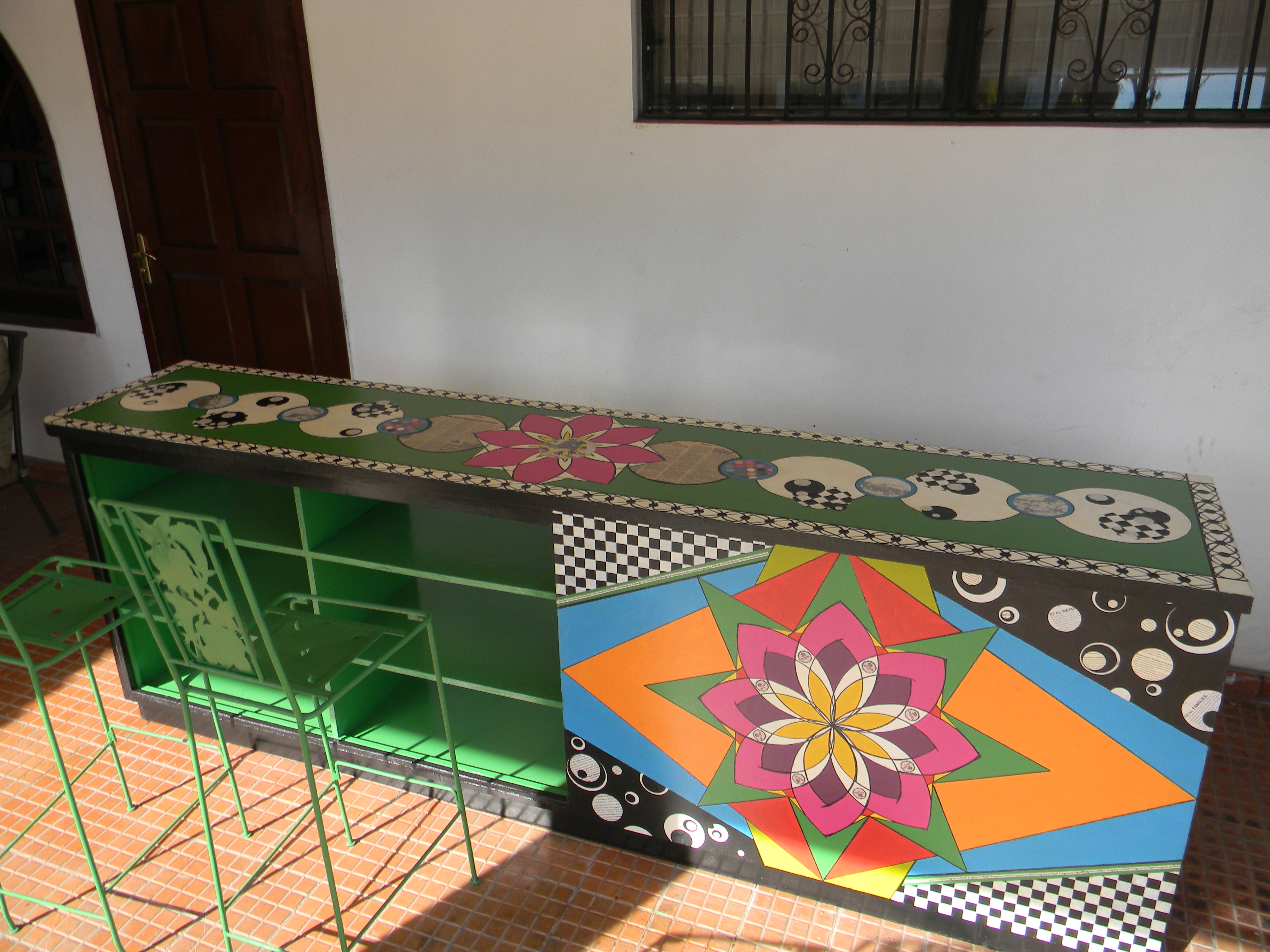
Indeed, one of the gifts I’ve given is a large piece of art, one I created for Sara’s NGO from a throw-away piece of furniture—a huge serving bar I painted last summer.


The bar is nearly 9 and a half feet long and lives on an upstairs patio at Sara’s office in Port-au-Prince.

It was white, ugly, an eye-sore, really.  But Sara wanted to save it.  She thought it, like Haiti itself, should be given a second chance at life, that the bar could be used for receptions, to serve meals on special occasions.  She thought I was the one to midwife this rebirth, that I was the one to take on the task, that as someone who has repurposed art as part of my own recovery, I could gift a born-again bar to the wonderful people who work here.

I loved the idea and took on the project enthusiastically, in the end creating a mixed-media piece—one that incorporates the organization’s logo in strategic places, as well as decoupaged-maps of Port-au-Prince and each location in Haiti the organization works.

I also included stories from the local newspaper, highlighting big events in the news during the months after the earthquake.

I included text from the organization’s 6-month, post-earthquake report, as well as the names of almost all the people who had worked on the NGO’s reconstruction effort—folks from more than a dozen countries around the world.

The front of the bar repeats the organization’s logo above each flower petal:

As well as the names of staff in black and white circles:

The top of the bar includes the maps and newspaper text:

However, soon Sara and I will leave Haiti; soon we’ll leave the places mapped on the bar-top at a bit of a distance, at least geographically.
And though we’ll leave when the organization’s work here is still incomplete, though in many ways it seems too soon, I’ll leave a piece of myself behind, one that I hope will serve the NGO’s mission here well into the future.  I’ll leave not only a piece of my art, but also a piece of my heart, knowing this is not really an end.  We leave but others will come.

Haiti has taught me this lesson: that indeed good things can come from our departure.   It has taught me not only how to birth a new bar, but also  how to hope, how to see potential in seeming destruction,  how to dream a new dream, how to hope a new hope.  It’s reminded me that, if art can come out of sickness, then indeed beauty can come out of the earthquake’s ruin. 

I believe that in every beginning an end is waiting to happen and from every illness or devastation a new beginning will grow.

Peace to people of Haiti—

And thank you!

Haitian Housekeeping from a Beach in South Florida!


Today I promised another post on Haitian graffiti artist, Jerry Rosembert Moise (if you missed yesterday’s post on graffiti, click here).  However, you street art enthusiasts are being put on the blog’s back burner, while I recover from a near all-nighter, waiting for election results that were not actually announced here in Haiti until this morning. 

As it stands, Mirlande Manigat and Michel Martelly will run off in the second round of presidential elections on 20 March.  This means the Haitian electoral council has followed the recommendation of the OAS (Organization of American States).  The OAS reviewed the results of November’s election and recommended that government-backed candidate Jude Celestin be disqualified because of fraud.  Ultimately members of the CEP (electoral council) were split 5-3 on whether or not to remove Celestine, deliberating all night, before finally announcing their decision just after 7:30 this morning EST. 

The good news–this should mean relative calm on Port-au-Prince streets.  In fact, there was a good bit of cheering this morning when the decision was finally broadcast.

For me personally, this means my long-weekend in South Florida should become a much-needed reality tomorrow morning.  As long as streets remain quiet and the airport stays open (it closed for several days following the last announcement), Sara and I will be sipping margaritas on the beach through Monday.

The ensuing drunkenness may mean no posts till Tuesday  (we’ll see) and my inability to officially pass along the “Memetastic Award” Clouded Marble cursed honored me with 2 days ago.  Sorry for this delay until next week, but in the meantime, you should visit her amazing blog and check out the other winners, who, I assume, will not be beaching it up in Miami this weekend, and may post something you’d enjoy reading in my absence.

In the meantime, check out my archive to catch up on posts you may have missed.  And enjoy the genuine genius always available on my blogroll.

That’s all the house-keeping this blog can handle for one  morning, but I will continue tidying from the sands of South Beach–a Kindle in one hand, a cool beverage in the other.

So toodles–I’ll be sipping  till Tuesday———–

Graffiti: Inscribing Haiti’s Future on the Rubble that is Now


There’s a long-standing tradition of political graffiti in Haiti—one that began soon after the Duvalier dictatorship ended its 29 year reign of terror with the ouster in 1986 of now newly-returned Baby Doc.

 We’ve come full circle. 

Duvalier is back.  Aristide is on his way.

However, political graffiti isn’t gone.  In fact, it’s virtually everywhere in Haiti’s capital—buildings and walls defaced by political thugs given $35 (US) and some spray paint to propagandize Port-au-Prince—scrawlings in red, black, and blue—the names of presidential candidates literally littering the city in ink.

What’s different, however, is this: there’s a new kid on the block, a graffiti artist named Jerry Rosembert Moise, who began his brilliant work just hours after an earthquake devastated his city.

What’s also different is that Jerry’s graffiti is decidedly non-political.  It articulates the suffering of an otherwise silent city, whose pain is tented and tarped along rubble-strewn streets, where cholera rages and rioters react in a language of flaming tires—a solidarity of burning rubber.

Jerry, a twenty-five-year-old graphic artist by training, paints simultaneously with both hands.   By now he’s completed more than 50 pieces, beginning in Port-au-Prince proper, before moving uptown to Petion-ville where we live. 

Directly across the street from my partner Sara’s office, is a painting that looks like this:

Though getting good photos of this piece is now complicated by a billboad’s intrusion, you can still see the ball-holding boy, watching the world cup.  There’s a lot of watching going on here, the person on the street seeing the painting, the young man staring at the set.  Passively the world watches and plays games, while Haitians wait, forced to make furniture from rubble?  Who holds the ball here?  Are these the questions Jerry asks?

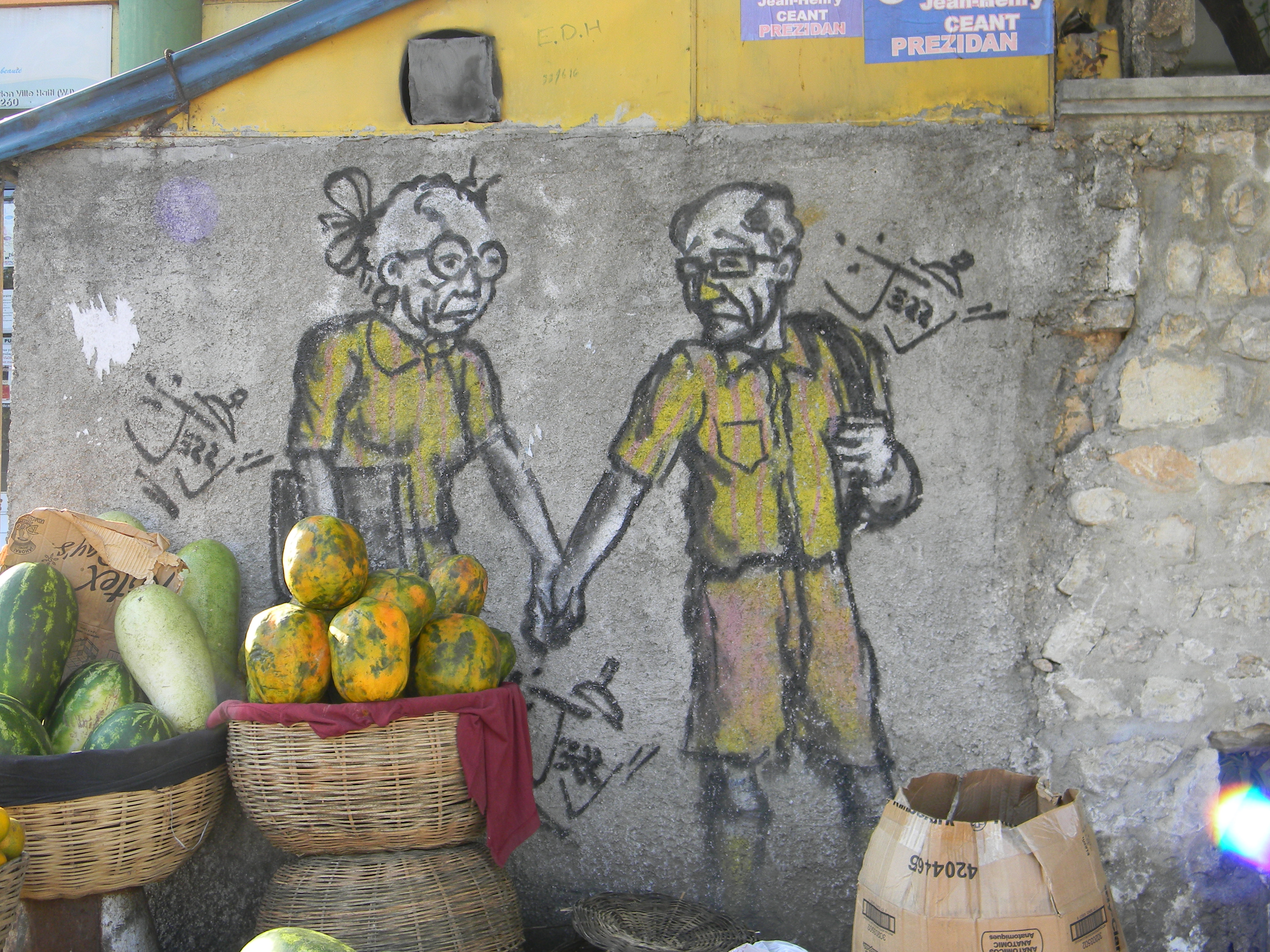
Just half way up the block, however, on the same side of the street is a piece that looks like this:

What’s Jerry’s message here?  The hand-holding couple walk in solidarity.  What makes them so sad, so tired?  Why do they look down instead of up or at one another?

Still further up the block and across the street from Sara’s second office is a woman leaning against the very wall she’s painted on:

Her gaze is directed over her shoulder and into the street, perhaps even across the road at the NGO where Sara works.  She wears glasses, smokes a cigarette in high heels that force her to stand on tip-toe, legs crossed—tentatively.  She’s suggestively watching what?  What does she need assistance seeing or saying?  When does “suggestively” become “suggest?” 

Not far from the block where these three pieces peer at televisions and NGOs, is an even sadder commentary of post-earthquake Haiti:

Here the boy in a wheel chair is watched by Santa Clause.  Santa, suited up in high holiday-fashion, is the passive on-looker.  The boy participates, waving a bleeding Haitian flag, popping a wheely—stunting for Santa. 

“I may be hurt,” he says. 

“I may be bleeding.  But watch me wave patriotically, while you stand idly by, hot under the collar in that stupid European suit!” 

“Why are all the ex-pats pissed?” he wants to know.

Santa may not know the answer.  We may not either.  But Jerry himself has this to say:

So Jerry’s message is one of hope, a belief that the youth of Haiti can and will make a difference, build a stronger future on the rubble that is now.

Tomorrow, an update on Jerry’s latest project! 

Stay tuned.

Haitian Street Art: A “Good Report”


Most mornings in Haiti I drive past displays of “street art”— a common sight in and around Port-au-Prince.  In most instances, hundreds of paintings are attached to walls that line the roadways, a collage of folk art images quilting the street.

In Petion-ville, just down the mountain from where we live, art is sold across the street from a camp of earthquake survivors, and in fact, some paintings now for sale along the road have selected the disaster itself as their subject.

Below is a video about street art that was produced about a month after the earthquake.  In it two artists are interviewed, the first lamenting the loss of his mentor in the disaster, the second discussing his own earthquake-focused paintings.  Despite the language barrier, try to appreciate the images and emotions shared here:

Responding to the same depth of emotion expressed above, Sara and I, over the last year, have purchased a number of paintings from the street.  We love the stuff and have bought 5 or 6 pieces, not only because of the emotionally charged nature of the work, but also because the art is highly affordable and equally portable.  (Canvases can be removed from frames, rolled up, and packed away in suitcases when we return to the US.)

The first piece we purchased in March of 2010 depicts a market scene, a common motif in Haitian folk art and an especially popular one in street art:

We enjoy the bold colors in this painting by A. Emmanuel and are struck by the featureless faces of the market women.  Notice the women wear the head coverings common in the Haitian countryside.

Still other paintings feature religious themes, as in this image of the Madonna:

Notice the mirror images of the Baby Jesus.  Twins are especially important in voodoo, and sometimes even Christian paintings include elements of it.

However, other street paintings more overtly explore voodoo, this other side of religious life on the island.  Some offer heavily painted symbols of the loa, the deities of Haiti, such as the “vever” (design) for Agwe, the voodoo water spirit:

Sara and I have none of the “vever” paintings, but we do have the one below that is, at least obliquely, associated with voodoo:

Still other street art paintings, like the one below, explore rural village life:

I think it’s important to remember, that street art, like the painting above,  like those sold adjacent to the camp in Petion-ville, not only humanizes situations that might otherwise seem hopelessly inhumane, but also dignifies these places, in some instances almost encircling the camp with images of loveliness and grace, embracing the Haitians encamped there, culturally reinforcing messages about beauty’s ability to triumph over pain.

So the next time you think about Haiti—the earthquake, the cholera, the political corruption—remind yourself, and others for that matter, that though things here might seem singularly hopeless, they are, in fact, neither simple nor beyond repair.

Remember that over 200 years ago Haitians defeated the French, becoming only the second country in the Western hemisphere (after the United States) to gain independence from a colonial master—a nation of slaves strong enough and determined enough to refuse oppression even its most imperial form.

Remember, as well, that Haitian folk art in general and street art in particular articulate the daring of a people determined to overcome.  Remember that Haiti is not a hopeless place, but is, in fact, one whose people have endured centuries of mistreatment, first from a colonial system of servitude, then from a social and political elite whose wealth has depended for decades on the poverty of so many.

Indeed, the future may look bleak, prospects may seem poor, but Haitians are rich in emotional resources,  their creative spirit screams from street corners where art echoes centuries of grief and centuries of hope, decades of determination, and ages of insight, wisdom, and strength.

Haitians remember the Biblical imperative to think on “whatsoever things are true, whatsoever things are honest, whatsoever things are just, whatsoever things are pure, whatsoever things are lovely, whatsoever things are of good report.”  (Thank you, Jane, for the reminder!)

Haitian art indeed reminds us that things are lovely–

That beauty  paints a “good report.”

Make Green, Not Greed: Sustainability in Haitian Art


When you think “island music,” you most likely think “steel drums” and the almost bubbly music they produce—happy notes.

But here in Haiti, the 55 gallon oil drums recycled for music-making have yet another artistic application—one I learned about last spring on my first trip to Haiti.

In March of 2010, I traveled to Port-au-Prince to celebrate a birthday with my partner Sara, who had already been in Haiti for nearly two months.  Nine weeks after the earthquake, the place was not exactly a “vacation destination”—the city was largely a landscape of rubble and debris—remnants of a city that used to be.

But Sara had recently moved into a house expected to be home for the next several years.  So in an effort to make it feel more like “home” and less like a house of a hill seeking its soul, Sara and I decided we wanted our home to mirror the cultural landscape of the city, to fit with the creative lay of the land, so to speak.  And it seemed easiest to accomplish that with art, or whatever remained of it here after the earthquake.

In fact, last January’s earthquake dealt Haitian art a devastating blow, severely damaging the Centre d’Art, which launched Haiti’s art movement in the 1940s, and collapsing the Musee d’Art Nader, which had housed the country’s largest private collection of more than 12,000 pieces.

But even so shortly after the earthquake that nearly leveled the city, in March artists were back at work, perhaps, partly because Haitian art is largely a study in sustainability, and artists use whatever materials they have on hand to make creative statements, sometimes even hammering them from the steel remains of oil drums, the same material on which musicians mallet out their melodies.

Ever since the 1950s Haitian artists have been pounding cultural messages into steel—a tradition of metal art that owes it origins to a blacksmith from Croix-des-Bouquets named Georges Liautaud, who began fashioning simple metal crosses to mark graves in his village, since so few Haitians could afford tombstones.  

In fact, the first piece of metal art Sara purchased and had hanging in our home when I arrived last March was such a cross.  Yes, they’re still being made some 60 years after Liautaud began the tradition.  The cross Sara had hanging on our bedroom wall looks like this:

However, the piece of metal art we purchased that Saturday in March was done in the African mask style, a stunningly beautiful Haitian woman with bold spiraling hair and DNA-ed dangles hanging from either ear:

When I returned more permanently to Haiti in June, we purchased our lovely lady a mate—a warrior, whose long, stern face guards our entrance way with steely spikes of hair and sadly serious eyes:

Since then, Sara selected and purchased a spritely angel who hovers in our bedroom—a circling girlish figure, a feminine compliment to the more masculine cross that still hangs on an adjoining wall:

So what’s one to make of this art being pounded out in Port-au-Prince?

In the US some still accuse the Bush administration of entering Iraq for oil, but it’s unlikely Obama will make war in Haiti for empty barrels of the same black gold, so Haitian artists will use the rubbish from the rest of the world’s over consumption, its gas-guzzling greed and extravagant excess, to hammer home a message other countries had better learn, learn before it’s too late.

Haiti reminds us that maybe we should sing a different tune, beat our drums not for more oil, but make do with what remains.

The pied piper of Haiti may make his music on metal drums, but will the world follow a Haitian example of green consumption over greed?