Make Green, Not Greed: Sustainability in Haitian Art


When you think “island music,” you most likely think “steel drums” and the almost bubbly music they produce—happy notes.

But here in Haiti, the 55 gallon oil drums recycled for music-making have yet another artistic application—one I learned about last spring on my first trip to Haiti.

In March of 2010, I traveled to Port-au-Prince to celebrate a birthday with my partner Sara, who had already been in Haiti for nearly two months.  Nine weeks after the earthquake, the place was not exactly a “vacation destination”—the city was largely a landscape of rubble and debris—remnants of a city that used to be.

But Sara had recently moved into a house expected to be home for the next several years.  So in an effort to make it feel more like “home” and less like a house of a hill seeking its soul, Sara and I decided we wanted our home to mirror the cultural landscape of the city, to fit with the creative lay of the land, so to speak.  And it seemed easiest to accomplish that with art, or whatever remained of it here after the earthquake.

In fact, last January’s earthquake dealt Haitian art a devastating blow, severely damaging the Centre d’Art, which launched Haiti’s art movement in the 1940s, and collapsing the Musee d’Art Nader, which had housed the country’s largest private collection of more than 12,000 pieces.

But even so shortly after the earthquake that nearly leveled the city, in March artists were back at work, perhaps, partly because Haitian art is largely a study in sustainability, and artists use whatever materials they have on hand to make creative statements, sometimes even hammering them from the steel remains of oil drums, the same material on which musicians mallet out their melodies.

Ever since the 1950s Haitian artists have been pounding cultural messages into steel—a tradition of metal art that owes it origins to a blacksmith from Croix-des-Bouquets named Georges Liautaud, who began fashioning simple metal crosses to mark graves in his village, since so few Haitians could afford tombstones.  

In fact, the first piece of metal art Sara purchased and had hanging in our home when I arrived last March was such a cross.  Yes, they’re still being made some 60 years after Liautaud began the tradition.  The cross Sara had hanging on our bedroom wall looks like this:

However, the piece of metal art we purchased that Saturday in March was done in the African mask style, a stunningly beautiful Haitian woman with bold spiraling hair and DNA-ed dangles hanging from either ear:

When I returned more permanently to Haiti in June, we purchased our lovely lady a mate—a warrior, whose long, stern face guards our entrance way with steely spikes of hair and sadly serious eyes:

Since then, Sara selected and purchased a spritely angel who hovers in our bedroom—a circling girlish figure, a feminine compliment to the more masculine cross that still hangs on an adjoining wall:

So what’s one to make of this art being pounded out in Port-au-Prince?

In the US some still accuse the Bush administration of entering Iraq for oil, but it’s unlikely Obama will make war in Haiti for empty barrels of the same black gold, so Haitian artists will use the rubbish from the rest of the world’s over consumption, its gas-guzzling greed and extravagant excess, to hammer home a message other countries had better learn, learn before it’s too late.

Haiti reminds us that maybe we should sing a different tune, beat our drums not for more oil, but make do with what remains.

The pied piper of Haiti may make his music on metal drums, but will the world follow a Haitian example of green consumption over greed?
Stumping for Haitian Art: Gorgeous Gardens in Port-au-Prince


I had a close encounter with garden art last week—

An unexpected one at that.

Regular readers of my blog know that I’m a visual artist—of sorts—self-taught, poor, and living in exile on a Caribbean island, where electricity is in short supply, political stability is even harder to come by, and cholera is spreading like good gossip in a gaggle of girls.  I’ve shared my work in previous posts.  I love art, support art, enjoy it in all its incarnations, shapes, and sizes.

But it surprised even me last week, when an artistic enterprise unfolded in my own Port-au-Prince back yard—one uninitiated by me.

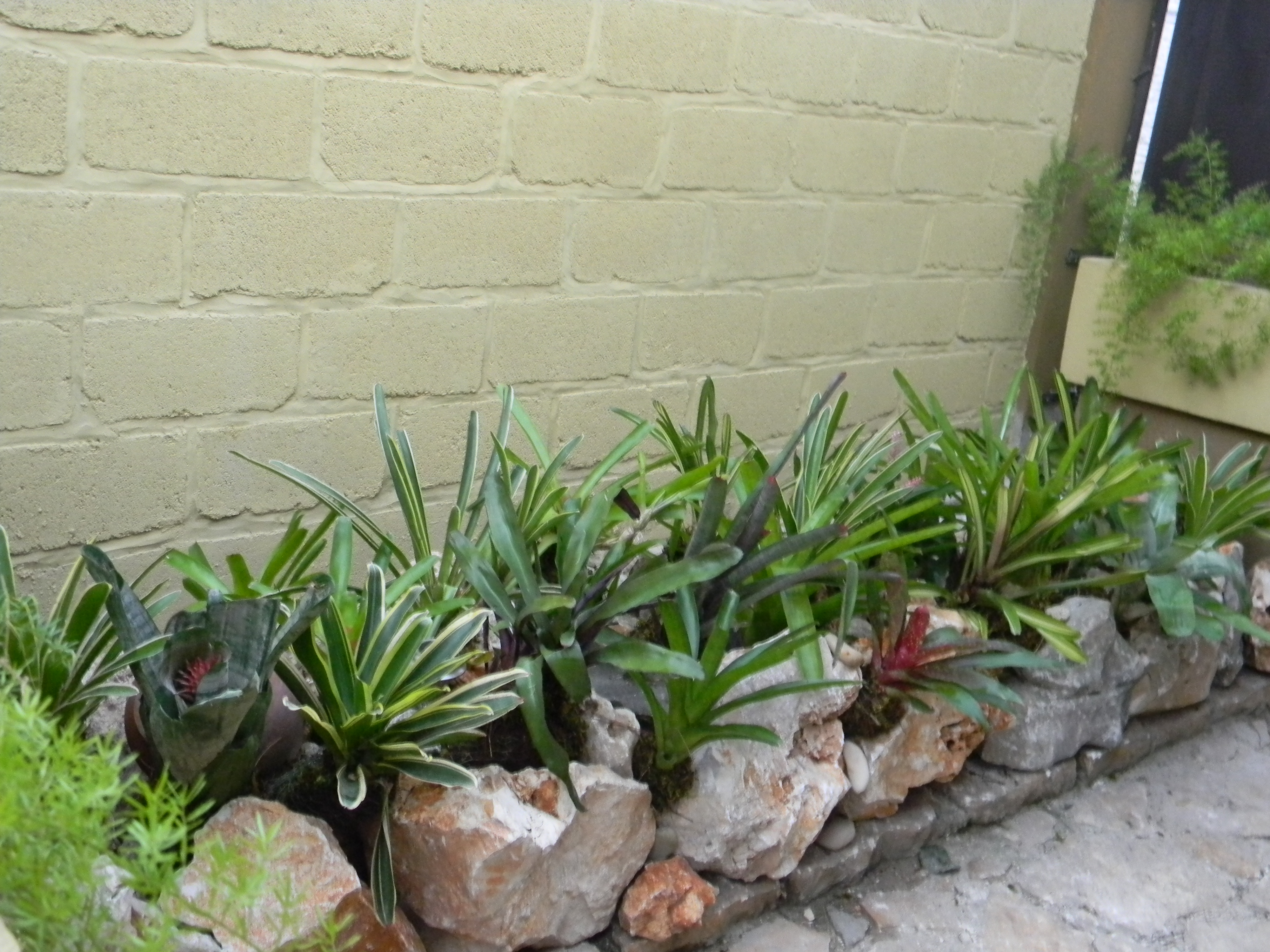
Ever since last spring when Sara moved into our house on a hill—Morne Calvaire (where we’re told a new neighbor is Baby Doc Duvalier), the land-lady has promised a garden, and last week she delivered, arriving with a landscape artist who installed a stunning rock garden near our front door.

We were happy.  We were actually thrilled.  However, we were not prepared for act two, which unfolded the following day.

It was morning; the sky was clear, blue bold enough to brighten even the most bored of bloggers.  I was writing, enjoying light that angled through my wall of windows.  While I was working, however, the dogs alerted me to a noise outside, one I might have otherwise ignored. Thank God for canine clamor.

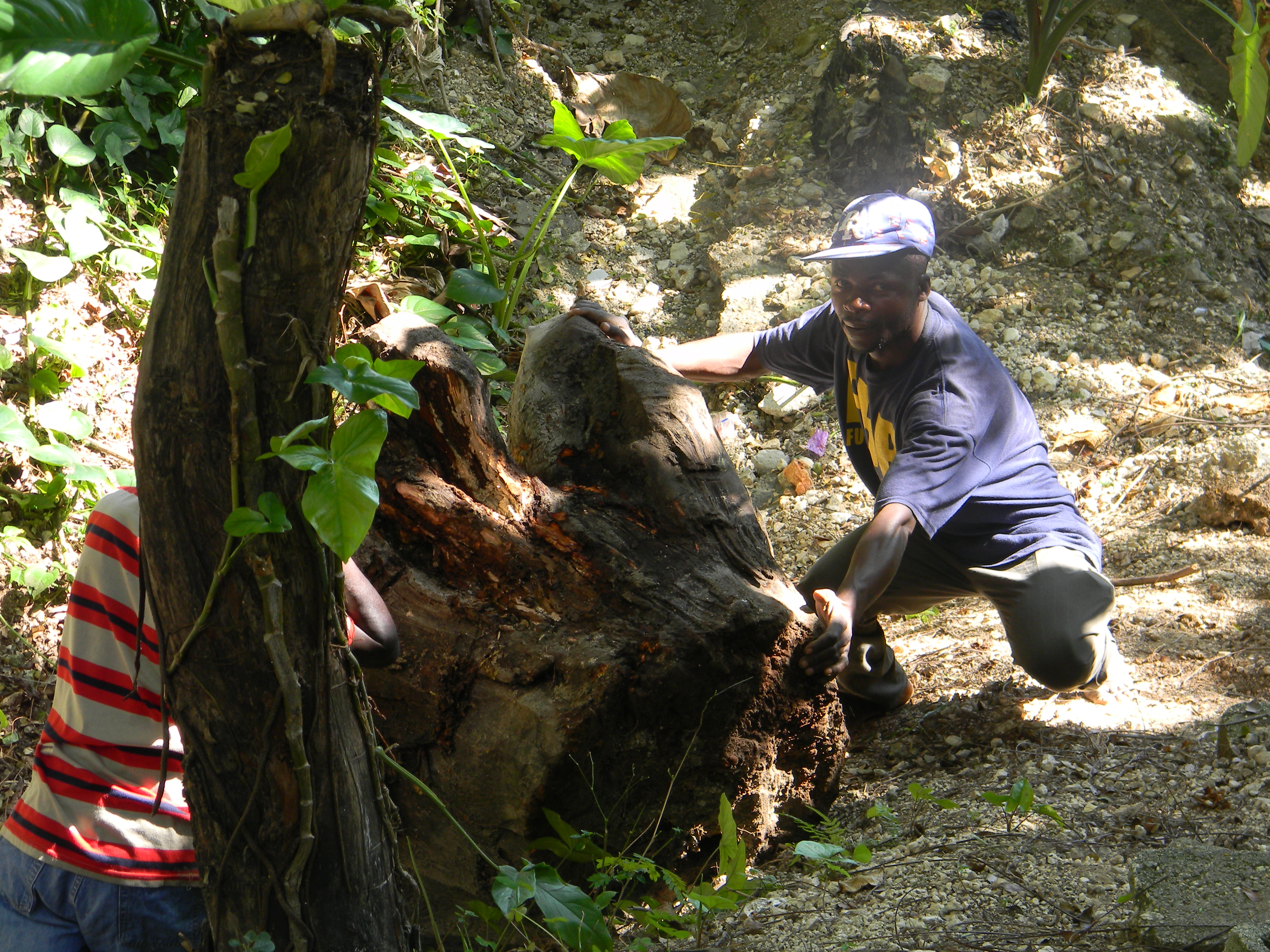
There on the hillside that slants down and away from our house, three men, our landscape artist included, pushed and pulled, grunted and groaned the most massive of stumps toward a wall and fence that border the back of our garden.

I couldn’t imagine why.  What was the purpose behind this effort?  Why had Sisyphus himself shown up on my Haitian hillside?

What concerned me most, however, from my interpretation of signs and signals being gestured below, was an apparent plan to heave the stump over the wall and through the fence cemented into it.  I watched and wondered, watched and wondered some more till I was sure the plan indeed involved such fence bull-dozing, before running out to get our security guard to intervene and interrupt this planned assault.  Within seconds Sonny came running, riffle gesturing the men away from ruining our fence.

It was soon discovered via a phone call to our landlady that, having forgotten the fence was attached to the top it, she had asked the men to remove the stump by pushing it over the top of the wall.  Our stump-movers extraordinaire interpreted her instructions quite literally, intending to force the tree through the fence in an effort to accomplish the task.  So much for common sense.

Stump removal ceased for the day.

The men then returned the following morning, removing a section of fence, forcing their burden over the top of the wall, lowering it with ropes into the back of a truck on the other side, and replacing the offending section of fence, before departing—

I assumed forever.

However, the following morning, while I was again writing, a horn honked outside our gate, the dogs barked like insane caricatures of canine companionship, and I soon heard the shouting of what turned out to be seven men.  Within minutes massive crashing commenced on the deck above, more shouting, still more housing-rattling crashes, shouting and crashing, shouting and crashing, until I simply had to investigate.

The stump had returned.

It was now living on our patio, puzzling me, puzzling indeed.  I like trees as much at the next semi-green ex-pat on the island, but REALLY, did we want this stump on our patio?

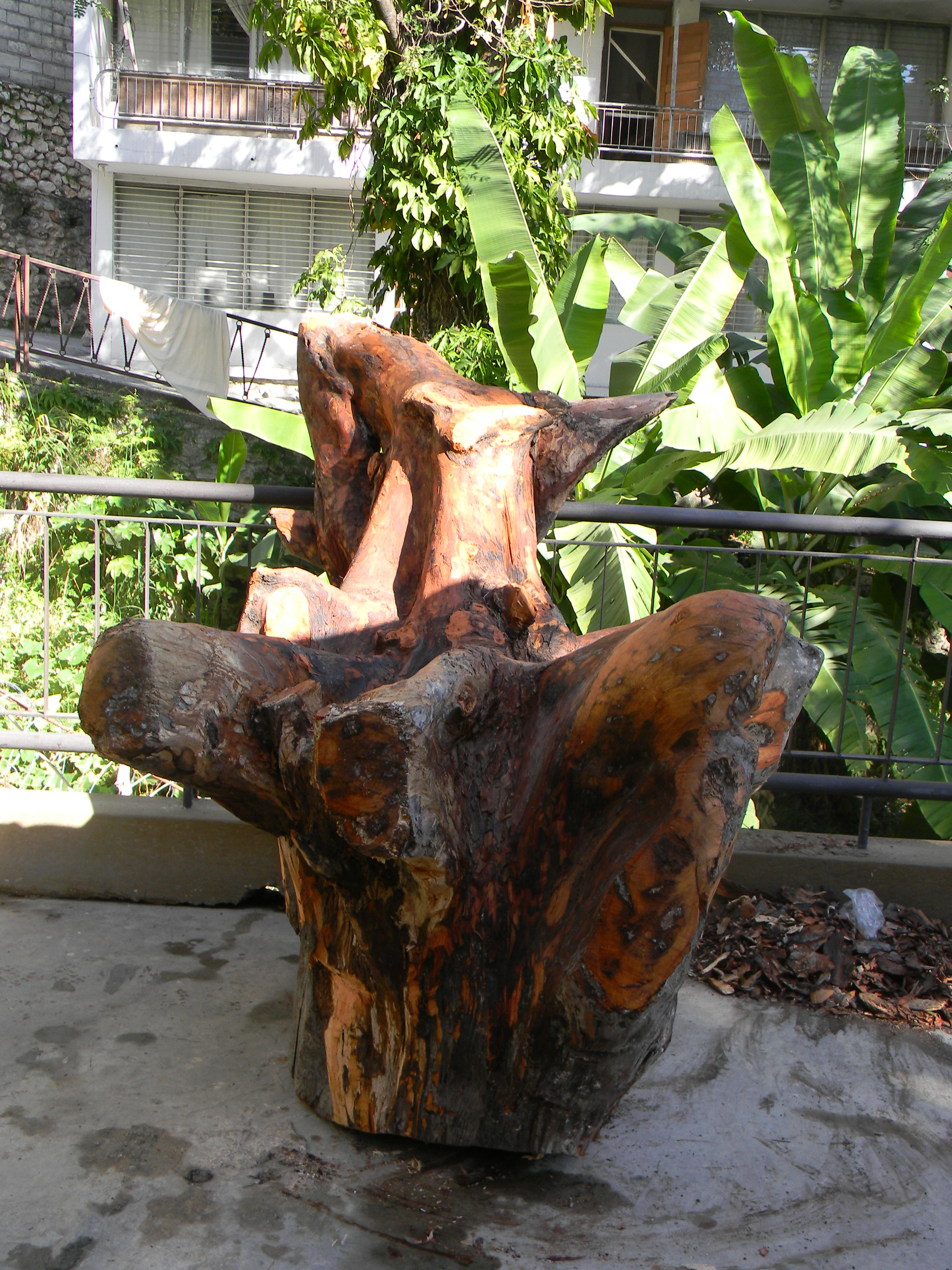
Over the next several days, however, Dicton Gaston, our new gardener guy answered that question for me, proving more and more a sculpting savant, as the stump morphed from this:

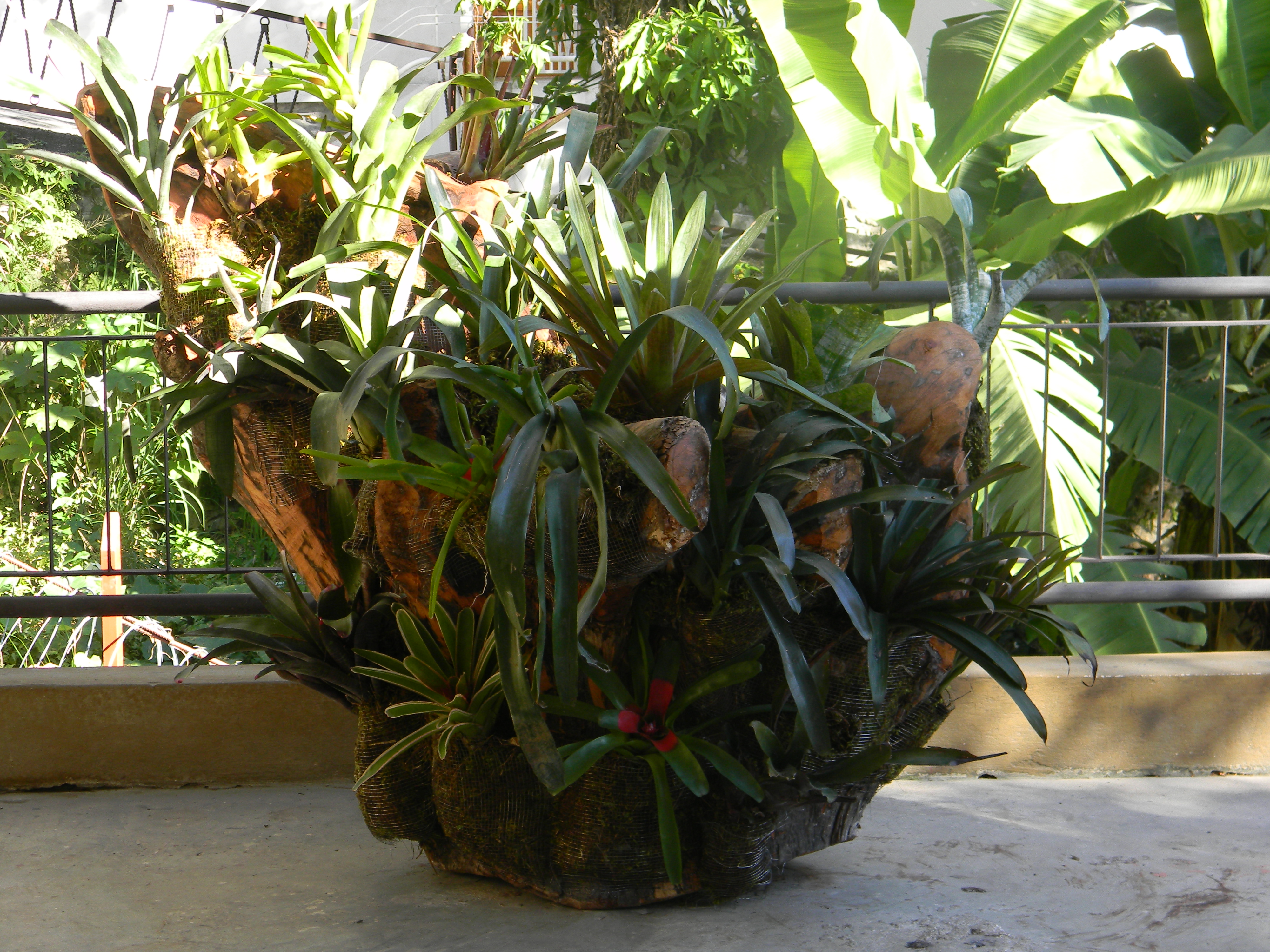
Into this:

Dicton Gaston is a gardening genius.

Dicton Gaston proves art emerges from even the most unlikely places.

Dicton Gaston proves that in Port-au-Prince, though ex-dictators may show up unannounced at airports, though they’ll be arrested and released and move onto the mountain where you live, art can come from equally surprising places, in delightfully surprising packages.

So, this week, as long as the ex-dictator can maintain his EX-dictator status, as long as protesters don’t take to the streets and shut down the city, as long as posts can go as planned, this week I’ll bring you a series on Haitian art, hoping to remind you—

Port-au-Prince may be leveled, reduced to a dead stump of its former self, discarded on a hillside, in ruin.  Haiti may be broken, lost, and nearly forgotten, but still, like Dicton’s stump, it can occupy a prominent place, a patio blooming, green, and living once again.

A work of genuine genius.

Bargaining for the Good Life: Duvalier and the Haitian Elite


As I’ve struggled over the past several days, trying to make even minimal sense of Jean-Claude Duvalier’s return to Haiti Sunday evening, and worked even harder attempting to understand the Duvalierists I’ve discovered in my life since then, I’ve remembered why art is such a good way for me to grapple with complex issues, ones for which there are no easy answer.  When slugging through the muck and mire of not knowing remains the only way through a particular darkness, I, like both Aristotle and Shakespeare, find comfort in art and literature’s ability to “imitate nature,” be like the thing that’s bothersome, while, at the same time, not being the thing itself.

 So, in the midst of my Duvalier-induced dementia, I remembered a short story by Ursula Le Guin, “The Ones Who Walk Away From Omelas.”  I’ve often taught this piece to composition students when wanting to demonstrate how “showing,” rather than merely “telling,” makes for stronger writing.  But yesterday Le Guin’s story reminded me why and how literature can become a way through confusion, especially in a place where more than a million remain homeless, cholera continues to kill, and ex-dictators come home to roost. 

“The Ones Who Walk Away From Omelas” describes a seemingly ideal city that hides a dark and disturbing secret (a dystopia, in literary terms).  Happiness and peace in Omelas depend on the suffering and misery of one small child, dungeoned in filth and despair.  According to Le Guin’s narrator, coming of age in this seemingly perfect place involves visiting this child and realizing, for the first time, the price Omelas pays for peace.

Clearly Omelas is not a perfect parallel to Port-au-Prince, since here the wealth and luxury enjoyed by an elite minority depend on the suffering of millions.  My Duvalierist friends may long for the good-old-days of Papa Doc and Baby Doc, an era when the lights stayed on and the streets were clean, but even now in Haiti the balance is shifted in favor of the privileged few.

 In the story’s final paragraph (click here to read the story in its entirety), Le Guin tell us about a few citizens of Omelas, but only a few, unwilling to accept this “bargain,” unwilling to exchange the suffering of an innocent child for their own well-being, to trade conscience for comfort.  These are, indeed, “The Ones Who Walk Away From Omelas.” 

Night falls; the traveler must pass down village streets, between the houses with yellow- lit windows, and on out into the darkness of the fields. Each alone, they go west or north, towards the mountains. They go on. They leave Omelas, they walk ahead into the darkness, and they do not come back. The place they go towards is a place even less imaginable to most of us than the city of happiness. I cannot describe it at all. It is possible that it does not exist. But they seem to know where they are going, the ones who walk away from Omelas.

 For the same reason these few in Omelas walk away, here in Haiti some have come and  decided to stay, refusing, in their own way, to accept the bargained-comfort that is life back home.  But this situation is extreme. 

I wonder how this same unwillingness to compromise conscience plays itself out in your life.  What do you sacrifice, what do you say “no” to, because doing so is good and fair and just? 

 How is conscience alive and well in your life?

I Encountered a Duvalierist: Haitian Atrocities Then and Now


It’s getting to me folks. 

Really, really rubbing me the wrong way and getting this Confused and Befuddled Foreigner all up in arms and ready to kick some Duvalier ass.

Oops!  Did I just say that with my outside voice, my typing voice, my public, face-to-the-world voice?  Did I just threaten to kick ex-dictator-dying-to-be-dictator-again ass?

I’m what my grandmother would call “all riled up,” and “in a tizzy” over some Haitian’s seemingly laissez-faire attitude toward Baby Doc–

The attitude of at least two upper-middle class Haitian’s I talked with this week.

But what strikes me as odd is that both of these acquaintances shared a frighteningly similar perspective—one that scared the pro-democracy socks off of my oh-so middle-class American sensibilities. 

Obviously it’s important not to generalize from this small sample, but what amazed me was that both said the same thing—something I thought I wouldn’t hear—especially from well-informed and well-educated Haitians.

Both were pro-Duvalier.

I encountered a Duvalierist, two of them.

Both were not just neutral, both clearly supported someone who makes Saddam Hussein look like a Sunday school teacher.

Both said life was better during the Duvalier Era.  The streets were safer.  There was better infrastructure, more electricity, the lights stayed on longer at night.

“Okay,” I said, “but what about the oppression, the arrests, the torture, the killings?”

“That’s exaggerated,” both claimed, both in separate conversations.  Neither knew the other.

“Okay?” I said, half rhetorical question, half affirmation that I had heard them—heard the words at least.

I was dumb-founded.  I literally couldn’t come up with something to say. 

I still don’t know what to say, how to write about this, how to think.

But the stunned silence I’ve felt inside myself since those conversations has been telling.  I’m thinking, as I suspect most well-informed North Americans like me might, “So the numbers are inflated.  Then what’s a more accurate estimate?  Some say 30,000 Haitians lost their lives.  What would have been an okay number to have imprisoned, tortured, killed?”

Quite frankly I’m more than just confused.  I’m irritated.

Angry. 

Yes, I’m angered that people think this way. But I’m more angered by my own ignorance, my own naivety, my own not knowing how to talk or write about it.

How could I assume so wrongly?

Am I wrong to believe democracy is always best?  Are there indeed places on the planet where it won’t work?

I’ve long thought the Bush mandate to “export democracy” expressed many of the faulty assumptions Americans have toward the rest of the world.  I’ve known that Thomas Jefferson, one of America’s founding fathers, insisted Democracy depended on an educated citizenry—that the uneducated and ill-informed are poorly equipped to think about, let alone make decisions about good government.

But how does that apply here in a country where so few have gone to school, so many remain illiterate?  If education is the key—then which education, what kind, who decides?

I beginning to believe I am indeed in a place where other rules apply.  Life’s lived differently, and I don’t have the How-To Manual.

For so long Europeans and Americans have imposed their perspectives on Port-au-Prince.  Since the days of Columbus and the original “colonizing,” the conquerors have been wrong—

Done wrong.

Who’s the real dictator here?

Which are the true atrocities?

An Event Horizon for Haiti? Baby Doc’s Mind-Bending Return from Exile


As events unfold here in Port-au-Prince around Jean-Claude Duvalier’s return from exile on Sunday, his being detained and charged with corruption by Haitian prosecutors yesterday, only to be released last night and returned to the Karibe Hotel having had his passport confiscated, I can’t help but repeat how surreal it feels—like living on the edge of a bizarre Caribbean twilight zone where reality contorts itself into a banana republic parody of all things right and just and  good.

In the midst of this twisting of right and wrong, caring and corruption, goodness and greed, I’m reminded of why I began this blog in the first place and why I called it “reinventing the event horizon.” I’m reminded of the quote from T. D. Allman’s After Baby Doc I cited in my first post back in November.  It bears repeating, as Allman associates Haiti with the same “convoluting” of reason we see happening here this week:

Haiti is not simply one more of those tropical dictatorships where to rule is to steal, and headless bodies are found by the road.  Haiti contorts time:  It convolutes reason if you are lucky–and obliterates it if you are not.  Haiti is to this hemisphere what black holes are to outer space.  Venture there and you cross an event horizon. (After Baby Doc, 1989)

Wrap your brain around that statement and you may begin to understand how Haiti feels this week—how this warping of the already absurd, not only wearies me, but worries folks the world over.

Remember, an event horizon is the edge of a black hole, a bending in the space/time continuum beyond which no light can escape—in many ways, a point of no return.

Was the earthquake an event horizon for Port-au-Prince?  Will cholera bend time and space so there’s no escaping the dis-ease that’s plagued this place for centuries?  Will fraudulent presidential elections and now Baby Doc’s return from exile push the Haitian people into further darkness?

Is there light for Haiti?

Duvalier Update


This afternoon Jean-Claude “Baby Doc” Duvalier was detained by Haitian authories, formally charged with theft and corruption, and, as of a few minutes ago, allowed to return to his hotel here in Petion-ville.  He must remain at the disposal of prosecutors for further questioning.  Baby Doc has a press conference scheduled for tomorrow afternoon at 2pm EST.

Though I’m not the story by any means,  this newest turn of events affected me only inasfar as UN helicopters droned over-head for much of the day, and by mid-afternoon tires began burning, the stench of which I find nauseating.  If you’ve never been up wind of burning rubber, I suggest you stay away at all costs.  Eyes will water, heads will ache–blindingly so for some, me included.

Frankly, I feel whirl-winded and whip-lashed by the day’s developments–unable really to make sense of this place, this Port-au-Prince I now call home. 

More tomorrow.

Duvalier Arrested?


Police are leading Jean-Claude Duvalier out of the Karibe Hotel.

Breaking News in Haiti


Heavily-armed police have surrounded the Karibe Hotel where Jean-Claude Duvalier is staying. Haitian authorites have entered Baby Doc’s hotel room, as UN helicopters circle over-head. There’s speculation that an arrest is imminent!

Another “If only I (k)NEW(s)!” update from Haiti


I have a confession to make—

I’m a tad bit apprehensive here in Haiti today—

Since, as many of you know by now, Jean-Claude “Baby Doc” Duvalier arrived in Port-au-Prince Sunday evening.  If that doesn’t blow your ever-lovin’-Haitian mind, nothing can, nothing will.

It’s in honor of this less-than-happy happening, that today I offer another “If only I (k)NEW(s)!” update from Port-au-Prince.

First, a brief overview:

Sunday night former Haitian dictator Jean-Claude “Baby Doc” Duvalier landed unexpectedly at the Port-au-Prince airport.  He had been exiled in France for nearly 25 years.  Duvalier, son of the infamous and brutal “Papa Doc” became “president for life” when his father died in 1971 and he himself continued to brutalize the Haitian people for 15 years, until exiled in 1986.  Many believe he may have ulterior political motives for returning at this time, wanting to fill the power vacuum left here after a fraudulent presidential election in November.

Duvalier history in Haiti:

–Francois “Papa Doc,” Duvalier, a medical doctor, served as president from 1957-1986.

–In 1959 Papa Doc established the Tonton Macoutes, a secret police, that terrorized Haitians for nearly 27 years.

–Papa Doc had political opponents imprisoned and/or executed.  Some estimate as many as 30,000  were killed.

–Papa Doc died in 1971, having named his 19-year-old son as his successor.

–Baby Doc continued the atrocities begun by his father: “prison camps, torture, arbitrary executions, extrajudicial killings . . .” in the words of Amy Wilentz (see her book The Rainy Season).

–In 1986 a coup exiled Baby Doc and his family to France.

–Haitians danced in the street, knowing he was gone.

Current developments:

On Sunday at 5:50 pm Duvalier, along with his wife, arrived in Port-au-Prince aboard an Air France flight from Paris.  59-year-old Baby Doc, wearing a dark blue suit and tie, is said to have kissed the ground upon deplaning.  From the airport, where he told reporters only, “I’m here to help,” Duvalier traveled in an SUV to Petion-ville’s Karibe Hotel.  (Petion-ville is the up-scale Port-au-Prince suburb Sara and I call home.)

Sources indicated that Baby Doc traveled to Haiti on a diplomatic passport, but it’s not clear which country issued it.  Though most find this hard to believe, a senior aid of current President Preval said it did not become clear to Haitian officials that Duvalier was returning until the plane he traveled on stopped on the Caribbean island of Guadaloupe.

It’s the timing of the former dictator’s return to Haiti that seems suspect, his arriving on the day a final run-off presidential election was to be held, one day before the head of the OAS (Organization of American States)  was scheduled to meet with President Preval to discuss the outcome of a vote recount.  The OAS findings were leaked to the press a week ago and suggested the OAS would recommend that Jude Celestin, candidate from president Preval’s political party, and Preval’s hand-picked successor, be eliminated from a final round of elections, due to massive election “irregularities”—namely ballot boxes having arrived at polling places already stuffed with votes for Celestine.

Because of this, some, both in Haiti and abroad, believe Duvalier has arrived for political purposes, hoping to fill a power vacuum here in Port-au-Prince.  It’s this fear that has lead the United Nations to restrict the movement of its staff until further notice (or until Baby Doc’s motives for coming can be clarified).

We can only wait ourselves, since Duvalier’s press conference scheduled for Monday was postponed and is expected to be held today, Tuesday, instead.

Finally and, perhaps, more importantly, some journalists and academic experts are asking if this return of Baby Doc’s will prompt Jean-Bertrande Aristide to come home, as well, or at the very least drive Aristide supporters to the streets demanding that their exiled hero be allowed to return.

A few good news articles you might want to read:

–“’Baby Doc’ Duvalier returns to Haiti in a surprise move”—a piece from CNN.com.

–“Haiti’s ‘Baby Doc’ in surprise return from exile”—at Yahoo news.

–“Duvalier Meets with Advisers as Haiti Holds its Breath”—from the New York Times.

Disclaimer:

Remember, as I’ve said before, that here in Haiti it’s hellaciously hard to get good news.  And by “good news” I mean accurate news.  More often than not I throw my hands in the air and exclaim in utter and complete newsless-ness, “C’est la vie, la vie.”  Indeed—whatever will be will be—cause I’m not gonna be able to change it and I’m sure as hell not gonna know about it ahead of time.

Confessions of a Desperate, Writing Neurotic


Sara (my partner) has been saying for weeks that I should blog about this—this being what I wrote last summer about my struggle to write.

“I swear, it’s funny as hell,” she says.

Repeatedly—

So I gave in this morning, agreeing, maybe it is funny—

Or pathetic—

You decide.

But first a bit a background— how it all got started.

Just after the Christmas holiday, Sara returned to Haiti ahead of me.  And because of this, over the New Year’s weekend, she was doing what Sara does to relax.  What she calls “piddling,” what I would more accurately describe as “recreational organizing.”  This can come in many forms: straightening closets—obsessively earnestly rearranging items according to color, all clothes on wooden hangers only—ordering and reordering items in the refrigerator—neurotically enthusiastically arranging jars and bottles in tidy rows, like-items soldiered together according to kind rather than rank.

(a subject for another post, perhaps?)

At any rate, you get the picture—

Over this particular weekend, however, Sara extended her reign of organizing terror to the contents of my drawers, my closets, cabinets, shelves.

Now I have mixed feelings about this. 

Sometimes I don’t want my stuff touched—because in her cleaning frenzy, Sara is inclined, at times, to throw things away, pieces of paper she thinks useless but which are, in fact, important to me.  On the other hand, Sara is extremely good at organizing, really good, as you might expect from someone who behaves this way for sport.  So sometimes I agree to let her “piddle” with my precious possessions, but only if I can extract from her, my “everything-is garbage-gal,” the promise that nothing, absolutely nothing—not even the most seemingly senseless scrap or decades old sales receipt— will be discarded.

On this weekend in question, I extracted such a promise, and Sara came upon such a scrap—something I had scribbled on index cards—the contents of which she says I should blog about here.

But—before I lay my naked and neurotic writerly self out to me mocked and laughed at—I offer a disclaimer, of sorts—

Namely—that real writers, good writers, famous writers do indeed write about the kind of stuff I describe below.  I’m thinking specifically about Natalie Goldberg, who in her book Writing Down the Bones: Freeing the Writer Within, outlines the basics of writing as spiritual practice and in Chapter 1, “Beginner’s Mind, Pen and Paper,” addresses the writers struggle to find the perfect pen, the even more perfect paper.

(And remember, as well, that this was NEVER meant to be read by anyone but me—so it’s bad, it’s raw, it’s, well, neurotic.)

So, without further adieu here’s what I wrote on 13 June 2010, what I scribbled in pink ink on unlined index cards:

When I have tried to journal recently I’m always bothered by the notebook I’m writing in—I know that sounds crazy—and surely it’s a mere excuse—but I truly believe I should be keeping my entries in another format—

Perhaps, typing them on my computer—if the paper is lined, perhaps, it should be unlined—if it’s plain—perhaps, it should be graph paper.  If I write in blue ink, probably, it should have been black or green or gray—any other color than the one I’m using.

So here I’m writing on an index card—knowing that it too will feel wrong—and using pink ink—equally incorrect, I’m sure.

Most everything about writing feels wrong—doing it—not doing it—doing it in the morning, in the evening, in the afternoon—equally problematic.

Now, these index cards feel too small—not enough space—I feel confined—God knows I’ve got it wrong again!

But I try to tell myself it doesn’t matter.  It’s better to get it wrong than not to have gotten it at all.

There you’ve GOT her folks—Kathy, the “Writing Neurotic,” evidence that she does indeed exist.

So laugh if you will.  Mock if you must.

But, where in the name of God’s good implements of ink, does Writing Neurotic come from?  Does she live in other writers?  Does she roam from writer’s body to writer’s body, circling the globe, imparting authorial insecurities across the entire planet?  Or does she only live in little old me?

Tell me—

Have you ever been possessed by Writing Neurotic?  Has she come to your country, your city, house and street, forced herself uninvited into your office, taken over your desk, borrowed into to the deepest and most secret corners of your scribbling-obsessed self?

If she has, I want to know.  I want to join forces with others who’ve been haunted—track her down—bury her once and for all, far from WordPress  and Freshly Pressed—ban her forever from the Blogosphere!

Please note:  I scheduled this piece to post yesterday before news broke that former Haitian dictator Jean-Claude “Baby Doc” Duvalier  had returned unexpectedly to Port-au-Prince. 

To see an article from Yahoo News about this potentially ominous development, click here.  To see the piece I posted  as soon as we got the call that Duvalier was at the airport, click here.  To read an article from CNN click here.  ( Thanks to Mrs. H. over at “A. Hab.’s View of the World” for the CNN link.)  And finally, to see a helpful piece from MSNBC.com, click here.

I will try to keep you updated as the story develops.