Miscellaneous Monday (and more Mindy to come)


It’s Monday.  And we’re launching another week’s worth of less-than-brilliant (but often, above-average) blogging here at Reinventing the Event Horizon. 

And, in honor of the week’s beginning, I bring you an “inspiring” (at least I’m trying) laundry list of updates:

1.  First, thanks to all of you for your kind and supportive comments in response to last week’s news that I wanted to begin moving my blog in the direction of memoir, not that I would discontinue writing about the event horizon that is Haiti, but that I would also address event horizons from my personal past:  namely my father’s organized crime connections and the black hole that is my battle with bipolar disorder.  (To read these posts click here and here.)

I believe the best writing is inevitably the most honest writing and my not addressing these issues was becoming a form of compositional dishonesty—a way of avoiding the shame associated with my father and the sigma connected to my illness.

One way to lessen stigma is to stop hiding, or, in my case, to boldly address my demons in the blogosphere’s bright light, to share my struggle, to tell my story, both the pain of the past and the hope that is recovery.

2.  Secondly, I’d like to announce an upcoming series of posts from my friend and fellow writer Mindy Shannon Phelps.  (I introduced Mindy last week.  To read her first post click here.)   As she finds time, Mindy will write pieces that address our sometimes serious, sometimes silly misadventures in being human. 

3.  Finally, an update on my dog Lucy’s adventures in Vietnam—her Maltese march, North to South, South to North. 

In last Monday’s post (click here to read) I forgot to include a few of the funniest photos—namely Lucy in Halong Bay . 

(Some of you may have heard of a recent accident in Halong Bay.  A tour boat sank.  12 were killed.  To read about this February 17th incident click here.)

In case you’re not up on the geography of Vietnam, Halong Bay is an UNESCO World Heritage site and hugely popular tourist attraction in northern Vietnam.  According to legend, the Vietnamese were being invaded by the Chinese when the gods sent a family of dragons to protect the bay.  The dragons were said to spit jewels into the water, to build a wall against the invaders, what is, in fact, a series of nearly 2,000 limestone islands that decorate the bay:

   http://www.en.wikipedia.org/wiki/File:Ha_Long_Bay_with_boats.jpg

In fact, a highlight of Lucy’s adventure in Vietnam included a swim with me in Halong Bay:

And last but not least, a photo of Lucy dressing for her outing on the bay:

The bottom line is this, a lesson I learned from Lucy:

Sometimes the most over-whelming of crises can be ovecome with the most obvoius of answers.

Indeed, sometimes the biggest of problems can be conquered by the smallest of canines in the most amazing of hats.

Hats off to our struggles. 

Hats off to hope.

Canines in Conical Hats: Lucy Does Vietnam


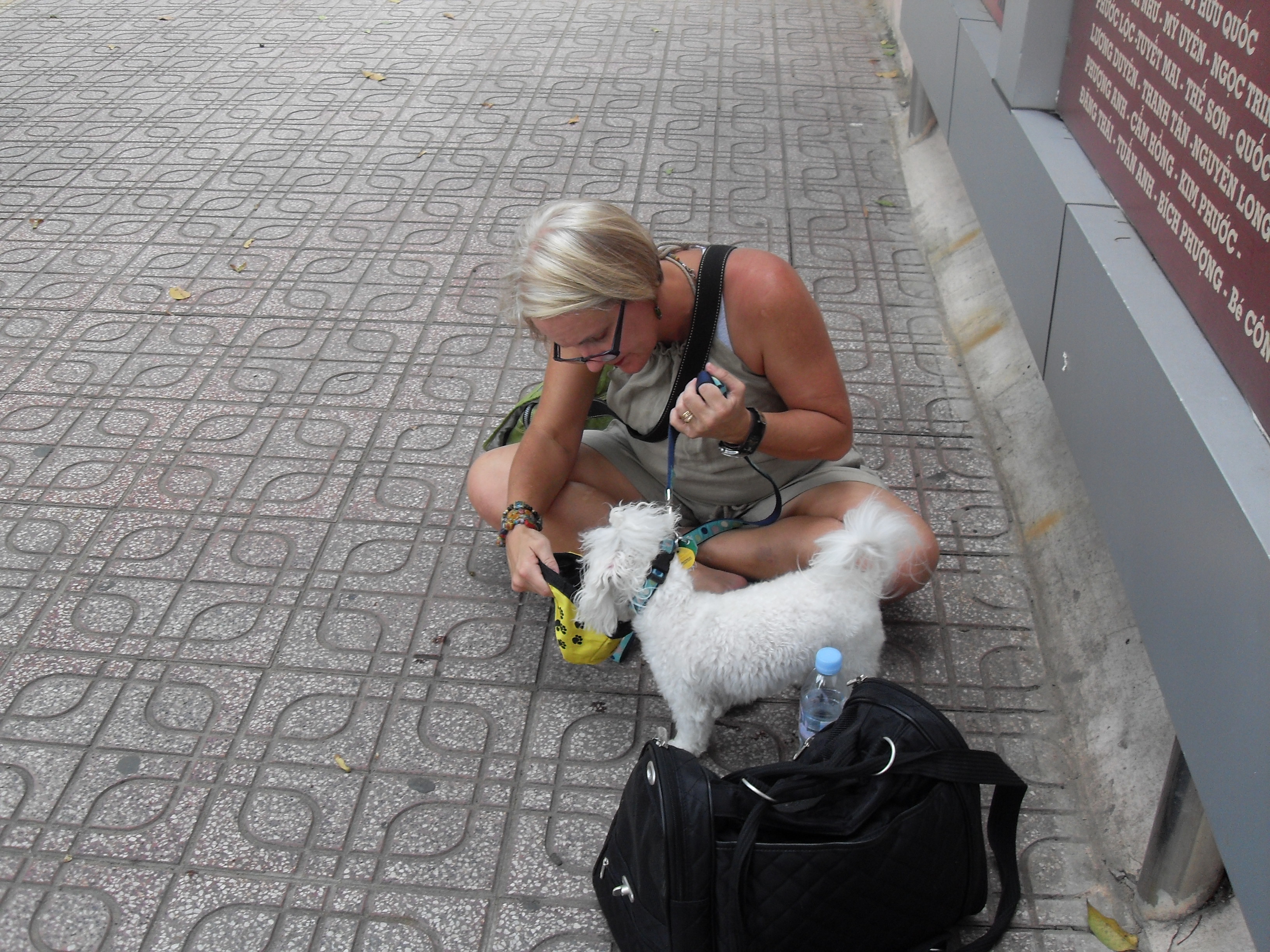
Lucy is a dog with wanderlust.  She loves to go just about anywhere.  And though she looks the part of precious pup–

My seven pound “princess,” in fact, behaves badly anywhere other than her black, backpack carrier—

Very badly!

Lucy does not possess anything remotely resembling a sweet disposition.  Her bark–loud, high-decibeled, and persistent–is her best weapon in an arsenal of ways to get what she wants.

But John Grogan, author of Marley & Me, insists that all dogs are great, and bad dogs–“the greatest of them all.”

And Lucy is indeed a great traveler—

Lucy is such a perfect companion on the road, that Sara and I have trotted the globe with her in tow—if for no other reason than she’s at her best, her most charming and well-behaved in planes, trains, and automobiles.

And on our world-wide odyssey to find canine obedience and tail-wagging good manners, our first stop with Lucy was Vietnam—a country Lucy traveled top to bottom, bottom to top.

Lucy behaved beautifully during our grueling 24 hour trans-global trip to Saigon.  Honestly, I couldn’t have hoped for a better outcome. 

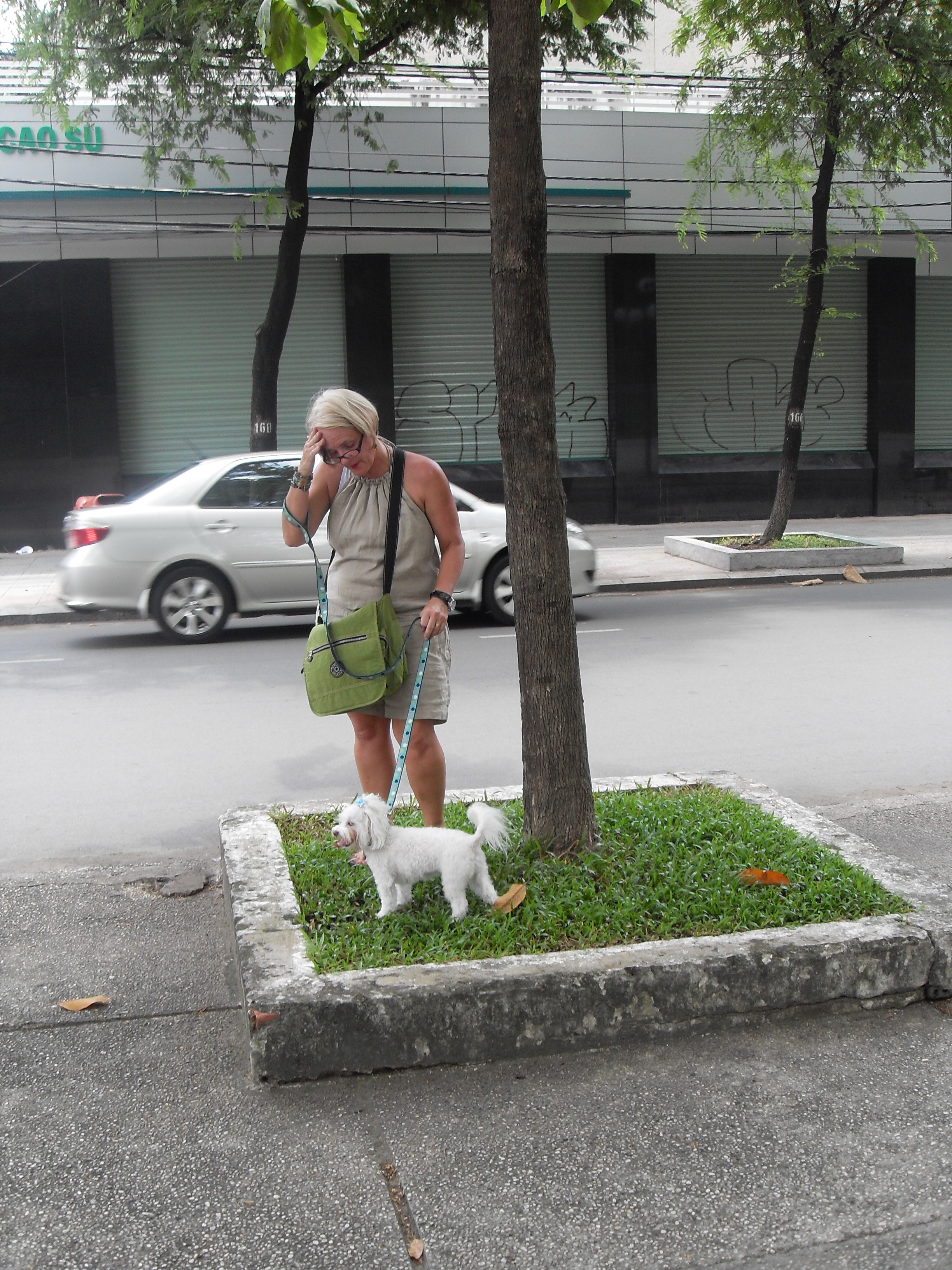
However, day-to-day living with Lucy in Vietnam proved more challenging, since, for the first several days, I couldn’t locate a blade of grass within a 10 block radius of our apartment.   There was a park a 15 minute walk away, but it was so far that even getting there involved rehydration stops along the way:

And once we finally arrived, it turned out dogs were not allowed on the lawn.  I kid you not! 

One morning, a security a guard reprimanded me, “Not dog on grass!  Not dog on grass!”  When I showed him the pink poop bag with which I intended to pick up any excrement, pink poop bag I had brought purposefully all the way from the US—biodegradable and environmentally friendly—he seemed not the least impressed and repeated his demand with all the more irritation, “Not dog on grass!  Not dog on grass!”  But Lucy refused to pee or poop on pavement.  What was an environmentally conscious, dog-toting-to-the-Far-East American to do?

What I did was find this lonely square of grass in front of the Indonesian Consulate:

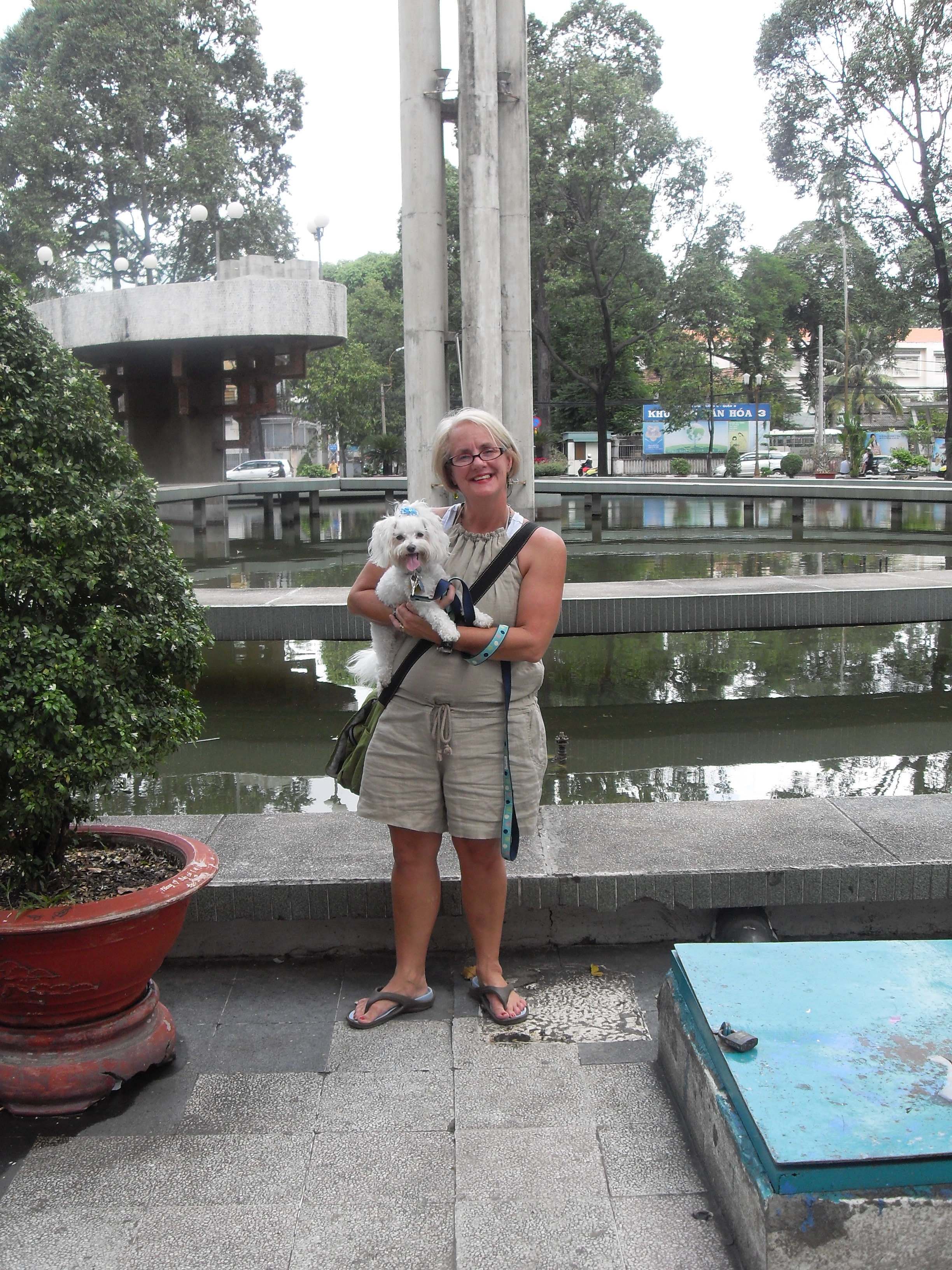
But once she adjusted to only a tiny turf, Lucy was off to places like the Reunification Palace:

She visited famous fountains:

She even participated in a student survey:

She insisted on praying at Notre-Dame Basilica:

Lucy traveled the 1,100 miles from Saigon to Hanoi by train—a nearly 30 hour trip:

She loved lounging in our compartment and mooching meals from Sara:

In Hanoi she visited the Temple of Literature by back pack:

She enjoyed Sunday brunch at the world-famous Metropole Hotel:   

Lucy took us shopping in the Old Quarter:

There she bought the smallest conical hat in all of Southeast Asia:

Lucy continues to turn heads even now that we live in Haiti,  but she still insists no well-mannered Maltese would do Vietnam without a millinery consultation. 

Hats off to Hanoi!

Verizon Wireless is the Devil


(And I’m not even exaggerating.) 

This story is about the heartless and dishonest action taken by a company that claims to not only be “America’s largest and most reliable wireless network,” but also the one “more people trust.”

Clearly, America’s trust is ill-founded.  And I am about to show you why.

My partner Sara and I live in Haiti, where Sara directs the recovery operation for one of the world’s largest and most well-known international aid organizations.  I live in Port-au-Prince with her and blog about Haiti’s need for more relief, more aid, more care, more prayer.  Sara does the work.  I spread the word.

On the weekend of February 4th, Sara and I were in Miami for a long weekend away from the stress and strife, the grit and grime that is Port-au-Prince.  But before hitting the beach and soaking up the sun, we wanted to upgrade our phones and renew our Verizon Wireless contract.

Up until that Friday I had an unlimited international data plan for my mobile phone—something that was essential to my functioning in Haiti, where access to both electricity and wireless is limited.  I needed to upgrade my phone because I blog and the WordPress software I need was not available on the model of Blackberry I owned.  Sara also needed an equipment upgrade, since her BlackBerry had stopped working several months before.

Frustrated that our access to electricity in Haiti had not improved even a year after the earthquake, we stopped at a North Miami Verizon Wireless store on our way in from the airport.  We were eager; we were enthusiastic as we burst through the door and were greeted by a Verizon employee with, “Would you like to buy a Droid today?”

“No,” I sighed.  “Really, I’d prefer another Blackberry, perhaps the Storm.”

The Verizon representative was willing to show me the Blackberry but eager to point out how difficult it was to type from the touch screen.  He suggested I try. I did.  Indeed, it was difficult.

“Really,” he offered.  “The Droid 2 keyboard is more user-friendly and easier to operate.”

To make a long story short—

I tried the Droid.   I love the Droid.  Sara tried it.  She loved it.  We were sold.

We were in the store for close to two hours.  We explained our circumstances to our now friend from Jamaica, who understood our frustration, as he too had grown up on a Caribbean island.  We discussed my need to blog from my phone.  He even loaded the WordPress software for me and moved the icon to my home page for easy access.

He empathized.  He insisted the Droid was truly the answer to our data needs in Haiti.  He referred to the unlimited access to email and internet we would enjoy.  Things would be better.

Two hours later we left the North Miami Verizon Wireless store 2 Droids richer and $600 poorer—

Since, when we got back to Haiti the following Monday evening, we discovered we had no unlimited international data package. The phones were useless to us.  We spent $600 and, in doing so, lost the very feature that made the phones useful to us, in fact, essential to us.

We had been duped.

So the first thing Tuesday morning, I called Verizon to have the problem resolved.  I spoke with a “customer service” representative.  I spoke with 2 managers.

Finally, manager Lenora empathized with our situation and agreed to submit a claim to the “Inactive Pricing Committee. “

Now, 7 expensive phone calls to US “Customer Service” later (Verizon refuses to remove the roaming charges associated with those calls), I learned this morning that Verizon has denied our claim, because we bought Droids and the unlimited data package had only been available on Blackberries.

If only we would return our phones to the nearest Verizon store and trade them for Blackberries then the committee MIGHT be able to reconsider our claim.

Maybe the “customer service” representative offered we could mail our phones back to the US.

Yeah, right—mail 2 VERY expensive phones from a country that doesn’t have a national mail service.

Yeah, right—mail them safely from a country where we can’t even trust our own gardener not to steal our tools—not because he’s a dishonest thief, but because he is that desperate to feed his family and might be able to trade the hammer on the street for a handful of rice, a cup of beans.

We won’t be using these phones for economic gain.  Really, I‘d be a lot more comfortable blogging from the US, and Sara would be more relaxed if she weren’t trying to house the 1.3 million homeless Haitians living in Port-au-Prince.

We don’t make nearly enough money to pay the $70 per month for the 7 GB of data per phone that won’t come close to meeting our needs.

International aid work doesn’t pay well.  Blogging about Haiti pays nothing.

Bottom line—

Verizon refuses to restore the unlimited international data plan we had until February 4th, when a Verizon representative dishonestly persuaded us to buy Droids rather than the Blackberries our unlimited access to data depended on.

Verizon has essentially crippled us in our ability to function in Haiti.

Verizon may be the wireless company most Americans trust, but God forbid, the Haitian people place a similar trust in corporate America’s willingness to meet their needs.

Verizon insists there’s really nothing more they can do.

Verizon Wireless is the devil! 

(If you are willing, please pass along this story of corporate greed at the expense of the planet’s poor.  Please help me hold Verizon accountable.)

Happy Valentine’s Day–from the Heart of Haiti


Be patient toward all that is unresolved in your heart and try to love the questions themselves.  —Rainer Maria Rilke

The weekend here in Haiti has ended . . .

The time to catch up—do laundry, make beds, have some spaghetti with the ones we love—has lead us to Valentine’s Day—muddy, gone-amuck Monday Cinderella-ed into—

More laundry, more beds, more spaghetti with the ones we don’t always love.

Yes, the ones we love may be less than lovely at times.  But on Valentine’s Day, I’m also thinking about my home here in Haiti and about my home in the blogosphere, readers who care, readers I’ve come to love.

So, it seems essential on this day that celebrates love, a day that celebrates caring and appreciation, that I invite readers I love into the heart of my life here in Haiti–into my home.  For it’s as true as it is cliched: home is where the heart is.

A while back, on a truly muddy Monday, I promised photos of our house in Port-au-Prince, promised, that is, when so many of you ranted about our kitchen decor in a post called “Haiti needs to be HGTV’d.”  (If you missed that post, click here.)

So, though “Writing Neurotic” still threatens (for an introduction to “Writing Neurotic” click here and here), our wireless is working well today—is almost, semi fast . . .  (Notice the adverbs that qualify “fast.”  All apply.)

Given this, I’m going to attempt a giant photo upload.   (If you’re not familiar with the wireless challenges we face at our house here in Haiti, click here.)

If I succeed, a virtual tour of our home should follow.  (Please pray the bandwidth gods, maybe even Saint Valentine himself, remain with us.)

Here’s the deal.  Our house sits on a hillside, hovering above the up-scale Port-au-Prince suburb of Petion-ville, where the streets are poorly paved, if at all, and the twists and turns of “almost-roads” threaten even the most seasoned drivers—pot holes the size of swimming pools are not uncommon.

Though there’s little electricity, once you get here, things are lovely.  Truly—our home is small but adequate, and we have dressed it up with paint—bold color, saturated color, the kind you want to drink in and absorb.

After honking to alert the guard (yes, he’s armed), he’ll open the gate and you’ll drive onto what is essentially the roof of our house—an outside deck that, for the most part, doubles our living space, (only sometimes exposing us to the stench of burning tire in the town below.  Don’t worry there’s been no rioting today.  We’re sinus-ly safe for now.)

Jean-Jean will open the gate, and our dog Ralph will greet you.

So come join us, pull up a chair, have cup of tea or a cocktail, if you like.  The roof-top deck, where we’re sitting looks like this:

The view from your seat looks like this:

And, if you wonder about that roaring, rumbling sound—it’s our generator round the corner, keeping the lights on for us:

Sorry for that obnoxious noise!

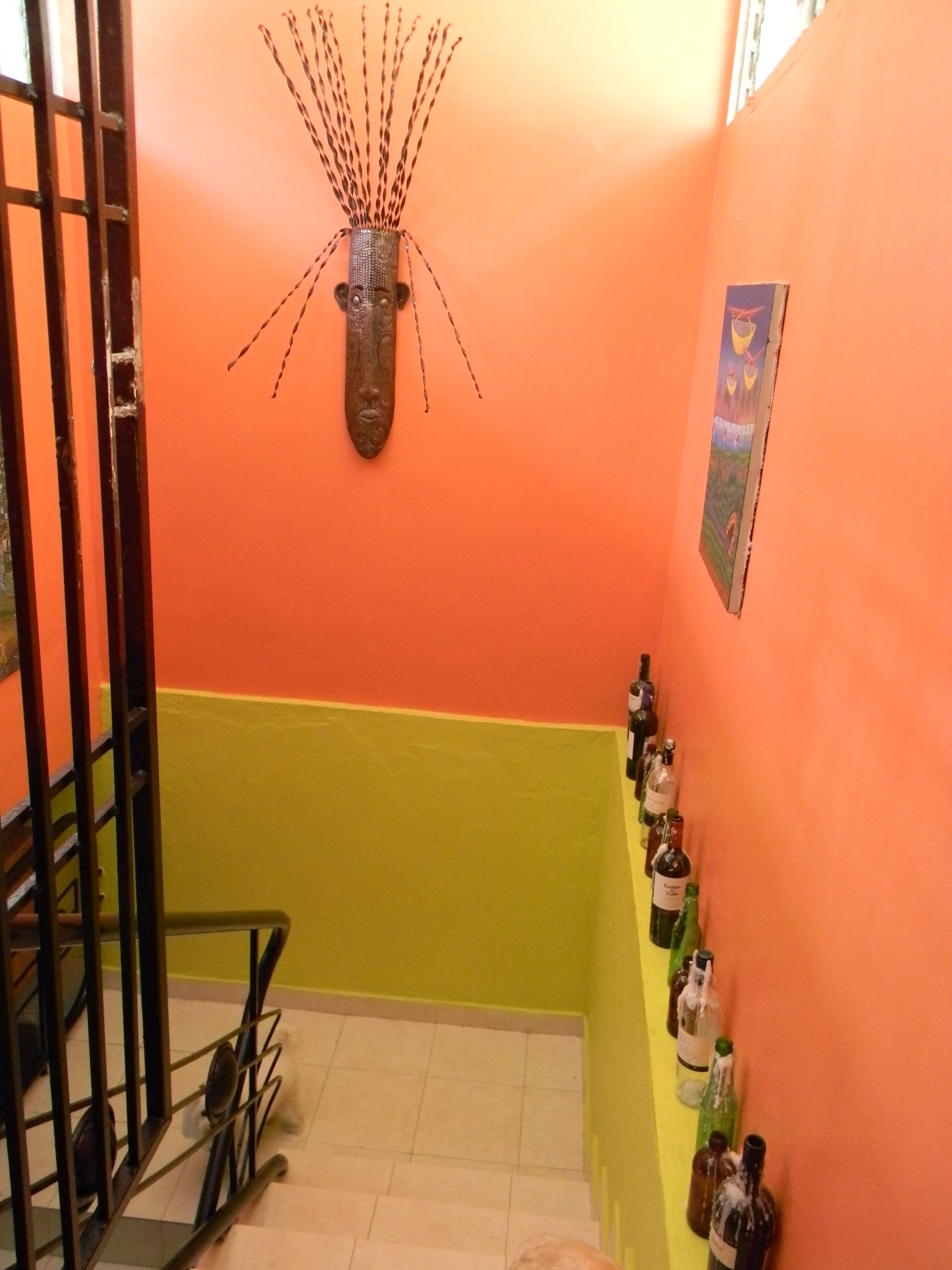
You’ll enter the house itself from the roof, by descending a set of stairs:

From the opposite side of the room, the staircase looks like this:

You’ve entered our main living space—a kitchenlivingdiningroom—what in the US we might call a “great room,” though ours is not so grand. 

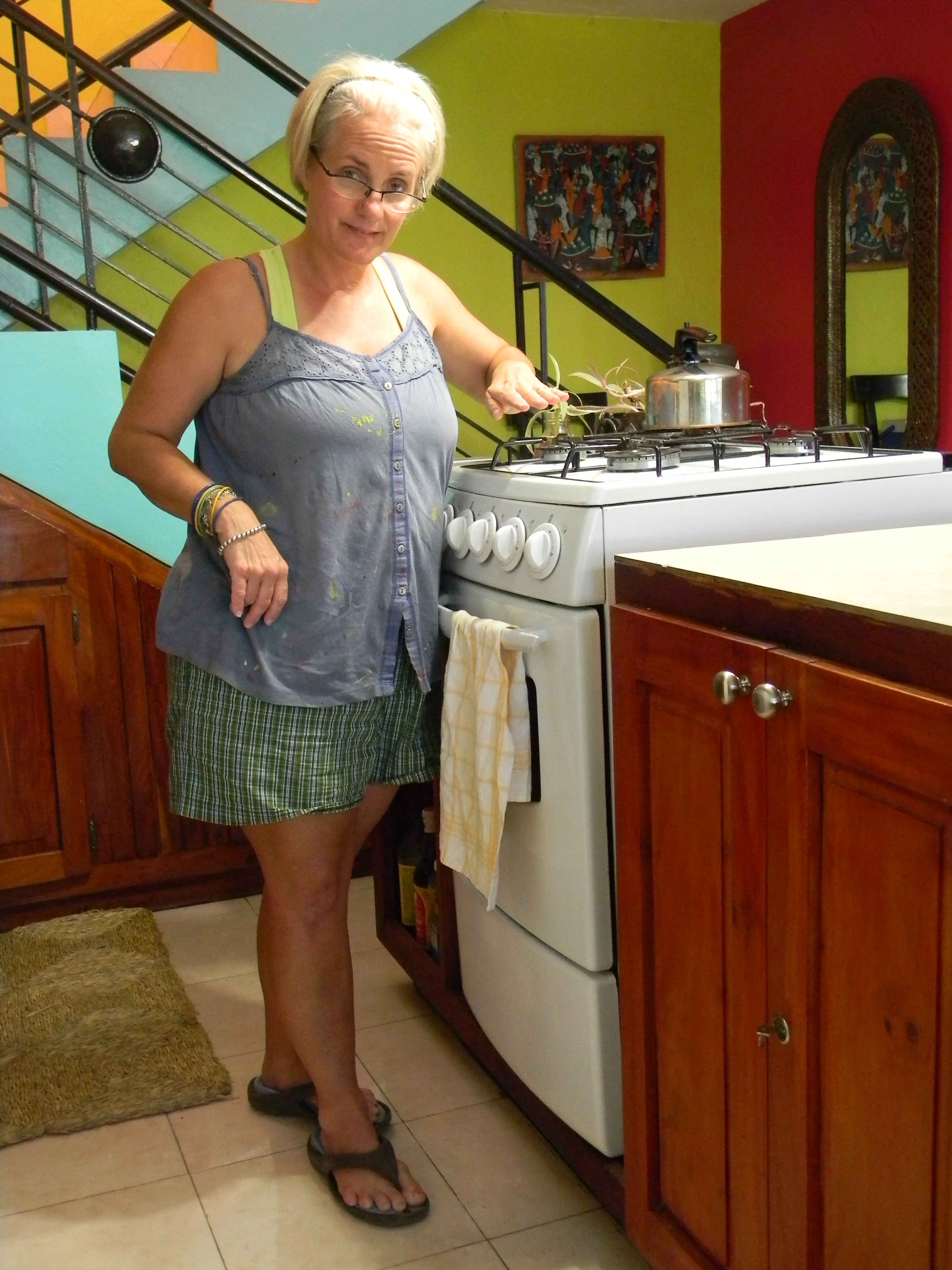
The kitchen looks like this:

smallandcrampedbutweloveit

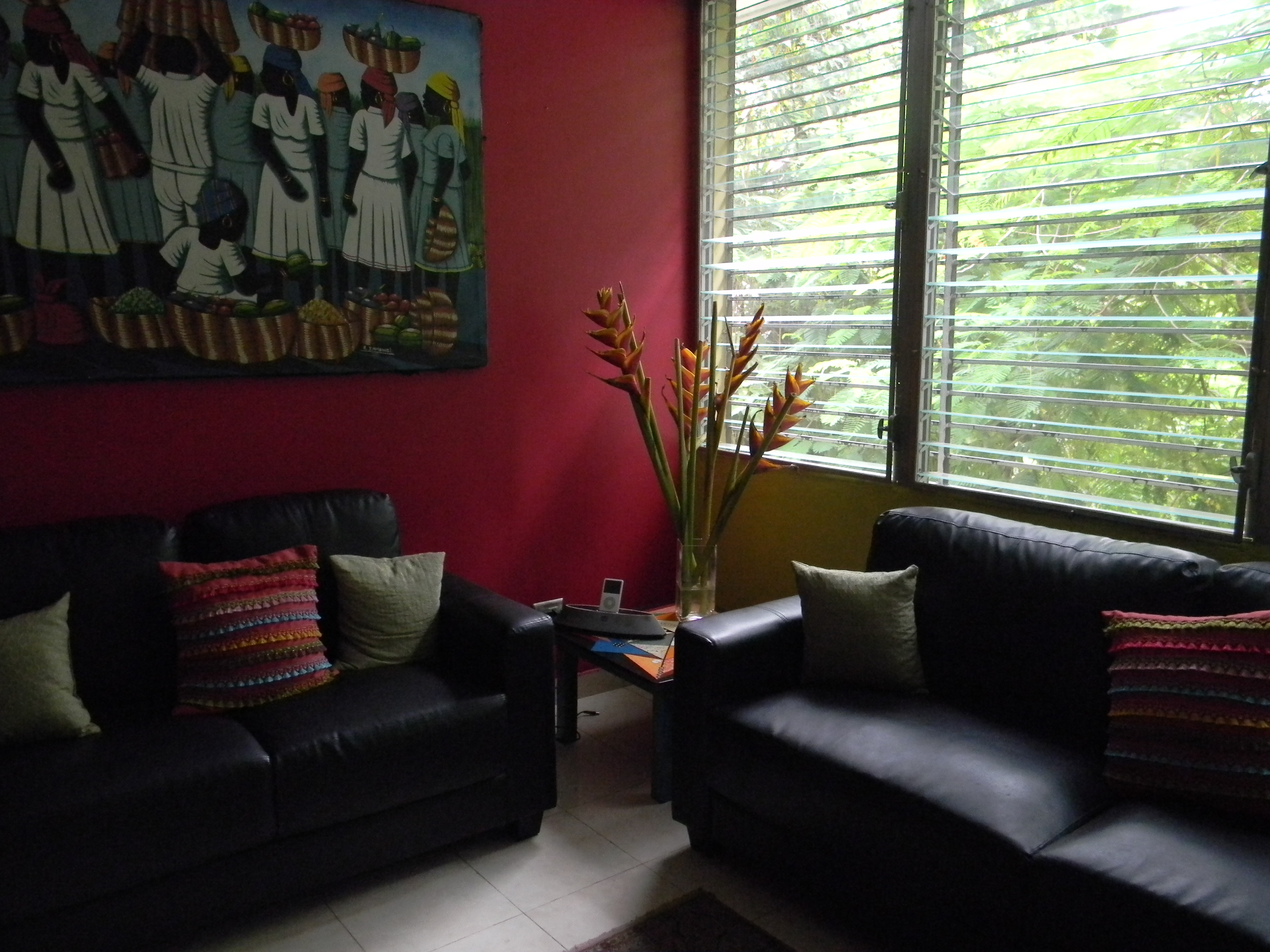
Our main seating area looks like this: 

Have a seat. Soak in the color.

On opposite sides of this space, doors lead to two rooms, the master bedroom and bath on one side, the guest room and bath on the other.

The master bedroom looks like this:

And the master bathroom looks like this:

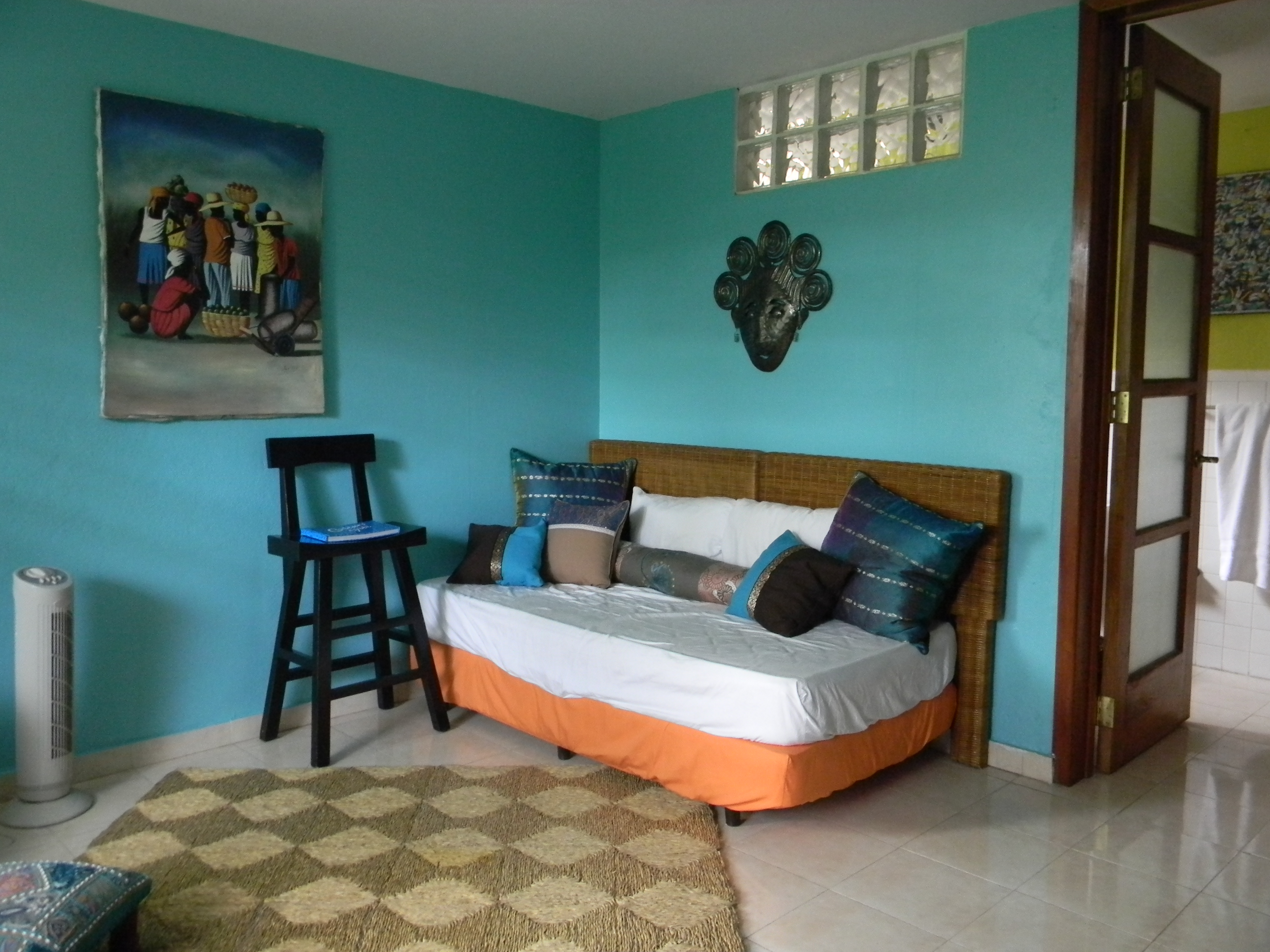
You’ll enter the guest room through this doorway:

This room doubles as Sara’s office, but if you spend the night, you’ll sleep here:

Your bathroom, a mirror image of the master, looks like this:

Another door off the guest room leads to a balcony that looks like this:

And a stairway that looks this:

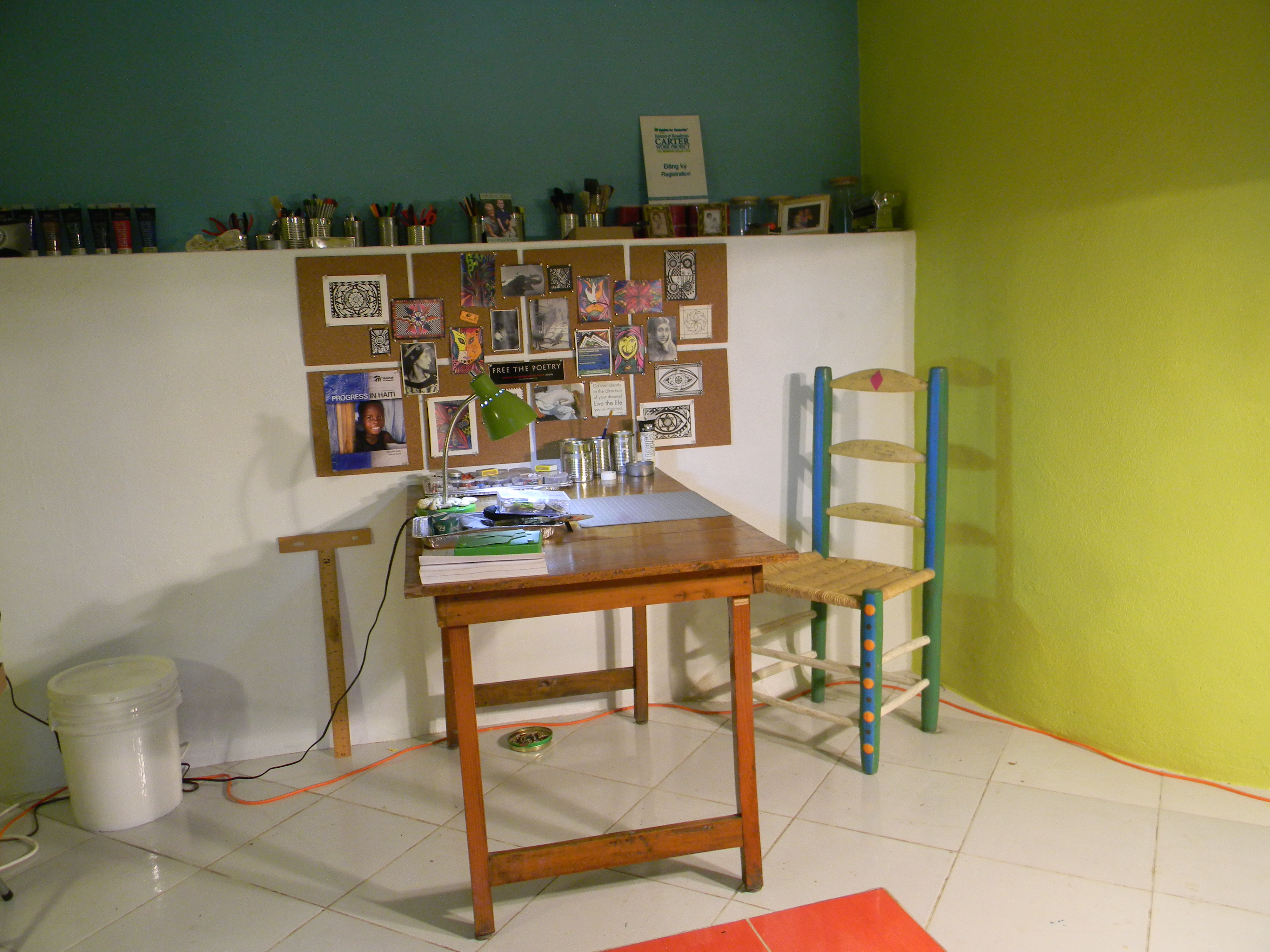
At the bottom of the stairs, another door from the outside opens into my studio and study:

Wait!

Our guard Jean-Jean rushes down the stairs–interupts the tour.  He insists the protests have started again.  You need to go.

Gosh, darn, you just got here——

We hurry back up the stairs to your car.

Well, at least you’ve gotten a sneak peak at our home in Port-au-Prince, I concede, and as you close the car door, I shout above clatter of gate opening–

Let us know when you can come again, stay a little longer, spend the night. 

I’ll send a driver and an armed-escort to meet your flight. 

(For a post about madness at the Port-au-Prince airport, click here.)

Happy Valentine’s Day from the heart of our home! 

Happy Valentine’s Day–from the (still unresolved) heart  of Haiti—————-

Aristide is coming home—


—or so I’m told—

 And Sara and I are glad to be back on Planet Port-au-Prince, where a routine of strange and absurd leaves predictability-addicted ex-pats like us whip-lashed and dizzied.

Remember the epigraph that inspired “reinventing the event horizon”——

Haiti is not simply one more of those tropical dictatorships where to rule is to steal, and headless bodies are found by the road.  Haiti contorts time:  It convolutes reason if you are lucky–and obliterates it if you are not.  Haiti is to this hemisphere what black holes are to outer space.  Venture there and you cross an event horizon. (T. D. Allman, After Baby Doc, 1989)

From a much-too-short weekend in Miami, Sara and I have crossed that event horizon, come home to Haiti, where the streets are rocking with protesters— 

Literally—

Stone-throwing, tire-burning Haitians took to the streets on Monday, calling for the removal of unpopular President Preval, whose term ended yesterday, or should have, had he not decided to extend it by three months.

So it seems—————Preval is staying, Baby-Doc has settled in, and Aristide is on his way.

As journalist Emily Troutman tweeted yesterday, the only thing that would be weirder is if  “Toussaint Louverture and Jean-Jacques Dessalines came back too.”  (Both were Haitian revolutionary heroes who fought for freedom against the French more than 200 years ago.)

In the unfortunate (but sanity-maintaining) event that you are new to Planet Port-au-Prince here’s a recap of recent events:

–On January 12, 2011 an earthquake leveled Haiti’s capital, killing nearly a quarter of million, and leaving one and a half million homeless and still living in tents a year later.

–In October Hurricane Tomas hit Haiti, further complicating relief efforts.

–Also in October, a cholera epidemic took hold, and by now, 3 months later, has needlessly killed more than 4 thousand.

–On November 28, 2011 Haiti held a fraudulent presidential election, during which ballot boxes arrived at poling places stuffed with votes for the ruling political party’s candidate, Jude Celestine.

–After election results were announced on December 8, 2010 (identifying Mirlande Manigat and Jude Celestine as the top two vote-getters who would run-off in a final round on January 16, 2011  and excluding popular, musician candidate Michel “Sweet Micky” Martelly from the second round), protesters took to the streets, rioting for an annulment of the election and leaving Port-au-Prince in a virtual lock-down that even closed the international airport for four days.

–In January 2011 the OAS (Organization of American States) reviewed election results and determined that they were indeed fraudulent and that Jude Celestine should be eliminated from a second round run-off.

–On January 16, 2011, the scheduled day of the original run-off, the delayed event was nearly forgotten when the former Haitian dictator (exiled in France since 1986) Jean-Claude “Baby Doc” Duvalier arrived unexpectedly in Port-au-Prince.

–Two days later Baby Doc was arrested and released on charges of corruption.

–Also in January, when members of President Preval’s Unity Party refused to follow the recommendation of the OAS that their candidate Jude Celestine be disqualified, the US State Department revoked the visas of 12 top officials in an effort to force the issue.

–On February 3, 2011 the Haitian Provisional Electoral Council, following the recommendation of the OAS, announced the revised results of November’s election, determining by a vote  of 5 to 3, that the two candidates to run-off in a March 20th final round would be Mirlande Manigat and Michel Martelly.

–Though this announcement too was expected to result in rioting, the exclusion of unpopular Celestine left Port-au-Prince relatively quiet and calm.

–(In the midst of this, Sara and I left Port-au-Prince on Friday, February 4th for a long weekend on the beach in South Florida.) 

hundreds of jelly fish on South Beach

 –Monday, February 7th, the Haitian government issued a sting of its own to Duvalier supports, when  it announced it had printed a diplomatic passport for the still-wildly-popular and first-democratically-elected president Jean-Bertrand Aristide, who has lived in exile in South Africa since 2004.  (So he can return home, Aristide has been requesting a passport for more than a month.)

–(As Haitians await the imminent return of Aristide, Sara and I snuck back into Haiti on a nearly empty American Airlines flight (because few folks are stupid enough to return to Port-au-Prince during this time of political unrest with arch rivals Duvalier and Aristide waiting in the wings.)

So readers of my blog should be assured—I’m back on the job.

This week I’ll be formally accepting “awards” I’ve received during my holiday—the “Memetastic Award” (from Clouded Marbles) and “The Stylish Blogger Award” (from Wendy over at Herding Cats in Hammond River).  And I’ll pass along the “prizes” to other deserving bloggers in the next couple of days.

So I’m back at my desk—

Blogging from my home-sweet Haitian home on Planet Port-au-Prince.

Come play with me.  You too can have time-contorted and reason-obliterated!

Come wait for Aristide with me———————-

(I look forward to catching up with all of your blogs, as well.)

Haitian Housekeeping from a Beach in South Florida!


Today I promised another post on Haitian graffiti artist, Jerry Rosembert Moise (if you missed yesterday’s post on graffiti, click here).  However, you street art enthusiasts are being put on the blog’s back burner, while I recover from a near all-nighter, waiting for election results that were not actually announced here in Haiti until this morning. 

As it stands, Mirlande Manigat and Michel Martelly will run off in the second round of presidential elections on 20 March.  This means the Haitian electoral council has followed the recommendation of the OAS (Organization of American States).  The OAS reviewed the results of November’s election and recommended that government-backed candidate Jude Celestin be disqualified because of fraud.  Ultimately members of the CEP (electoral council) were split 5-3 on whether or not to remove Celestine, deliberating all night, before finally announcing their decision just after 7:30 this morning EST. 

The good news–this should mean relative calm on Port-au-Prince streets.  In fact, there was a good bit of cheering this morning when the decision was finally broadcast.

For me personally, this means my long-weekend in South Florida should become a much-needed reality tomorrow morning.  As long as streets remain quiet and the airport stays open (it closed for several days following the last announcement), Sara and I will be sipping margaritas on the beach through Monday.

The ensuing drunkenness may mean no posts till Tuesday  (we’ll see) and my inability to officially pass along the “Memetastic Award” Clouded Marble cursed honored me with 2 days ago.  Sorry for this delay until next week, but in the meantime, you should visit her amazing blog and check out the other winners, who, I assume, will not be beaching it up in Miami this weekend, and may post something you’d enjoy reading in my absence.

In the meantime, check out my archive to catch up on posts you may have missed.  And enjoy the genuine genius always available on my blogroll.

That’s all the house-keeping this blog can handle for one  morning, but I will continue tidying from the sands of South Beach–a Kindle in one hand, a cool beverage in the other.

So toodles–I’ll be sipping  till Tuesday———–

Seemingly Selfish, Lesbian Ex-Pats Seek Personal Peace (and some damn, good shopping) in South Florida


Sara and I are planning a weekend trip to Miami and hoping that Haitian streets remain quiet this week, ahead of our planned departure on Friday.  However, recent developments in the news, some even in the past several hours, hint that peace in Port-au-Prince could be short-lived.  Let’s keep all selfish, Lesbian fingers crossed that we gals get gone from Haiti before politics throw an exile-returning monkey wrench into our scheme for peace.

Over the weekend we learned specifically that the Haitian Electoral Council will announce on Wednesday the winners in Haiti’s first round of presidential elections—“winners” being the two candidates with the most votes, who will run-off on March 20th.

The American government, in an effort to persuade Haiti to accept the election outcome supported by the OAS (Organization of American States), revoked the US visas of 12 top political leaders from Haitian President Preval’s Inite party.  An OAS investigation found massive fraud in November 28th’s election and recommended that Preval’s hand-picked candidate, Jude Celestin, be eliminated from the run-off.  Bowing to this pressure late last week, Preval’s party withdrew its support of Celestin, but Celestin himself has refused to concede defeat and remove himself from the process.

However, any potential unrest from Wednesday’s electoral announcement could be complicated further by what Haitian President Preval and his council of ministers decided to do on Monday afternoon—grant former President Aristide a diplomatic passport, so he can return to Haiti.

Clearly, the Obama administration was concerned enough about Haiti’s ability to transfer power away from Preval, whose term ends on February 7th, that it sent US Secretary of State Hillary Clinton to Port-au-Prince on Sunday to meet with the current president and the three presidential candidates fighting for top spots on March 20th’s ballot.  I suspect the US is concerned that Haiti not devolve into the same kind of political unrest we’ve seen recently in Tunisia and Egypt.  US interests in the region depend on peace being maintained in its own hemisphere, especially in a place just 600 miles south of Miami and too close to Cuba for comfort, a goal that Aristide’s return could threaten.

Cuba also came into play on Monday afternoon, as rumors spread that Aristide had already left South Africa, where he’s lived in exile since 2004, and had returned in the Caribbean, in preparation for his arrival Port-au-Prince.  Some reports had him in Venezuela, others in Cuba.  However, Aristide’s attorney has since confirmed that the former president has not yet left South Africa.

Aristide maintains a huge following among Haiti’s poor, and his Lavalas party was not allowed to participate in November’s election.

Today’s New York Times has a story that nicely assesses the Aristide situation, outlining the potential complications.

Clearly, political tensions here in Haiti seem to be heating up   Selfish as it sounds (and admittedly it is selfish), Sara and I hope things don’t boil over before our weekend escape to South Florida.  Though not returning home to Kentucky, we’re looking forward to the comforts of American television (minus Super-Bowl Sunday), foods as heart attack-inducing as McDonald’s Big Mac and fries, and some quiet time to enjoy South Beach and play our part, as gratuitous American consumers, shopping till greed and guilt get the best of us or our wallets are emptied—a little retail therapy to lift our spirits and boost the lagging US economy.

Somebody’s got to do it; might as well be this pair of globe-trotting, dog-loving lesbians, who need a little personal peace, as well. 

(Apologies for the Super Bowl snub; we expats like our football better in the form of World Cup action.)

Haiti needs to be HGTV’d!


Like many Americans, I love HGTV (Home and Garden Television).  When I go home to the US, I can’t wait to watch kitchens upgraded, bathrooms remodeled, landscapes transformed.

Whether I’m cooking with the ease of Lean Cuisine, laundering with the convenience of Kenmore, or cleaning with the miracle of Mop & Glo, I appreciate the perky background chatter of “Divine Design” (to learn more about the show click here) and “Design on a Dime” (to learn more about the show click here).

I enjoy segments on how to install bamboo flooring at a diagonal as much the next surface-obsessed, granite-loving, domestic goddess in North America.  Even when I’m at our house in Haiti, I complain about our stove, our oven, our cook-top.

It’s so small:

So tall:

—so not the stainless steel I have at home in the States.

But—(and this is a big BUT)

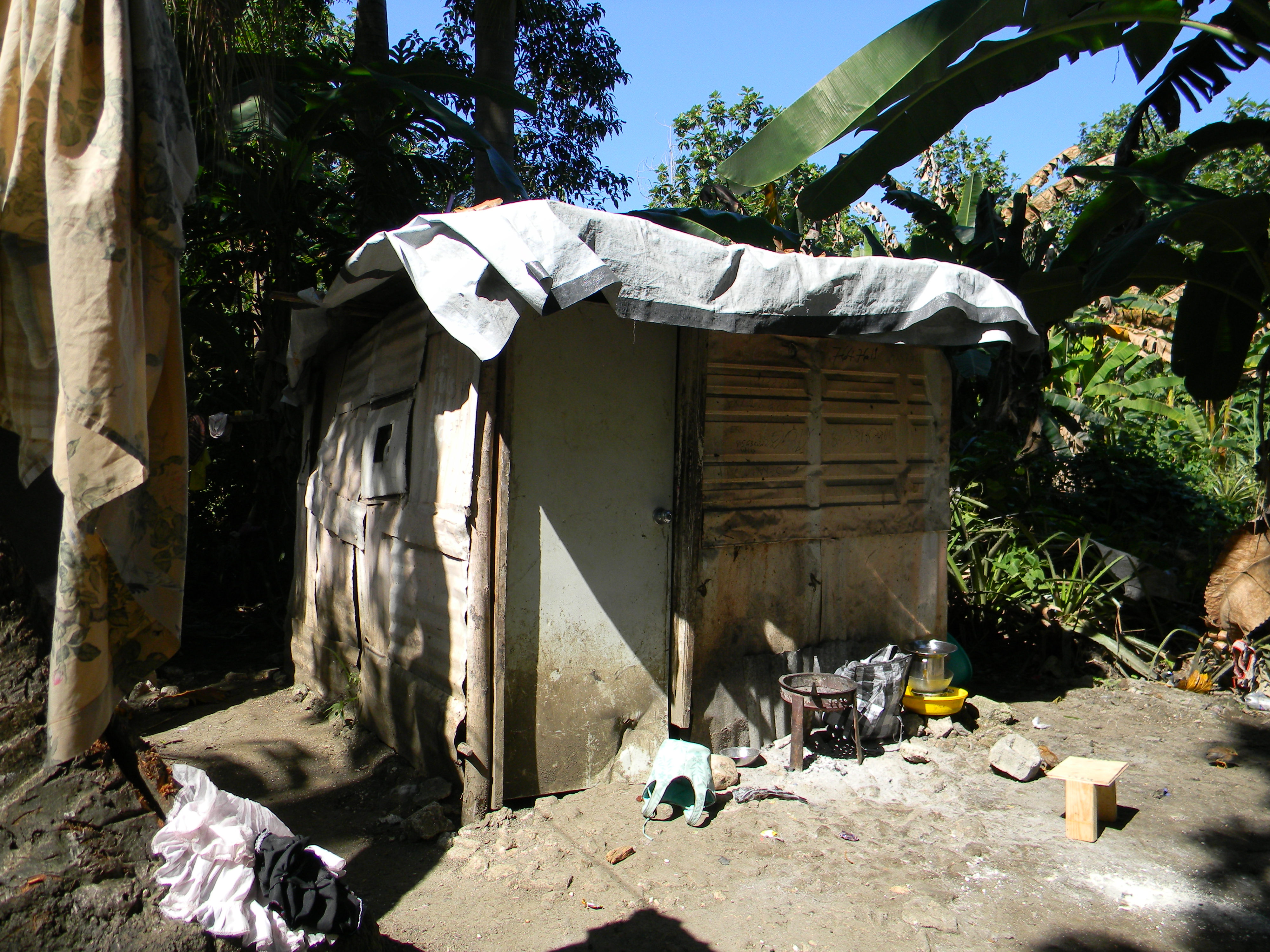
This past week I went with Sara to Leogane, a coastal town about 30 kilometers west of Port-au-Prince, close to the epicenter of the January 12th earthquake.  A United Nations assessment team deemed Leogane “the worst-affected area” in Haiti, with 80 – 90% of buildings damaged and nearly all concrete structures destroyed.

Just outside of Leogane I visited a community called Nolivos—

Where the houses look like this:

a "Desperate Space?"

(To learn more about the show, “Desperate Spaces,” click here.) 

The washing machines look like this:

doing laundry for a family of 7 children

The kitchens look like this:

a "Sizzling Outdoor Kitchen?"

(To learn more about the show, “Sizzling Outdoor Kitchens,” click here.)

The sinks look like this:

the community well

And the stoves look like this:

a "Kitchen Impossible?"

(To learn more about the show, “Kitchen Impossible,” click here.)

Watching a woman cook dinner for seven on  a stove of sticks and stones, I wondered whether Vern Yip would be willing to bring a “Deserving Design” to this mother or another mother in the Port-au-Prince slum of Cite Soleil.  (To watch an episode of “Deserving Design” click here.)

I wondered whether David Bromstad would splash some color a little south of Miami.  (To watch an episode of “Color Splash: Miami” click here.)

I thought:

Haiti needs to be HGTV’d!  (To learn more about the show, “HGTV’d,” click here.)

(and I thought I needed a kitchen remodel.)

What’s up with the stats! (at certain times of the month)


Poor Sara!

I swear to God, the woman is a saint.  She should be winning the “my-partner-is-a-pain-in-the-ass-and-I-am-the-picture-of-patience” award any day now.

I’m emotional.

Overly emotional—

Big-time, ranting and raving, tantrum-throwing emotional—

At certain times of the month.

When Sara walked in the door from work yesterday, I accosted her with worries about my blog.

“Only 78 people have read so far today.”  No “hello”—no “how was your day.”

“It’s still early,” she offered in consolation.

“But I had over 200 readers nearly every day last week.”

“Haiti’s not in the news as much this week.” She put down her bag and walked to the frig.

“My writing has gone to hell.  I have nothing else to say.  Yeah, I had a good post on Monday about the stump, but it’s all been down-hill since then.  I have no idea what I’m going to write about for tomorrow.  I planned on doing a graffiti piece as part of my Haitian art series, but I don’t have all the photos yet and I can’t deal with hours trying to upload them this evening.”

“Why don’t you write about your driving?”

“What about my driving!”

“Richard said you hit a parked car as you were pulling out of the office this morning.”

I’m stunned.  Utterly and completely not believing what I’m hearing.

“That’s not possible.  I would have know if I’d hit a car.”

“I’m just telling you what he said.” 

She’s not mad that I may have damaged our car.  She genuinely thinks I should write about this.

And the fact of the matter is, she’s probably right.

I’m not a good driver.  I hate to drive.  I think owning a car is way, way over-rated—especially in a country where the “roads” (if you want to actually dignify them as such) boast craters the size of swimming pools—canyons that could swallow a mid-sized SUV, then take on an economy car for dessert.

But I promised yesterday to emphasize the positive about Port-au-Prince, and this post is not so much about highway maintenance (and streets that double as public toilets), as it is about my pathetic driving and Sara’s pending sainthood.

When I was an undergraduate and drove to visit a friend for the first time at her home, I was so focused on getting there, that at one point the police pulled me over for running three stop signs.

The officer approached my car in disbelief.

“Lady, you just ran three stop signs.  You didn’t even slow down.”

I wanted to justify myself by asserting that, of course, I hadn’t stopped, I was busy counting. (My friend had told me to turn right after the third sign.)  Not exactly the queen of multi-tasking—at least not on the road.

When I was driving from Kentucky to Oklahoma a few years later, I asked my friend in the seat next to me, if the lights on the car were, perhaps, not working properly.  It was just past dusk.

“It just seems so dark!” I insisted.

“That’s probably because you’re still wearing your sunglasses.”

Oops!

So, it’s true.  I’m not the best driver in Port-au-Prince, but I’m also far from the worst, in a place where driving skills may be the worst I’ve encountered on the planet.

Yes, it’s possible I hit a car without noticing—busy as I was trying to prevent the road from swallowing  my vehicle whole).

And, yes, Sara is saintly in her tolerance of both bloggerly rants and driverly mishaps.

But, honestly, what’s up with the stats?

(at certain times of the month)

Haitian Street Art: A “Good Report”


Most mornings in Haiti I drive past displays of “street art”— a common sight in and around Port-au-Prince.  In most instances, hundreds of paintings are attached to walls that line the roadways, a collage of folk art images quilting the street.

In Petion-ville, just down the mountain from where we live, art is sold across the street from a camp of earthquake survivors, and in fact, some paintings now for sale along the road have selected the disaster itself as their subject.

Below is a video about street art that was produced about a month after the earthquake.  In it two artists are interviewed, the first lamenting the loss of his mentor in the disaster, the second discussing his own earthquake-focused paintings.  Despite the language barrier, try to appreciate the images and emotions shared here:

Responding to the same depth of emotion expressed above, Sara and I, over the last year, have purchased a number of paintings from the street.  We love the stuff and have bought 5 or 6 pieces, not only because of the emotionally charged nature of the work, but also because the art is highly affordable and equally portable.  (Canvases can be removed from frames, rolled up, and packed away in suitcases when we return to the US.)

The first piece we purchased in March of 2010 depicts a market scene, a common motif in Haitian folk art and an especially popular one in street art:

We enjoy the bold colors in this painting by A. Emmanuel and are struck by the featureless faces of the market women.  Notice the women wear the head coverings common in the Haitian countryside.

Still other paintings feature religious themes, as in this image of the Madonna:

Notice the mirror images of the Baby Jesus.  Twins are especially important in voodoo, and sometimes even Christian paintings include elements of it.

However, other street paintings more overtly explore voodoo, this other side of religious life on the island.  Some offer heavily painted symbols of the loa, the deities of Haiti, such as the “vever” (design) for Agwe, the voodoo water spirit:

Sara and I have none of the “vever” paintings, but we do have the one below that is, at least obliquely, associated with voodoo:

Still other street art paintings, like the one below, explore rural village life:

I think it’s important to remember, that street art, like the painting above,  like those sold adjacent to the camp in Petion-ville, not only humanizes situations that might otherwise seem hopelessly inhumane, but also dignifies these places, in some instances almost encircling the camp with images of loveliness and grace, embracing the Haitians encamped there, culturally reinforcing messages about beauty’s ability to triumph over pain.

So the next time you think about Haiti—the earthquake, the cholera, the political corruption—remind yourself, and others for that matter, that though things here might seem singularly hopeless, they are, in fact, neither simple nor beyond repair.

Remember that over 200 years ago Haitians defeated the French, becoming only the second country in the Western hemisphere (after the United States) to gain independence from a colonial master—a nation of slaves strong enough and determined enough to refuse oppression even its most imperial form.

Remember, as well, that Haitian folk art in general and street art in particular articulate the daring of a people determined to overcome.  Remember that Haiti is not a hopeless place, but is, in fact, one whose people have endured centuries of mistreatment, first from a colonial system of servitude, then from a social and political elite whose wealth has depended for decades on the poverty of so many.

Indeed, the future may look bleak, prospects may seem poor, but Haitians are rich in emotional resources,  their creative spirit screams from street corners where art echoes centuries of grief and centuries of hope, decades of determination, and ages of insight, wisdom, and strength.

Haitians remember the Biblical imperative to think on “whatsoever things are true, whatsoever things are honest, whatsoever things are just, whatsoever things are pure, whatsoever things are lovely, whatsoever things are of good report.”  (Thank you, Jane, for the reminder!)

Haitian art indeed reminds us that things are lovely–

That beauty  paints a “good report.”