“Writing” a Stereotype Wrong


I understand where the stereotypes come from, the ones that say government-subsidized housing is the black hole of shelter options, that filling out an application at the local housing authority is an event horizon beyond which one will never emerge regular renter, let alone home owner.

Yet, the problem with this stereotype, as with most others, is that they’re wrong—impressions formed in ignorance about issues most of us would rather ignore.  And frankly—it was an impression I shared—that is until poverty and illness forced me into this option, a worst case scenario I’d been determined to avoid at any and all conceivable costs.

I’ve shared in a previous post the benefit of friendship I found via the housing authority in Dallas.  However, the gifts I gained through government housing here in Kentucky were even more significant and life-changing.

The apartment complex I moved to in September of 2001 was  designated Section 8, a kind of subsidized housing that shelters more than welfare moms.  Some section 8 only accepts residents who are elderly or disabled.  Briarwood Apartments in Lexington is one of these.

Briarwood boasts 4 white brick buildings, three stories a piece.  Each has 51 one-bedroom apartments, its own library, laundry room, and lobby—as well as a community room where folks can socialize—a space residents can reserve for free, if they hope to host a family reunion or some other non-profit-making activity.  I use the word “library” loosely, as these were actually called “craft rooms.”  However, I never saw a single craft done in these spaces, and there were way more games and puzzles than books.  Still the craft room/library was a quiet, air-conditioned place to read Harry Potter or Sylvia Plath on hot and humid summer afternoons.

But what matters most about Briarwood is that it became a kind of haven for me, a place from which I emerged 4 years later nearly whole and healthy.

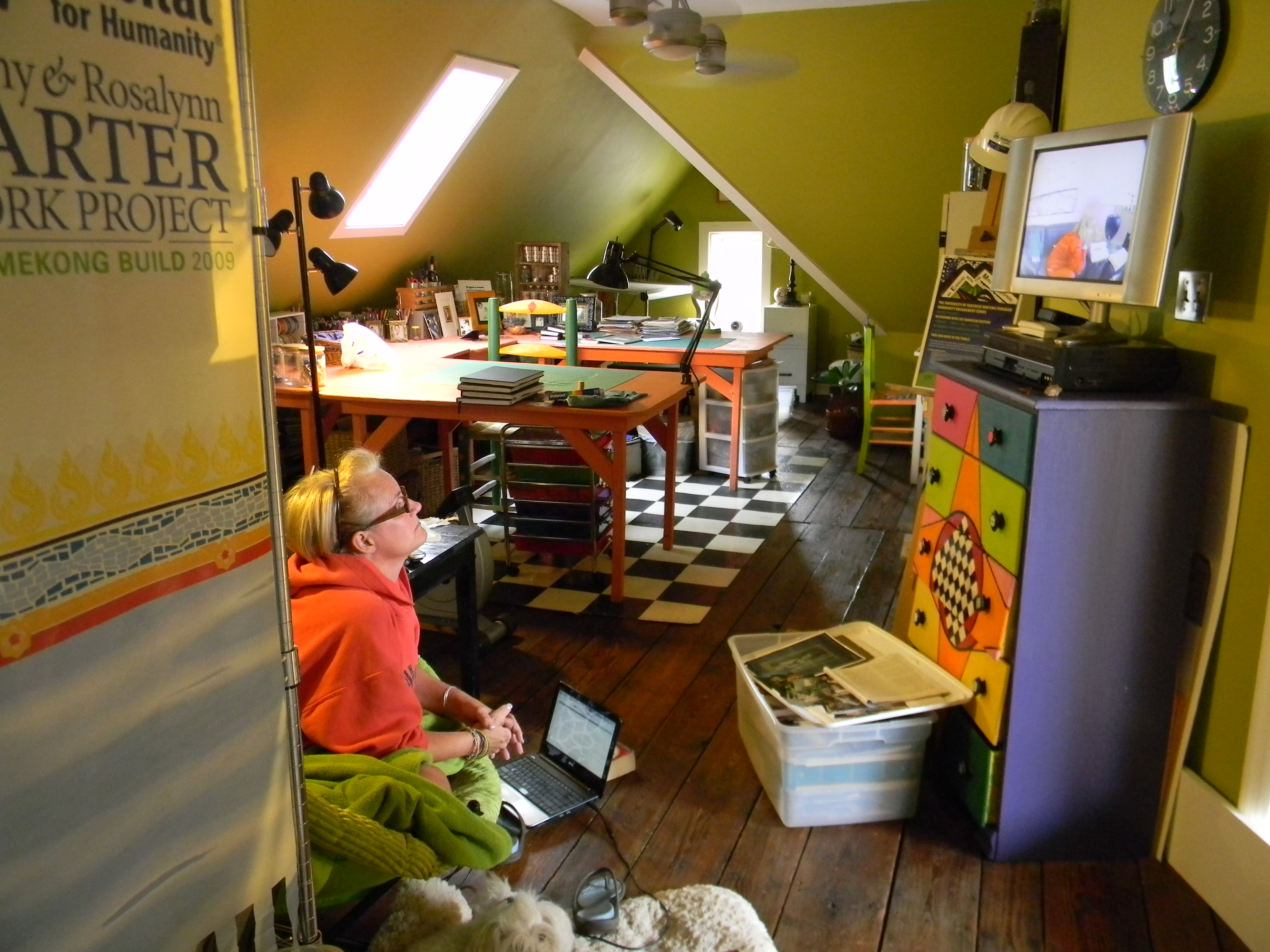
Kathy's Briarwood apartment, art table in foreground

I use the word “haven” here purposefully, as that’s exactly what the place was for me—one that sheltered and nurtured—a place I still think of fondly—one I would recommend to anyone needing an affordable and safe place to live, especially during difficult times.

It may have helped that I like old people—anyone aging who even remotely reminds me of my maternal grandmother—but then nobody ever really dislikes senior citizens, do they?  I mean, there aren’t exactly a lot of knife-wielding geriatrics wrecking havoc at local nursing homes. 

What I’m trying to say is that this was an easy group to get along with.  No crime, no noise—not even any walker or wheelchair races in the hallways.  If anything it was too quiet—a place where the biggest event of the day was the arrival of the mail carrier, who was greeted 6 mornings a week like a cancer-conquering hero—the bearer of tidings from the outside world.  Clearly, this was not a demographic that emailed much or got their news, medical or otherwise, via smart phone—not a tweeting, googling kind of group, for the most part. 

Kathy, Briarwood community room, building A, 2005

At any rate, I hope you’ll  tune in over the next several weeks, when, among other things, I’ll share some highlights about my years at Briarwood, introduce you to some residents who changed my life for the better, and maybe even dispel some housing myths, some misunderstandings folks naturally have about a kind of home they only see stereotyped on TV.

The elderly and disabled may not consistently rock the world of social media, but, this little-blogged-about demographic deserves our attention,  our willingness to share their stunning stories of wisdom, endurance, and daring.

Only then can we “write” a stereotype wrong.
 

When One Boomer’s Madness Morphs into Dream-Come-True


In 2011, it’s hard to know which is weirder—watching myself on videotape narrating my psychiatric struggle in 1997 or knowing now how inherently different my life is 14 years later.

Though ’97 was difficult, I generally had to fight hard for more than 10 years following my diagnosis with bipolar disorder in 1990, a decade of pain and endurance, as I struggled with every ounce of energy available, battled a diagnosis that doomed me to countless psychiatric hospitalizations and chronic poverty.  I lived without a car and in 1997 on $736 a month.

Things were particularly bleak during the winter and spring of 1997, when I was hospitalized twice and struggled to complete even the most basic tasks of daily living—getting myself to and from treatment, feeding myself regular meals, taking medications as prescribed.  I spent 5 hours a day on Dallas city buses, struggled to purchase groceries on $30 a week, and suffered so with memory loss, I couldn’t remember whether or not I’d taken the Zyprexa (an anti-psychotic drug) that dulled my thinking and left me listless, not to mention sleepy and ravenously hungry.

But yesterday, in the context of a memoir-writing project, I watched video-taped therapy sessions from 1997, a number of them, at least 6 hours worth.

I noted especially that on March 6, 1997, wearing red sweat pants and my hair in a loose bun, I congratulated my therapist on the occasion of her 49th birthday.  I was 35 years old but looked at least 10 years younger than that—thin and toned as I pretzeled myself into a corner of black leather sofa.

what I looked like in 1997

But what I remember about that time, recall without having to watch a video, is the belief that my therapist was rather old—unimaginably older that I could ever imagine myself becoming.

Yet now, in 2011, I am myself 49.  I am the “old” I couldn’t imagine myself becoming.  And this is a hugely strange experience— sitting in a home I own, with my graying hair and gained weight—watching a much younger version of myself, wishing a woman I so respected happy birthday, knowing I was thinking, “Gosh, she’s almost 50.  I can’t imagine being that old.”

watching videos of myself 14 years later

Not only am I watching myself 14 years ago—seemingly endless hours of myself frozen in time—but also I’m thinking about who I am myself now at this ripe old age—how different I look—how inherently reversed my circumstances are—how much better, richer, fuller my life is—how my experience is now what I only hoped it could be then, what I only dreamed it could be, but never expected it could become.

Clichéd as it sounds—I am now literally living a dream come true—a dream I articulated to my therapist in 1997—a dream about teaching at a university again, a dream about writing—a dream about succeeding—a dream about love.

I don’t know how it happened.  I don’t know how or why I became ill, why my mind deteriorated to the point it could no longer be trusted, how it is that now I am well—at least in relative terms—my symptoms well-managed. 

In 1997 Bill Clinton was just beginning his second term as president; scientists were cloning Dolly the sheep; and in the US we would soon have a balanced budget.  Though Princess Diana and Mother Teresa died, it was a time of hope—a time of new beginnings and relative prosperity.

However, my memory at the time was so poor, my connection to the larger world so tenuous, I recall little of this.  I know most of this from my more recent efforts to go back and fill in the blankness my brain experienced as real life.

Now, as I watch these videos, as I reflect on how I felt 14 years ago, on how it feels now to not remember, I’m amazed that I have come this far.  That I no longer fear homelessness, that I no longer live in government housing, that I now own a home, function well, love an amazingly accomplished woman who loves me even more. 

How did I survive more than a decade of seeming defeat?  How is it that I’ve recovered to this degree?  How did this come to be, this tale of endurance, my narrative of hope?  How is it that this stunning grace has happened?

I hope my memoir can help me share this amazing magic—let others know that what sometimes seems an illusion of recovery can indeed become a solid and shared reality—a Boomer’s madness morphed into dream-come-true.

With the Edges of her Eyes


Today I’d like to share a poem I wrote about my maternal grandmother, who died in 1980, when I was only a senior in high school.

My grandmother was probably my favorite person on the planet.  I adored her and thought, as a teenager, that I could deal with just about any challenge, as long as it didn’t involve losing her.

Nana and I, two years before her death

My grandmother, born in 1903, was beautiful as a young girl:

However, when I was myself an adolescent, Nana fell and broke her hip.  She  was subsequently unable to reach her own feet, so when I visited her, my favorite place to stay in the summers, I often washed them for her–something I allude to in the poem that follows.

nana

(in memory of Martha Gilbert Kunkle)

we are oblique and
at odd angles:
     me at the feet
     i once washed
     on a regular basis
 
in the dream:
     she is getting older
                melting or
                shrinking
 
looking at me
only with the edges
     of her eyes.
 

Though often in my dreams my grandmother is still alive, I’m grateful in the mornings  to know Nana, in all the ways that matter,  has never really left–blessing enough–in my own now aging  eyes.

Airing Family Secrets via Haute Couture


Two days ago, on her 72nd birthday, my mother shared her newest mnemonic device.   And I thought, in all fairness, I should pass along the technique, in case you want to remedy your own memory deficits by adopting my mother’s method.

This all came up when I asked my mom to call us in Haiti during our family’s annual let’s-celebrate-mom’s-birthday-event scheduled for yesterday afternoon.

When I asked my mother to make the call, she said, “Well, I’m afraid I’ll forget.” 

I reassured her that she didn’t have to worry.   I would email my sister and ask her place the call. 

“No,” my mother declared confidently. “I’ll just clip a clothes pin to my lapel.”

“Really,” I replied. 

“Of course,” she claimed.  “Someone is bound to ask why I have a clothes pin on my blouse.  And when they do, I’ll remember we were supposed to call you.  It works every time.”

“Every time,” I said, dumbfounded that my mother had used the technique enough to have gathered such data.

“Always!”

“Wow,” I added.  “I think I’ll have to blog about that.”

“Oh, you should! It works really well—-and everybody has an extra clothes pin hanging around!”

“Sure they do . . . “

. . . but—-for those of you whose laundry habits have surprisingly not carried the clothes pin over into the 21st century or, god forbid, who lack the sartorial daring to add clothespins to your accessory repertoire, my mother claims the piece-of-paper-in-the-middle-of-the-living-room-floor technique works almost as well.

But, of course, I wouldn’t want to hang all  my family’s dirty laundry out to dry.