Graffiti: Inscribing Haiti’s Future on the Rubble that is Now


There’s a long-standing tradition of political graffiti in Haiti—one that began soon after the Duvalier dictatorship ended its 29 year reign of terror with the ouster in 1986 of now newly-returned Baby Doc.

 We’ve come full circle. 

Duvalier is back.  Aristide is on his way.

However, political graffiti isn’t gone.  In fact, it’s virtually everywhere in Haiti’s capital—buildings and walls defaced by political thugs given $35 (US) and some spray paint to propagandize Port-au-Prince—scrawlings in red, black, and blue—the names of presidential candidates literally littering the city in ink.

What’s different, however, is this: there’s a new kid on the block, a graffiti artist named Jerry Rosembert Moise, who began his brilliant work just hours after an earthquake devastated his city.

What’s also different is that Jerry’s graffiti is decidedly non-political.  It articulates the suffering of an otherwise silent city, whose pain is tented and tarped along rubble-strewn streets, where cholera rages and rioters react in a language of flaming tires—a solidarity of burning rubber.

Jerry, a twenty-five-year-old graphic artist by training, paints simultaneously with both hands.   By now he’s completed more than 50 pieces, beginning in Port-au-Prince proper, before moving uptown to Petion-ville where we live. 

Directly across the street from my partner Sara’s office, is a painting that looks like this:

Though getting good photos of this piece is now complicated by a billboad’s intrusion, you can still see the ball-holding boy, watching the world cup.  There’s a lot of watching going on here, the person on the street seeing the painting, the young man staring at the set.  Passively the world watches and plays games, while Haitians wait, forced to make furniture from rubble?  Who holds the ball here?  Are these the questions Jerry asks?

Just half way up the block, however, on the same side of the street is a piece that looks like this:
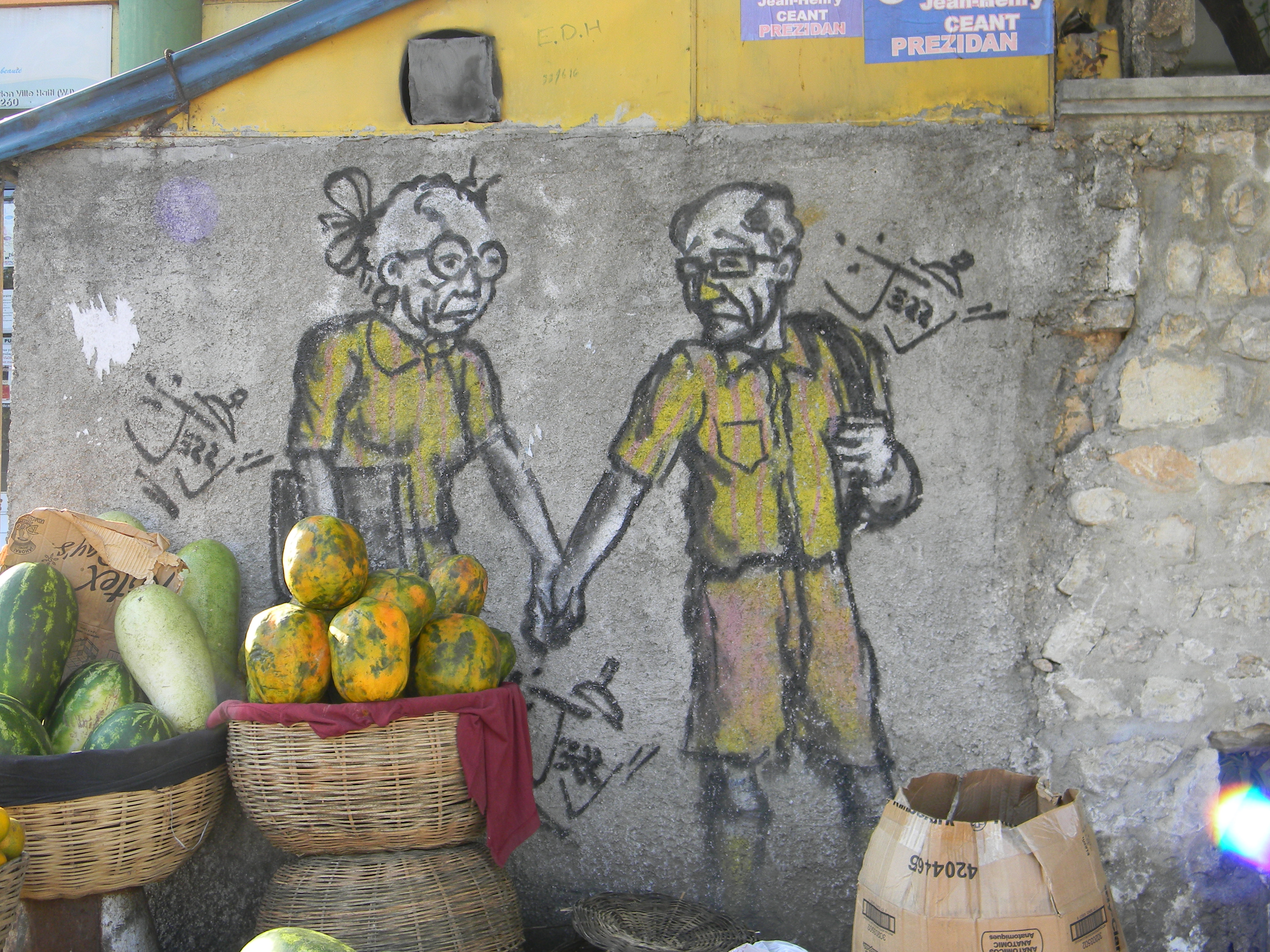
What’s Jerry’s message here?  The hand-holding couple walk in solidarity.  What makes them so sad, so tired?  Why do they look down instead of up or at one another?

Still further up the block and across the street from Sara’s second office is a woman leaning against the very wall she’s painted on:

Her gaze is directed over her shoulder and into the street, perhaps even across the road at the NGO where Sara works.  She wears glasses, smokes a cigarette in high heels that force her to stand on tip-toe, legs crossed—tentatively.  She’s suggestively watching what?  What does she need assistance seeing or saying?  When does “suggestively” become “suggest?” 

Not far from the block where these three pieces peer at televisions and NGOs, is an even sadder commentary of post-earthquake Haiti:

Here the boy in a wheel chair is watched by Santa Clause.  Santa, suited up in high holiday-fashion, is the passive on-looker.  The boy participates, waving a bleeding Haitian flag, popping a wheely—stunting for Santa. 

“I may be hurt,” he says. 

“I may be bleeding.  But watch me wave patriotically, while you stand idly by, hot under the collar in that stupid European suit!” 

“Why are all the ex-pats pissed?” he wants to know.

Santa may not know the answer.  We may not either.  But Jerry himself has this to say:

So Jerry’s message is one of hope, a belief that the youth of Haiti can and will make a difference, build a stronger future on the rubble that is now.

Tomorrow, an update on Jerry’s latest project! 

Stay tuned.

Haitian Street Art: A “Good Report”


Most mornings in Haiti I drive past displays of “street art”— a common sight in and around Port-au-Prince.  In most instances, hundreds of paintings are attached to walls that line the roadways, a collage of folk art images quilting the street.

In Petion-ville, just down the mountain from where we live, art is sold across the street from a camp of earthquake survivors, and in fact, some paintings now for sale along the road have selected the disaster itself as their subject.

Below is a video about street art that was produced about a month after the earthquake.  In it two artists are interviewed, the first lamenting the loss of his mentor in the disaster, the second discussing his own earthquake-focused paintings.  Despite the language barrier, try to appreciate the images and emotions shared here:

Responding to the same depth of emotion expressed above, Sara and I, over the last year, have purchased a number of paintings from the street.  We love the stuff and have bought 5 or 6 pieces, not only because of the emotionally charged nature of the work, but also because the art is highly affordable and equally portable.  (Canvases can be removed from frames, rolled up, and packed away in suitcases when we return to the US.)

The first piece we purchased in March of 2010 depicts a market scene, a common motif in Haitian folk art and an especially popular one in street art:

We enjoy the bold colors in this painting by A. Emmanuel and are struck by the featureless faces of the market women.  Notice the women wear the head coverings common in the Haitian countryside.

Still other paintings feature religious themes, as in this image of the Madonna:

Notice the mirror images of the Baby Jesus.  Twins are especially important in voodoo, and sometimes even Christian paintings include elements of it.

However, other street paintings more overtly explore voodoo, this other side of religious life on the island.  Some offer heavily painted symbols of the loa, the deities of Haiti, such as the “vever” (design) for Agwe, the voodoo water spirit:

Sara and I have none of the “vever” paintings, but we do have the one below that is, at least obliquely, associated with voodoo:

Still other street art paintings, like the one below, explore rural village life:

I think it’s important to remember, that street art, like the painting above,  like those sold adjacent to the camp in Petion-ville, not only humanizes situations that might otherwise seem hopelessly inhumane, but also dignifies these places, in some instances almost encircling the camp with images of loveliness and grace, embracing the Haitians encamped there, culturally reinforcing messages about beauty’s ability to triumph over pain.

So the next time you think about Haiti—the earthquake, the cholera, the political corruption—remind yourself, and others for that matter, that though things here might seem singularly hopeless, they are, in fact, neither simple nor beyond repair.

Remember that over 200 years ago Haitians defeated the French, becoming only the second country in the Western hemisphere (after the United States) to gain independence from a colonial master—a nation of slaves strong enough and determined enough to refuse oppression even its most imperial form.

Remember, as well, that Haitian folk art in general and street art in particular articulate the daring of a people determined to overcome.  Remember that Haiti is not a hopeless place, but is, in fact, one whose people have endured centuries of mistreatment, first from a colonial system of servitude, then from a social and political elite whose wealth has depended for decades on the poverty of so many.

Indeed, the future may look bleak, prospects may seem poor, but Haitians are rich in emotional resources,  their creative spirit screams from street corners where art echoes centuries of grief and centuries of hope, decades of determination, and ages of insight, wisdom, and strength.

Haitians remember the Biblical imperative to think on “whatsoever things are true, whatsoever things are honest, whatsoever things are just, whatsoever things are pure, whatsoever things are lovely, whatsoever things are of good report.”  (Thank you, Jane, for the reminder!)

Haitian art indeed reminds us that things are lovely–

That beauty  paints a “good report.”