Forgetting the Seclusion Room (Another Chapter in the Chronicle of Crazy)


(To read the post that precedes this, click here.)

I don’t remember arriving at Parkside Hospital, a psychiatric facility in Tulsa, Oklahoma; neither do I recall anything about the admissions process.  I don’t remember how my Maltese Lizzy came to be kenneled at the vet’s office, who took me to the hospital or if it’s possible I even drove myself.

Indeed, it’s these gaps in memory that I remember most. And this fact of forgetting remains my ongoing issue with memoir.  How does one memoir without memory?  How does one write the empty space where the story should be?

These gaps complicate the writing process, and the effort to fill in the details, to flesh out the facts, force me to depend on journals I kept at the time.  For example, the night I so unceremoniously removed the carpet from my living room, the night before the hospital admission I allude to above, I described an intense sense of alienation and confusion:

I know that other people must not experience the world in the way I do, because if they did, the world would be a very different place and I wouldn’t feel so strange—so marginal—so near the edge and falling off.  I have a kind of hyper-consciousness that nearly drives me crazy.  I feel driven.  I feel haunted.  I feel so alone in my experience . . . . I feel out of control and at the mercy of my own mind . . . . I’m so alone and so afraid . . . . I feel like a bad human being—like I’m just not good at it.  I feel like a failure.

I can’t control my thoughts.  I think thoughts I don’t want to think.  I feel out of control.

I feel like I can’t be true to myself and live in this world, like I want to wear bones on my clothes—on the outside pinned to me.

I don’t remember anything about this bizarre urge to “wear bones,” but skeletal fashion statement aside, I also don’t recall the particulars of this admission to Parkside in March of 1990.  However, by the time I left Tulsa in 1995, I had been admitted to this same facility any number of times and do recall a few facts about the place.

The building had three floors, for example, and a basement—the first an intake unit and small lobby, the second a locked but moderately restricted unit, and the third a locked but highly restricted one.

I was admitted to the third floor.  I remember a day room at one end, 4 dormitory style rooms at the other, and a hallway connecting the two. The hall had a nurses’ station along one wall, an elevator on the other. 

With windows along two walls, the day room was large, filled with square wooden tables with white Formica tops, four chairs at each.  We patients spent most of our time in this open space: played games, watched television, ate meals. 

The patient rooms were bare and barrack-like.  With a partition down the middle, two beds on one side, two on the other, each room also contained two desks and four small wardrobes.  Bathrooms, one per room, boasted, a toilet and shower stall, not to mention a metal mirror above each sink—no glass allowed, lest patients break it and purposefully injure themselves.

Behind the nurse’s station was another hall that was locked and off-limits to patients.  Here were a number of seclusion rooms, each with a single bed bolted to the floor in the center of the space—each equipped with 4 point restraints—wide leather cuffs that strapped wrists and ankles to the bed.   I spent time alone in these rooms when I was particularly distressed, but only once in 4 point restraints. 

I walked the hall between these dorms and day room, repeatedly, regularly.  The antipsychotic medication made me restless, so I paced, feeling the walls with my palms, an effort to comfort myself, to calm the cacophony of crazy that worsened every evening. 

One nurse was kind and would sometimes walk with me, attempting to reassure me, to lessen the aloneness, to quiet the chatter in my head, the echo of children’s voices saying senseless, sing-song rhymes.

But mostly I walked that hall alone, alternately fighting and forgetting a psychosis that whiplashed between extremes of nothingness and nowhere.

(to be continued)

A Prose Poem


Summer Circles Green

Summer circles green and my hair is growing another color, silver/white like tinsel or Christmas tree ornaments or snow on the slanted roof of the artist’s yellow house, who paints her daughter blonde, reclining as in a lawn chair, her oiled canvas stretching now in a museum down the road, where we, on Sunday mornings, relax like swans, drinking flavored coffee from blackened mugs so the darkened rims don’t show.  I despise the dirty rigs on my own blue mugs, like arctic circles, tea rings, skim milk spilling on the wooden floor beneath the picnic table benches.

Summer circles green and my hair is growing another color, preparing cob-webbed gowns we wear like gauze bandages, covering the cigarette burns on our wrists and upper arms, slices of roast beef for the noonday meal, when we should be eating turkey along with last year’s yellowed photographs, boxed memories of three years’ madness, the hospital gowns, green and open in the back, displaying what we’d prefer to hide behind some sturdier covering.

Summer circles green and my hair is growing another color, asking impossible questions about misplaced rooms and lilacs beside the brick house that stained my childhood brown, brown hair like dirty ponds in winter, though I pretended it was red, imagined I was burning, wondering—will I ever be consumed like bread crumbs scattered to the pigeons that roost on slate roofs, cooing, calling—

More about bipolar disorder


I wrote the following poem when I was struggling to differentiate between what was real to me and what others told me was real–the inherent confusion of the psychotic, thinking, believing, even knowing I knew better, knew more, could intuit things the experts couldn’t.

Long Ago

I went to the lilac bush
     because it was
                 is/is
     a safe place
     being nothing
     other than a branch
                a scent
     no light to make seeing happen
 
They told me I was sick
     but I knew
     that it was better
                we only know
                the real
                by the not real
 
Having lost
     all sense
     of up and down
                direction
the dignity of admitting
     I was wandering
                eyes closed
                following a faint glow
                of incense burning on a shelf
 
Smell, like touch, always precedes seeing

What I wrote when I was sick——


I promised to begin looking at the years when I was most sick with bipolar disorder, the most symptomatic.  During part of that time, I attended a day treatment program for the chronically mentally ill and wrote the following poem about theat experience:

Day Treatment  (Poem #1)

It’s Monday and again
we sit in chairs, sprawled
against straight backs,
mid-morning group at day
treatment, talking about
black holes:
                fear of abandonment
                fear of non-being
the endless longing to return
plato’s parable about the cave
                the dark place
                the shadow
                the holy
                the horrible
                the hot coal
carried close to
each of us
so we are, all of us,
                always
                burning

Haiti: The Art of Recovery


I’m a wanna-be artist, a sort-of, almost artist—certainly not by training and clearly not because of craft. 

I’m also an artist who has struggled with bipolar disorder, someone who appreciates the creativity that is often an unexpected gift accompanying the illness.  I’m someone who has not only made art when I was sick, but continues to create even when I am well, as an outgrowth of recovery.  In the art world I’m what would be called an “outsider” artist.  I don’t always know what I’m doing.  I just do.  Art. 

I’m also a writer and artist who has lived in Haiti for the last year with my partner.  Sara has directed an international NGO’s response to the earthquake.  But we are preparing to go home next week, and I’m thinking not only about what Haiti has given me, the gifts I will take home, but also what I’ll leave behind.

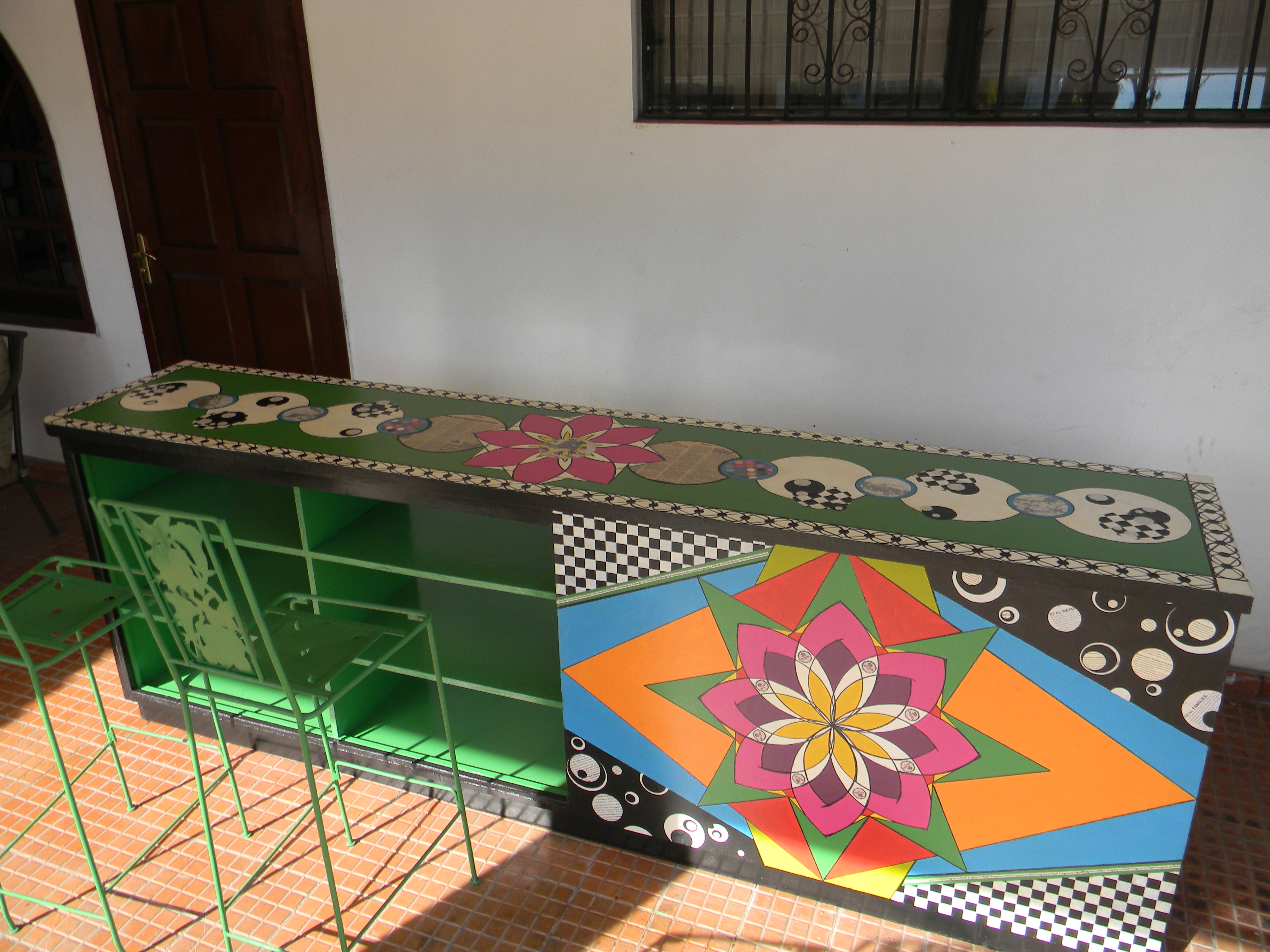
Indeed, one of the gifts I’ve given is a large piece of art, one I created for Sara’s NGO from a throw-away piece of furniture—a huge serving bar I painted last summer.


The bar is nearly 9 and a half feet long and lives on an upstairs patio at Sara’s office in Port-au-Prince.

It was white, ugly, an eye-sore, really.  But Sara wanted to save it.  She thought it, like Haiti itself, should be given a second chance at life, that the bar could be used for receptions, to serve meals on special occasions.  She thought I was the one to midwife this rebirth, that I was the one to take on the task, that as someone who has repurposed art as part of my own recovery, I could gift a born-again bar to the wonderful people who work here.

I loved the idea and took on the project enthusiastically, in the end creating a mixed-media piece—one that incorporates the organization’s logo in strategic places, as well as decoupaged-maps of Port-au-Prince and each location in Haiti the organization works.

I also included stories from the local newspaper, highlighting big events in the news during the months after the earthquake.

I included text from the organization’s 6-month, post-earthquake report, as well as the names of almost all the people who had worked on the NGO’s reconstruction effort—folks from more than a dozen countries around the world.

The front of the bar repeats the organization’s logo above each flower petal:

As well as the names of staff in black and white circles:

The top of the bar includes the maps and newspaper text:

However, soon Sara and I will leave Haiti; soon we’ll leave the places mapped on the bar-top at a bit of a distance, at least geographically.

And though we’ll leave when the organization’s work here is still incomplete, though in many ways it seems too soon, I’ll leave a piece of myself behind, one that I hope will serve the NGO’s mission here well into the future.  I’ll leave not only a piece of my art, but also a piece of my heart, knowing this is not really an end.  We leave but others will come.

Haiti has taught me this lesson: that indeed good things can come from our departure.   It has taught me not only how to birth a new bar, but also  how to hope, how to see potential in seeming destruction,  how to dream a new dream, how to hope a new hope.  It’s reminded me that, if art can come out of sickness, then indeed beauty can come out of the earthquake’s ruin. 

I believe that in every beginning an end is waiting to happen and from every illness or devastation a new beginning will grow.

Peace to people of Haiti—

And thank you!

This is what my head says . . .


 Today I thought I’d share a poem I wrote when my bipolar symptoms were in evidence–one that, I think, illustrates the chatter that, even now, I push aside but hear vaguely in the background–a whisper that back-drops and wall papers my expereince of almost everything–every bowl of cereal I eat, every peice of paper I pick up,  every book,  every door I close or open or slam shut, hoping to silence the sing-song.

This is what my head says . . .

The back of the truck
     is let down and I am
     in the street again
                lines down
          the center of the roadway
                yellow voices
 
The color of a dress I had
     age three
                yellow roses on the bodice
                yellow roses on the table
          where the place is set
                for us to eat zucchini
                and avocado and other vegetables
          with green skin that must be peeled
                away before consuming
 
Before comes earlier than after
               as does the obvious
              preacher talk
     of Jesus saving other people
                from their sin
 
Sin is always in the third person