I’ve been thinking a lot about memory this week. How we remember. What we remember. Why we remember some things but not others.
And in process, I remembered a poem I wrote some time back about my own expereince of memory, especially my experiencing the past as text.
In it, I allude to Anna Ahkmatova, the celebrated Russian poet who was so highly censored under Stalin , she resorted to writing her poems on cigarette paper, memorizing them with a friend (friend’s memory as carbon copy), and smoking the evidence of her crime against the Soviet State.
Here, I also allude to the texture of memory and the texture of texts themselves. It’s interesting to me that in English the word “text” is inherent in our word for “texture”–a sematic given.
Censorship
The past comes
back in bits
colorless as glass
ground almost to dust
so that any sense of shape
seems irretrievable
The taste of it lingers
in my mouth like
something burnt
marshmallow
toast
skin
Dream of Ahkmatova
stanzas scratched out
on cigarette paper
during Leningrad winters
memorized by a friend
burnt in ashtrays
saying what we don’t
(hear)
only know
like skin
(Something to be touched)
Text (ure)
is everything
(The formatting of the poem is not correct, but I could not get WordPress to recreate my Word document without changes in spacing. I finally decided to pass the poem along regardlesss, hoping its message would speak to you despite the irregularities.)
It’s the forgetting I remember most. The fact of forgetting. The past is fuzzy for me, something that will make memoir difficult.
So, for me, re-membering will partly be a process of re-constructing and re-assembling the story, piecing and pasting. Largely, this is due to trauma. Trauma around growing up in a dysfunctional family whose front door was broken down by the FBI on way too many occasions. Trauma around having a mental illness that at times disconnected me from reality and the people I love.
However, I have a strategy for doing this detective work, because I, clearly, need to research and document the parts of my life I can’t recall.
So today I’ll outline the most obvious steps to take in reconstructing both the story about my father’s connection to organized crime and the one about my mental illness—what amounts to a 20 year struggle to win (and sometimes seemingly lose) the battle against bipolar disorder.
Though I don’t know that my family is entirely comfortable with my writing about my father, who, in fact, died in 1981 (when I was still a teenager), I plan to do the following to document my dad’s story:
File a “Freedom of Information” act, so I can access my father’s FBI file.
Search news paper indexes to locate articles that were published about my father in the Pittsburgh Press and Pittsburgh Post Gazette during the 1960s and 70s.
Access transcripts of court proceedings, so I can understand why several grand juries indicted my dad and can appreciate the nature of my father’s testimony in court proceedings against him.
And in order to reconstruct the bipolar narrative, I plan to:
File for copies of in-patient medical records, so I can review notes taken by doctors and nurses during my many hospital stays.
Request copies of notes kept by doctors and therapists during out-patient treatment. (Some of this I’ve already done.)
Review journals kept from the time I was 15 until the present. I wrote a lot during the years I was sick. And though I don’t recall everything about that time, the journals recorded much of what I don’t remember.
Watch video tapes of several years’ worth of out-patient and in-patient therapy. This will be an invaluable source of information about my symptoms, my behavior, my thoughts and feelings at the time. (This first involves having the videos transferred to DVDs, so I can bring them back to Haiti. Frankly, the thought of watching this material terrifies me. I can’t imagine what it will be like to see myself so sick. I tried to watch one video a couple of years ago, but had to stop. It was too painful.)
As I lay out this agenda, I want you to be assured, also, that I am well these days. No one would ever know I had ever been sick or still carry this diagnosis. In fact, when I’ve shared this information with folks in recent years, they’ve been shocked.
My partner can certainly see how moody I remain. I’m not always easy to live with. As Sara says, when I feel something, my emotions fill the entire house. I still hallucinate at times, but you would never know. I’ve learned to manage the symptoms that remain, the ones that still break through despite the medication.
I hope some of you will help by holding me accountable with regard to the strategy outlined above. Renee over at “Life in the Boomer Lane” recently posted a two-part series on memoir writing (something you should check out by clicking here and here). But in the second of those posts Renee suggests assembling a supportive group of friends to keep oneself on track during the process of writing a memoir. (So, I hope some of you will be willing to “support” me with periodic kicks in my memoir-writing ass.)
Thanks to all of you who read my blog. Please know how much I appreciate your on-going support. You all have given me the courage, the faith in myself as a writer, to finally take on this task I’ve been avoiding for years.
Peace to each of you and, as always, hugs from here in Haiti,
And for me it is, indeed, a matter of re-assembly. Sorting and piecing , cutting and pasting.
(So, today I have a confession to make.)
From the beginning, I’ve wanted this blog to be an avenue into memoir, since, in many ways, the story of my past is far more interesting than the narrative that is now. And, in fact, the most significant “event horizons” in my life happened a long time ago.
I know that may be hard to believe, as the life Sara and I have lead over the past several years has been an exciting one—taking me to places like Bangkok, Hanoi, New Delhi, Port-au-Prince.
But in many ways to travel backward in time is the bigger challenge—more over-whelming, more frightening, yes, but also more meaningful, and perhaps even profound.
The story of how I’ve gotten here—how I’ve gotten “now” is one that must be told. And how I’ve gotten here involves telling at least two stories, requires that I follow two narrative threads. (There’s actually three but only two I’m even close to comfortable sharing now.)
The first is the story of my father’s involvement with organized crime and the second is the story of my twenty-year struggle with bipolar disorder.
Neither of these is easy to tell. And honestly I’m afraid.
I still intend to write about Haiti. I still intend to write about the “now” that is the life I share with Sara on this troubled island. In fact, I believe the struggles Haiti faces nationally are not dissimilar to the personal challenges I’ve endured. My story and the story of Haiti both involve sickness and corruption, oppression, endurance, even hope.
In the coming days and weeks I’ll outline my strategy, share my goals, my hopes, my fears.
I don’t know how to tell this story. I don’t know where to begin. I feel swallowed by the enormity of the task, dwarfed by it.
So, I’ll pray for peace—and if you’re a praying person, please offer your own prayer; if you’re not, please say you care, please say you’ll share.
I still need that massive infusion of grace. I still need that holy yes.
Today I’d like to welcome my friend and fellow writer Mindy Shannon Phelps to “Reinventing the Event Horizon.” Mindy’s guest post is also about “sheltering,” a topic explored in yesterday’s poem and one inherent to the recovery effort here in Haiti. Mindy’s narrative negotiation of this issue–an event horizon of its own–is stunningly poised and powerfully moving. (Mindy’s bio is below and her post “She Sheltered Me” just below that. Mindy will personally respond to comments, so feel free to ask questions.)
A journalist by training, Mindy Shannon Phelps is a project management and communications specialist.
Over the past 17 years, her clients have ranged from Habitat for Humanity
International and the US Department of Justice to the FEI World Equestrian Games and the Henry Clay Center for Statesmanship, which she launched in 2007. As a consultant, she focuses primarily on not-for-profit organizations.
As a wife and mother, she says she is humbled by the grace and love of her two daughters and husband, who encourage her to “write it down.” She does write – prose and poetry – and she is an editor, as well.
Her maxim: “Woman hath no greater satisfaction than editing someone else’s copy.”
It was the spring of 2004 in one of the worst years – work wise – of my life. I had been hired to transform a well-known non-profit organization from an affiliate of the national group to a state-only organization. The group’s mission was completely embraceable – justice and fairness for all – but the group was hamstrung by about 60 long-time stakeholders – board members and advisors and founders – who each decided to be my boss. I also had an entrenched staff that I simply could not manage. My associate director made Machiavelli seem like a decent person.
I could not win for losing.
One morning, on the drive to work, I stopped at Starbucks and stood in line behind a very odd person. She was very colorful. A black lady whom you could immediately recognize as being from Africa or the Caribbean. Not used to the chill March weather. Bright knit cap and scarf. Bangles and rings and clothing that seemed to surround, rather than actually fit, her body. Sneakers and thick socks. Carrying a knapsack and a small pair of bongo drums, she was about to beg the barista for coffee for one dollar. Before she got to the counter, she turned around to me and told me I was a “rainbow child” and that I blessed her with my smile.
She turned to the counter and the barista refused her request.
She hurried out the door. I was troubled that I did not quickly step in and get her some coffee. But I could see that she frightened the clerk and the customers. And she, herself, was frightened. So I got my own coffee and went on my little way.
She walked across the street and I overheard her asking for directions to Main Street. I really wanted to pick her up and debated with myself through a light change, then crossed lanes and stopped and offered a ride.
We sat for a minute and chatted and she explained how she had traveled from Jamaica to live with her sister – had sold $2000 worth of jewelry that she makes – and her sister had taken her money. My passenger was headed to the Hyatt Regency downtown to stay the night. Her sister had a reservation.
You know, I like to think I at least try to take people at face value. But I’m just as shallow as they come, really. I wasn’t sure I believed this woman’s story. Making it even more difficult were comments that interspersed her narration, such as, “but, you know, I am not worried because God takes care of me. We are all His children and He loves us. I used to be a rainbow but now I am here.” I was with her on God’s love but the rainbow metaphor was beyond my ken.
Then she told me something I had always believed.
“We need to continually stay in prayer.” With that, she began reciting the Lord’s Prayer and I headed the car down the road.
When I got to Main Street, I pulled into a parking lot next to a bakery. I don’t know why I didn’t just take her all the way down to the Hyatt. It was as if I was dreaming and did not have control of the car. This is what she told me in that lot.
“God bless you. Be on your guard. Satan has demons driving on the streets today. You are under attack and you don’t know it. You need to call on Michael. Do you know Michael, the archangel? He’s my angel and he will be your angel, too. You are God’s child and He loves you. You and I will see each other soon in paradise. We’ll be so happy then!”
All of this, she repeats, several times.
I began to weep because she touched something I didn’t know needed comforting. My heart.
The lady from Jamaica had blessed me and she was of God; that I knew. And I think God was there in the car with us and so was Michael, the archangel.
Before she got out of the car, I fished into my wallet and gave her a fifty-dollar bill. It was my two-week “allowance.” I felt as if I were giving it to God.
“It is in the shelter of each other that the people live.”
— Irish proverb
If we don’t shelter one another, we are lost. If we don’t shelter one another none of us has a home; none of us has heart, has peace, has rest. If we don’t shelter one another, we are alone, alienated, adrift.
Believing this to be true, struggling to understand community and what it meant to care for one another, I wrote the prose poem below some years ago, wrote it in the voice of a woman who had the experience described:
My apartment has a view of the city skyline
A street lady keeps coming to visit me. She’s looking for her son, leaves me notes. I called the police. They said to call if she comes again. She hasn’t come again, but when she does come, she tries to get in.
Of course, she can’t get in.
She only rattles the door.
Would you have responded differently to the woman’s visitor? What would you have said or done?
Tomorrow, in the spirit of these questions, I’ll bring you a guest post, written by my dear friend and fellow writer, Mindy Shannon Phelps. Mindy’s post will further address this issue of “sheltering”–offering another voice of witness.
Hope you will come back tomorrow and listen to Mindy. Let’s help her feel welcome!
Lucy is a dog with wanderlust. She loves to go just about anywhere. And though she looks the part of precious pup–
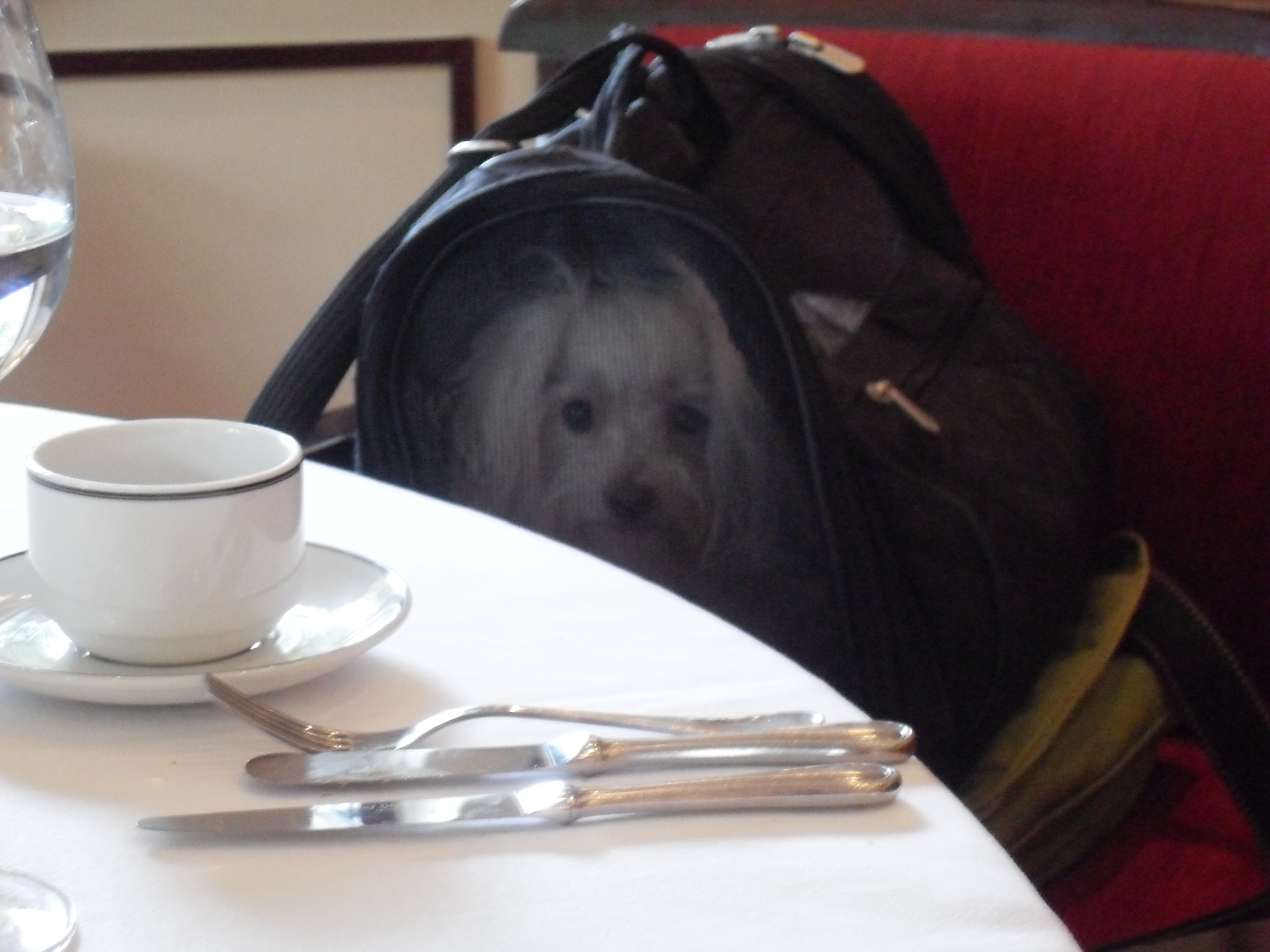
My seven pound “princess,” in fact, behaves badly anywhere other than her black, backpack carrier—
Very badly!
Lucy does not possess anything remotely resembling a sweet disposition. Her bark–loud, high-decibeled, and persistent–is her best weapon in an arsenal of ways to get what she wants.
But John Grogan, author of Marley & Me, insists that all dogs are great, and bad dogs–“the greatest of them all.”
And Lucy is indeed a great traveler—
Lucy is such a perfect companion on the road, that Sara and I have trotted the globe with her in tow—if for no other reason than she’s at her best, her most charming and well-behaved in planes, trains, and automobiles.
And on our world-wide odyssey to find canine obedience and tail-wagging good manners, our first stop with Lucy was Vietnam—a country Lucy traveled top to bottom, bottom to top.
Lucy behaved beautifully during our grueling 24 hour trans-global trip to Saigon. Honestly, I couldn’t have hoped for a better outcome.
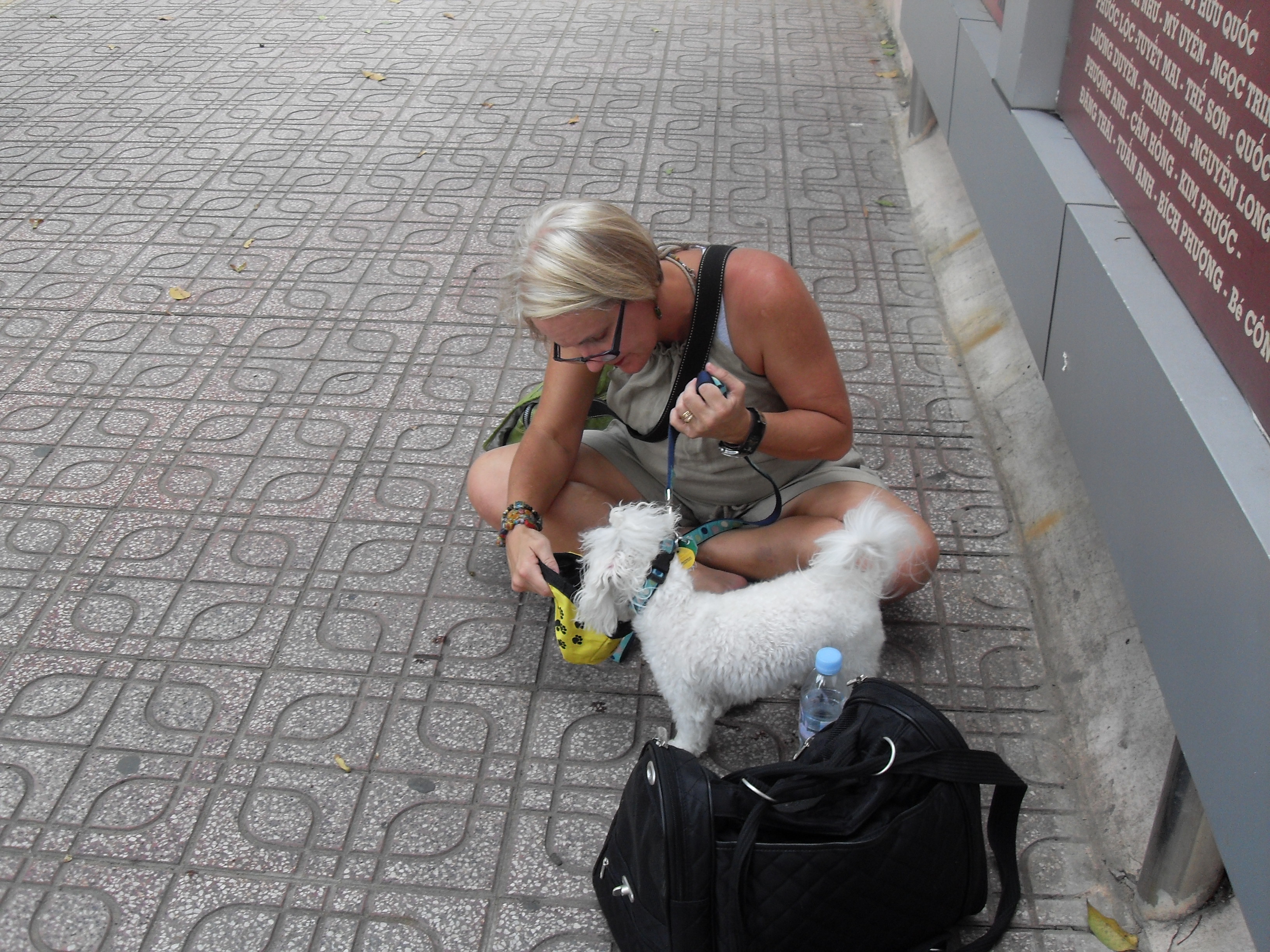
However, day-to-day living with Lucy in Vietnam proved more challenging, since, for the first several days, I couldn’t locate a blade of grass within a 10 block radius of our apartment. There was a park a 15 minute walk away, but it was so far that even getting there involved rehydration stops along the way:
And once we finally arrived, it turned out dogs were not allowed on the lawn. I kid you not!
One morning, a security a guard reprimanded me, “Not dog on grass! Not dog on grass!” When I showed him the pink poop bag with which I intended to pick up any excrement, pink poop bag I had brought purposefully all the way from the US—biodegradable and environmentally friendly—he seemed not the least impressed and repeated his demand with all the more irritation, “Not dog on grass! Not dog on grass!” But Lucy refused to pee or poop on pavement. What was an environmentally conscious, dog-toting-to-the-Far-East American to do?
What I did was find this lonely square of grass in front of the Indonesian Consulate:
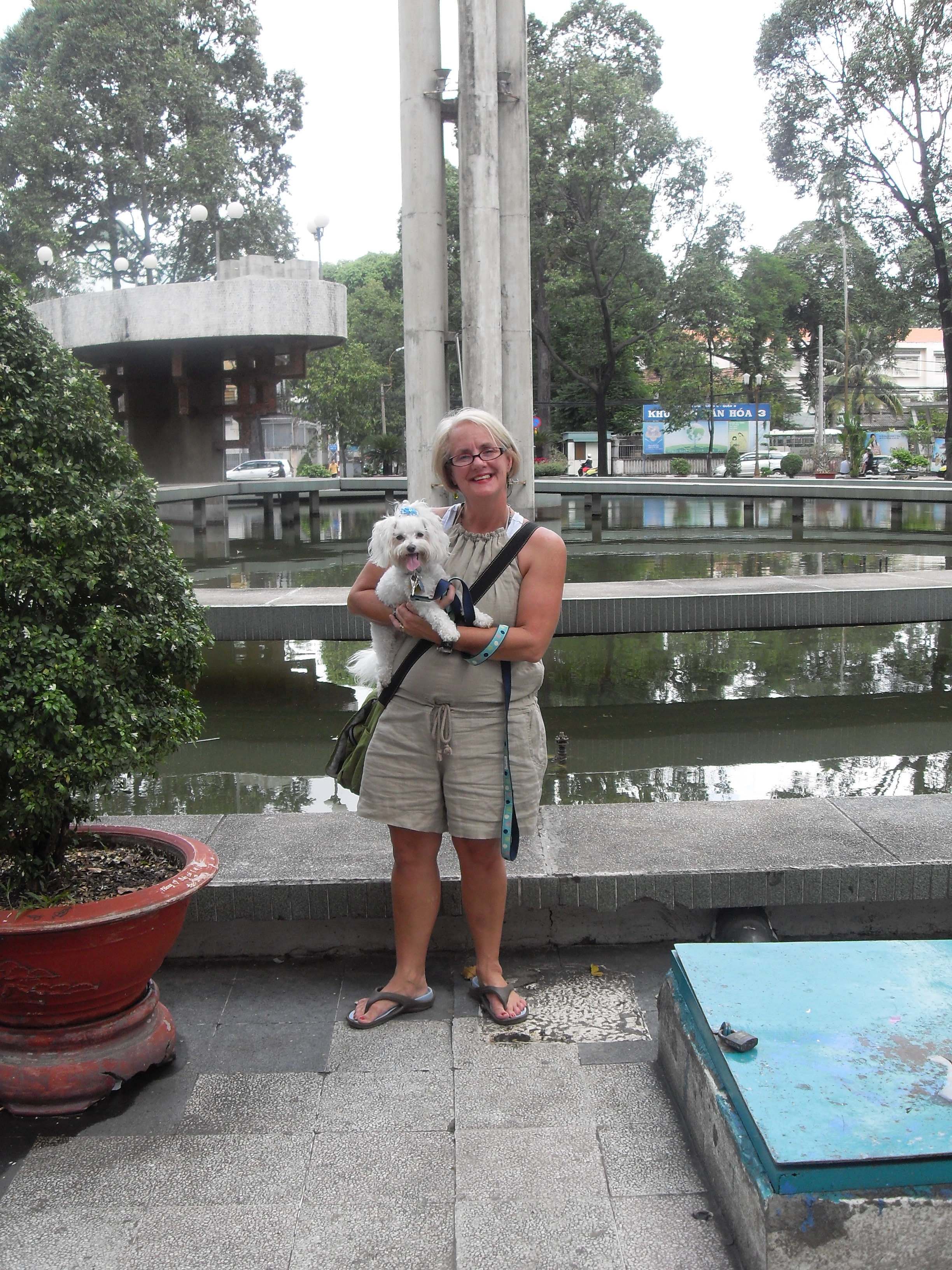
But once she adjusted to only a tiny turf, Lucy was off to places like the Reunification Palace:
She visited famous fountains:
She even participated in a student survey:
She insisted on praying at Notre-Dame Basilica:
Lucy traveled the 1,100 miles from Saigon to Hanoi by train—a nearly 30 hour trip:
She loved lounging in our compartment and mooching meals from Sara:
In Hanoi she visited the Temple of Literature by back pack:
She enjoyed Sunday brunch at the world-famous Metropole Hotel:
Lucy took us shopping in the Old Quarter:
There she bought the smallest conical hat in all of Southeast Asia:
Lucy continues to turn heads even now that we live in Haiti, but she still insists no well-mannered Maltese would do Vietnam without a millinery consultation.
Wall to wall
memory is platformed
into rows
Now asleep
Now awake
Now a place not namable
(asleep)
a jagged interlude
of spine
rock
tooth
decay
I am here, I remind myself
this bed
I am now
two faucets
one sink
I count
lose count
forget
Begin again
stripped
“Tell all the Truth but tell it slant—“
–Emily Dickinson
in the center where the people
should be is a red and white
checked cloth which covers the
dining room table where the
parent is working. the parent
has cut up the picture in order
to save space in the sticky
plastic-covered pages of the
family photograph album.
i want to write a poem about
this picture with a hole in the
center where the family should
be, but the parent says i should
write about something else.
perhaps then this is not a poem
about the picture. perhaps it’s
not the picture that’s important.
perhaps it’s the table.
think about the table.
My partner Sara and I are beginning to lose touch—
Lose touch with what it means to be an even remotely “normal” American couple. Some might say that’s not such a bad thing, but I promise you, we have gotten so far from the center of the bell curve, we can’t find the bell any more. We can’t even hear it ringing in the distance.
So–in light of this loss, today, I bring you the top 10 ways you too can be the most un-American of American couples:
#10. Station armed guards outside your house.
This is sure to eliminate any and all illusions of privacy.
(If you are new to the blog, my partner Sara and I live in Haiti where threats to security are common. Click here to read a post about this.)
#9. Argue frequently about how you will generate electricity.
Sara and I have been known to have some of our hottest arguments around just how long we can safely run our generator, especially on days when we have no or very little electricity from the city. I don’t like to be hot. Heat makes me irritable, bitchy, and stressed. So during the hottest nights here in Haiti, I’ve wanted to keep the air conditioning on, or at the very least, a fan running—neither of which are possible without electricity or our generator running.
(To read an entire post dedicated to Haiti’s infrastructure issues click here.)
#8. Do without television.
Instead watch DVDs of “30-Something” for evening entertainment. I knew things were getting bad when over the weekend Sara and I watched back to back episodes of the show’s first season and felt like we were enjoying a special treat, hovering around Sara’s laptop like kids in front of Saturday morning cartoons.
“Oh, boy!” we exclaimed elbowing one another. “Isn’t this great!” We would have broken out the popcorn, if we had a microwave to pop it in.
#7. Go to bed before dinner.
Not out of passion, but because you’ve become dreadfully boring and tire easily.
#6. Have no hot water in your kitchen sink.
Not to mention no dish-washer.
#5. Develop an active fear of kidnapping.
On average—there’s a kidnapping a day in Port-au-Prince—usually of foreigners, often of ex-pats working for NGOs on earthquake reconstruction. And in fact, a number of these kidnappings actually happen in Petion-ville, where we live, since most NGOs have set up their operations from this location.
Many ex-pats are kidnapped from their cars. To alleviate that risk we drive with seatbelts on, windows up, doors locked. It’s harder to be pulled from a vehicle that way.
#4. Stage incidents of international canine trafficking.
I know most folks don’t traipse the planet, canine companions in tow, but Sara and I, for whatever reason, see fit to move our mutts to whichever corner of the globe is hosting the latest in earth-shaking disasters.
For example, it was challenging to take a 40 pound, blonde terrier to Vietnam, where the meat of medium sized, light skinned canines is still considered a delicacy. And though it ended well, concluded with Ralph arriving uneaten in Hanoi, it proved so crazy-making along the way, we “sanely” decided to bring him here to Haiti this past summer.
However, that trip proved less eventful—except for his traveling companions on the flight from Miami to Port-au-Prince—the 10,000 chicks he still hasn’t stopped chirping about.
(For an entire post on pet-transport mishaps click here.)
#3. Appreciate the difference between “trash” and “stash.”
Sara has “placement issues”—a problem she blames on her training as an architect and which she insists I knew about prior to our partnering and simply can not change. Bottom line—Sara likes to arrange things: drawers, cupboards, closets, the contents of the refrigerator, mayonnaise, mustard, ketchup arranged in tidy rows—like items lined up together—like soldiers—an army of condiments ready for edible action. If an object doesn’t fall neatly into rank, the solution for Sara is simple—throw it in the trash.
I, on the other hand, tend to collect things—and not the kinds of things most would consider collectables, but which I gather in the name of “potential art”—items I prefer to call “collagables”—buttons, beads, ribbons, rocks, shells, business cards, bottle caps, maps, matchboxes, newspaper clippings, play bills, and, among other things, sales receipts—in my mind the most under-rated and readily available of all the collagables—a free gift with each purchase, so to speak.
Sara insists my stash is trash!
#2. Agree on only one thing.
That there are too many white people in America.
On one of our recent trips back to the US what stood out to both of us most, even though our home is in an ethically-mixed neighborhood, was the overwhelming huge number of Caucasian in the city where we live. At one point Sara turned to me in the grocery store produce isle and asked: “What do you notice about being home?” My response was immediate, “There are so many white people in America! I had forgotten.” It surprised us how quickly we both had become conditioned to what seems an appropriate ethnic mix. We had made a shift that we noticed only when coming “home.” If this can happen for us, it can happen for others. Come join us. Make the switch.
#1. Be denied the right to marry.
This one I think speaks for itself, but if not please watch this video:
Sara reminds me, that though we don’t have the right to marry in Kentucky, we at least now have an openly gay mayor in Lexington, so that’s a step in the right direction. (To read about Jim Gray click here.)
However, Sara also insists that, by far, the weirdest thing about us as couple is that I asked her to brainstorm with me about “what makes us weird as a couple.” I’m not exactly sure what’s so weird about that, but Sara says my not recognizing the strangeness of that request makes it even weirder. I don’t know. You be the judge.
At any rate, remember that “normal” is a difficult to define category. I appreciate that. But if you recall the 1960s television sitcom, “The Odd Couple,” you’ll see that I’m not talking so much about individual issues that separate us from the crowd. I’m looking at the entire constellation of individual quirks that combine to make a couple what most others would consider strange. I’m looking at the “Odd Couple” factor, if you will.
Felix Unger and Oscar Madison epitomized for a generation of Americans just what it meant to be uniquely coupled in the 1960s.
But If Felix and Oscar were the not-so-average pair of heterosexual bachelors in the 60s, I would argue that Sara and I are the same for this decade’s no-where-near-single lesbian couple—a uniqueness not related in the least to the reality of sexual preference.
In fact, Sara and I give whole new meaning to the notion of “odd couple”—sexual orientation not withstanding.
We may be weird–
But we do want to wed!
What sets you and your partner apart from the crowd? What makes a couple “weird” in the country you call home? Do gay and lesbian couple have the right to wed where you live?
Still struggling to create, still struggling over all. So, I’ll share another poem I wrote a while back. Thank God I have this stuff to pass along on off days. My apologies for this deviation from the normal fare. I hope this gives you another sense of who I am as a writer.











 Kathryn M. McCullough