What I wrote when I was sick——


I promised to begin looking at the years when I was most sick with bipolar disorder, the most symptomatic.  During part of that time, I attended a day treatment program for the chronically mentally ill and wrote the following poem about theat experience:

Day Treatment  (Poem #1)

It’s Monday and again
we sit in chairs, sprawled
against straight backs,
mid-morning group at day
treatment, talking about
black holes:
                fear of abandonment
                fear of non-being
the endless longing to return
plato’s parable about the cave
                the dark place
                the shadow
                the holy
                the horrible
                the hot coal
carried close to
each of us
so we are, all of us,
                always
                burning

What Does One Wear to Meet a Former Dictator? (Part 2)


(To read part 1 of this post click here.)

“Wear whatever you want,” Richard said.  “We’re just going to his [Jean-Claude Duvalier’s] house.”

Yeah, right!

Not only did I not know what I’d wear, I didn’t know that I could pull this off.

I had ironed two outfits, just in case, but ended up wearing a knee length plum skirt and sleeveless blouse just a shade lighter (one I had tailored when we were living in Vietnam).  I hung a striped silk scarf from India around my neck and carried a purple pouch purse from Bangkok over my shoulder—something small, but something  to hold what I assumed would be the essentials—a notebook, pen, and camera, one that refused to work properly when I tried to photographically document the event:
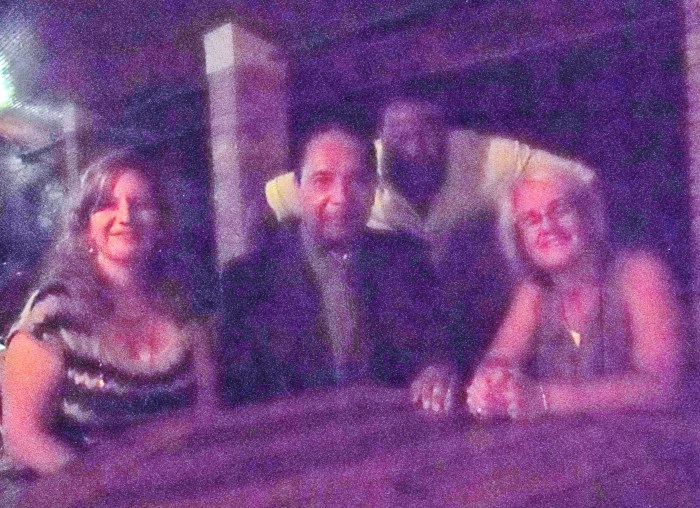
Kate, Jean-Claude Duvalier, Fito, and me

My friend Kate speculated with me, as we were driven up the winding mountain road.  What would we encounter once we arrived? Would we be searched? Kate removed a pocket knife from her purse and left it with the driver, just in case.  I had read that Baby Doc lived on Montagne Noir, but we were not headed in that direction.  Where were we going?

Along the way our Toyota SUV rendezvoused with our friend Richard and his friend Fito in a white pick-up truck for the final leg of the journey.  We passed the home of Rene Preval, current president of Haiti, and stopped just before Duvalier’s road, so Fito could call ahead to announce our imminent arrival.

Passing a rather grand-looking, well-lit house of the left, we continued down the street a bit, before turning around and circling back to that same stone house, now on our right.  This was it, we assumed, but there were a number of cars out front.  Was there a party in progress?

We were met at the gate and ushered in along the driveway, where two vehicles were parked, one an SUV, another a Haitian State Police pick-up truck, but no officer in sight.  As we approached the front door, we passed floor to ceiling windows that looked into the living room, where a number of people were gathered on two off-white couches that faced one another.  Duvalier’s Italian wife, Veronique Roy, cigarette in hand, answered the door when we knocked, welcomed us in, and escorted us out onto a covered patio to the left, where she offered us something to drink, and when we declined, promptly left.

We were seated at an octagonal, wooden table with white wrought iron chairs, when Baby Doc himself stepped out onto the patio, wearing a charcoal gray, double-breasted blazer over a cable knit, blue-gray sweater that zippered at the neck, seeming smaller, thinner, and more stiff-necked than I’d expected.

Once introductions were made and we were re-seated around the table, Richard did most of the talking and functioned as translator, explaining to Duvalier that I was intrigued by the former president and had hoped to meet him before leaving Port-au-Prince and moving back to the US on Monday.

Baby Doc, who spoke to us only in French, said that we all knew about the current political situation in Haiti, and that he didn’t want to talk about that. Instead he explained how happy he was to be back in Haiti, how saddened he was by the deplorable conditions his people were living in, and how surprised he was by the warm welcome he received, especially from young people who hadn’t even been alive when he was president.

I asked the former dictator what he thought the answer was for Haiti—how he thought the suffering could be alleviated.

Duvalier explained that there was not an easy answer, of course, but that “unity” was essential, unity between the rich and poor, between those who have much and those who have so little, that the government of Haiti needs to give the people what they want, and largely that involved not allowing them to live in such inhumane ways.

Clearly this was a vague and easy answer, a rhetoric few could disagree with, but I didn’t press the issue further.  I knew my question was overly broad and understood that his response would almost have to be equally sweeping in implication.  But I could feel myself being pulled in.  Baby Doc was feeding me what he knew I wanted to hear.  He and I both knew he was doing it, and I couldn’t help but respond to what seemed genuine care and concern in his tone, facial expressions, body language.  I could almost watch myself falling for this rhetoric, a seemingly circular logic, and I was reeling because of it.

I listened, still dizzied, and asked the former president what he thought made him unique, “Apart from your father having been president before you, when did you understand that you were unique in and of yourself, that you had something valuable to offer the country?”

Duvalier’s answer here surprised me, as he insisted that he was not “unique,” that he had come to the palace at age 6, that he had had a great education, that when his father told him at 18 he would eventually be president, he had said, “No thank you!”  He didn’t want to be president.  He didn’t want that job.

So Kate asked what he thought his biggest accomplishment was as president.  Baby Doc thought this was a good question, but said that, really, when you are president, you cannot have one accomplishment more significant than another, because everything you do is your job, your responsibility.  He went on to explain that he left the country in 1986 and went into exile willingly, to avoid bloodshed, that as he was leaving, he was more concerned about his people than he was about himself.

At this point, Richard turned to me and asked, “Don’t you have another question, you came here hoping to ask?”

“Yes,” I said looking intently at Duvalier across the table.  “A number of people have told me things were more stable in Haiti, when you were president, and things are decidedly unstable now.  I read in the media, that you have returned to Haiti not wanting to be president again, but if things were indeed more stable under your administration, why would you not want to be president again?  Don’t you think you would have something valuable to offer your people?”

To this Duvalier said simply and matter-of-factly, “We’ll have to see what the people want.”

And, what will the Haitian people want?

Another exiled former president, Jean-Betrand Aristide, is scheduled to return to Haiti today, the head of one Haitian political party, the OPL, was assassinated in his home yesterday, and the final round of presidential elections is set for Sunday?

So maybe, Richard was right. Maybe it didn’t matter at all what I wore that night.

Maybe all that matters is what the Haitian people want, what they hope, what they dream.

Will Haiti wear the cloak of democracy?

“We’ll have to see what the people want”—indeed!

(To read the third and final post on this interview, click here.)

What Does One Wear to Meet a Former Dictator?


Up until the last minute I didn’t believe it would happen. Even as we were on our way to Jean-Claude Duvalier’s home in the hills outside Port-au-Prince, my friend Kate (my ally in this effort) and I didn’t know what to expect or where we would rendezvous with Richard, who claimed to be Duvalier’s friend and had set up the “interview.”  The road was dark, as we wound our way up the mountain to encounter God only knew what.

It all started soon after Baby Doc’s unexpected return to Haiti in January.  I had asked Richard, who, in fact, directs the security operation in Haiti for Sara’s NGO, if I could go to the Karibe Hotel in Petion-ville, where Duvalier was staying, as we had to clear any out-of-the-ordinary outing with Richard’s team.  Security in Haiti is that precarious and risk-management is essential to the functioning of the NGO in potentially unsafe situations.   I wanted to attend a press conference Baby Doc was supposed to hold there on his second day back in the country.  Inevitably the event was delayed for a number of days first because the Karibe indicated it could not manage the number of press expected to attend and then by the eventual arrest of Duvalier on his third day back.

When I made the request, Richard, whose father had been a Haitian ambassador to France during the Duvalier era, surprised me, asking if I, in fact, wanted to meet Baby Doc.  At the time, I knew Richard’s father had been a diplomat, but I didn’t know when or for whom, and though I said I certainly I’d like to meet the man, I never expected it could or would happen.  Ultimately circumstances prevented me from attending the press conference which was held after the ex-dictator left the Karibe and was staying in a guest house on Montagne Noir.

I never again mentioned meeting Baby Doc to Richard, as, first, I had no real ambition of meeting a man who had allegedly committed crimes against humanity and, second, I knew Katie Couric herself would have loved to interview the former president.  I never expected it could be arranged for an unknown writer from Kentucky like me.

That is until this past Wednesday evening, when Richard approached me at my partner Sara’s going away party.  (We moved home to the US on Monday after a year in Haiti, where Sara directed the initial phase of an international NGO’s relief effort.)

“Would you still like to meet Baby Doc?” Richard asked at the barbeque, as I sat by the pool, minding my own business, admiring the setting’s breath-taking view of Port-au-Prince:

“Of course,” I stuttered, surprised by the question, imagining Richard was just making friendly conversation and couldn’t really make that happen.

“Then I’ll arrange it,” he asserted, turning to answer his phone.

He walked away.

And I laughed to Sara who was standing nearby, “Do you really think he can make that happen?”

“I don’t know, but I certainly don’t want to go,” she insisted.

She asserted the same, when Richard called the next day to announce the meeting had been arranged, “They’re expecting us Saturday evening.”

“Good God,” I said, having won the “Stylish Blogger” award, “What does one wear to meet a former dictator?”

(continued here)

Variations on Giving: a Friend’s Reflection on Lent


Disclaimer:   

Please know I do not allow Mindy to publish what she does below with any sense of comfort. In fact, I do so with fear and trembling, not wanting anyone to think, for a minute, that I believe the life Sara and I lead deserves Lenten comparison.   

Sara and I have chosen our path purposefully, but it, in fact, gives to us more that we give to others.  The sacrifice is reciprocal and then some, making our lives meaningful, challenging, sometimes even fun. 

 Please know the words below are those of a friend, a friend who has loved us for many years and may speak with a bit of bias—but a bias based in love.  As such, I am humbled and try to accept the gift with grace—acknowledging that though it may be too much, it’s a gift given from the heart.

 And the gift of love, the gift of grace, after all, is what the Lenten/Easter season is all about.  God only asks for our hearts and gives us grace in return.

 So thank you, my dear friend.  Thank you!

Dear Readers:
  
Kathy has taken the day off. 
  
While she finishes a myriad of tasks related to her move home to Kentucky, she let me talk her into publishing the following post I wrote about her and Sara.
 
This week Kathy is looking back and reevaluating the experience she and Sara have had in Haiti.  I hope this post will help them see how brave they’ve been.
  
I know I speak for many who have come to respect and admire these good people.  And though I speak about them in the context of Christianity, I believe good works are apparent in and of themselves, regardless of religion, creed or belief.
  
Kindest regards,
Mindy
 
_______________________________________________________________
 

As I reflect on Sara and Kathy and the lives they lead, I am reminded of the story in the Bible about the widow’s mite. “She gave extravagantly what she couldn’t afford…she gave her all.” (Luke 21-4)

 The Jews had been instructed to give to the Temple and to the poor as part of their service to God. One day Jesus sat at the Temple and watched people putting money into the offering boxes. Some were rich and gave lots of money. Some gave money, but were unhappy about it. Then a poor woman, a widow, came up to the boxes.

The poor woman put two small coins in the offering box. The disciples with Jesus weren’t very impressed, but Jesus said this woman had given more than any other that day. How could that be? Jesus said it was because it was all she had.

 I reflect on the selflessness of my friends because they inspire me on this first day of Lent to “give my all.”

 I’m Episcopalian and have always observed Lent by giving up something for the 40 days or so that lead up to Easter and the celebration of the risen Lord. When I was a child, I was instructed not to give up something I disliked, like spinach, but to give up something I loved, like chocolate.

 The physical act of fasting is meant to remind us to allow the Spirit of God to reshape the way we think, act and live. I know this as an adult. As a child, it was just something we were expected to do.

 It was a practice that was meant to become a habit and, then, a life lesson.

 The apostle Paul explained the lesson very neatly in his letter to the Philippians:

Think of yourselves the way Christ Jesus thought of himself. He had equal status with God but didn’t think so much of himself that he had to cling to the advantages of that status no matter what.  Not at all. When the time came, he set aside the privileges of deity and took on the status of a slave, became human! Having become human, he stayed human.  It was an incredibly humbling process. He didn’t claim special privileges.  Instead, he lived a selfless, obedient life and then died a selfless, obedient death – and the worst kind of death at that – a crucifixion. (Philippians 2:5-8 – The Message)

 This is how Sara and Kathy live. They go from disaster to disaster, at great expense – professionally, emotionally, physically, psychologically – giving extravagantly what they can’t afford…giving their all.

 Now, I want Kathy to run this blog post and if she does, you must know that it’s because I’ve asked her to do it on my behalf. 

 Because I thank her and Sara for reminding me, in this season of Lent, to allow the Spirit of God to reshape the way I think, act and live not only by giving up something I love, but by giving my all.

Moving as Meditation (and Other Pre-Lenten Events)


As Sara and I prepare to move back to the US next week,  leaving behind in Haiti a year’s worth of work, challenge, periodic victory and sometimes defeat, it’s a time for me to reflect, reminisce, think about where I’ve been over the past year, in an effort to figure out where I am going in the one to come.

In the reflective spirit of Lent* (which begins tomorrow), I thought that over the next week I’d revisit some of my earliest posts to the blog, remembering the lessons learned, even the questions left unanswered.

So–since I’m busy packing up one life and moving into another, and since, at the blog’s beginning, most of you weren’t reading yet, I’ll resurrect the first post below and give you a glimpse of how it all got started 4 months ago:

So–the old blog is reincarnated here under a new name!  It is, indeed, the Vietnam version “reinvented” from yet another edgy location–this time Haiti, where a cholera epidemic has spread to Port-au-Prince–my home for the next couple of years.

But before I address the big issues faced here on the western half of Hispaniola, I should clarify why I’ve chosen this new title.  For my less geeky readers, an “event horizon” is the edge of a black hole, a boundary in the space/time continuum beyond which no light can escape—in many ways, a point of no return.  You’ve taken physics; you know this; you’ve just forgotten.

Bottom line–it seems to me, that the far-away places Sara and I have been over the last couple of years have formed a kind of “event horizon” in my mind–taking me to the outer limits of my own comfort zone, shaping new perspectives in me about both the world around me and about this time in my life–a bending of my personal space/time continuum, if you will—–mind-bending for me, at the very least.

However, Haiti itself offers a kind of event horizon–a comparison I first found when reading Paul Farmer’s book “The Uses of Haiti.”  Farmer begins his chapter of the same name with the following epigraph by T. D. Allman:

Haiti is not simply one more of those tropical dictatorships where to rule is to steal, and headless bodies are found by the road.  Haiti contorts time:  It convolutes reason if you are lucky–and obliterates it if you are not.  Haiti is to this hemisphere what black holes are to outer space.  Venture there and you cross an event horizon. (After Baby Doc, 1989)

Wrap you brain around that statement and you may begin to see why I’ve renamed the blog–because this place, this  location has forced me to rethink my beliefs, not only about myself, but also about big issues such as poverty and hunger–and disease, for god sake!  We’re in the midst of a cholera epidemic!  

But even without cholera sickening folks by the thousands, we had an earthquake here last January, a hurricane last week, and a million and a half people homeless in Port-au-Prince today. 

Was the earthquake an event horizon for Port-au-Prince?  Will cholera bend time and space so there’s no escaping the dis-ease that’s plagued this place for centuries? 

Is there light for Haiti?

Now, fast-forward 4 months. 

Do you think the blog is fulfilling its mission so far?

And, even more importantly, if you have one, what task does your blog accomplish?  What is its purpose?  Tell us about it in the comments and leave a link.  You might attract some new readers!

And don’t forget that tomorrow we’ll have our “Mid-Week Mindy,” tomorrow a reflection on Lent*.  Mindy will be covering for me, answering questions, responding to comments.

* On the Christian calendar, tomrrow, Ash Wednesday, begins the season of Lent, 40 days of reflecting and fasting, leading up to Easter Sunday.  For a beautiful mediation on the meaning  of Lent, check out this post by my friend Jane over at PlaneJaner’s Journey.