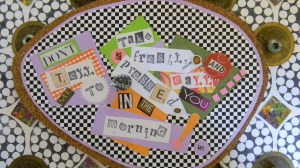
This Title Sucks!


Let’s face it, folks, readers crave surprise. 

They like titles they don’t expect or know how to interpret. 

They like titles about food, fat, failure, or frustration with any of the above.

I noticed this with my own blog.  For example, the other day I posted a piece called “It’s Official.  I’m Fat” and had a massive increase in traffic, received a total of 369 page hits, when generally I average way, way less than that.

Coincidence, you say.

Perhaps, but I think the bottom line is this:  successful blogging depends in some significant way on inventive titles, titles that push the envelope.

image via betterbooktitles.com

If you give readers a title they totally hadn’t anticipated or a title that says something they have always thought but never dared say—at least not in public—and certainly not online, where every Tom, Dick, and no-name blogger like me can read it—audiences go weirdly wild.

They love daring, and they love it even more if you do daring well.

I’ve decided though the readers aren’t attracted to outrage for the sake of outrage.  They like outrage with a message.  And they like a message that is so fundamentally real, so bottom-line authentic, they always knew it to be true on some intuitive level but had never quite conceptualized it as you have.

In other words, audiences like to be surprised, but surprised by a reality they recognize, by their own very real truth, an “aha” that’s personal.

I think I broke my logic bone” was Freshly Pressed last week, I suspect, because its fun and quirky title attracted editorial attention and audience approval.  You can decide for yourself whether or not you think the post itself was as successful as the title, but the title was, I’m convinced, brilliant.

Whether we like it or not or want to admit it, readers love crazy.  They love drama.  They love posts that are the cyberspace equivalent of train-wrecks.  They hate authorial hypocrisy but love posts about hypocrisy itself. 

They love stories about ridiculous things happening to prissy people—the germaphobe whose toilet overflows, the preacher who’s having an affair, the politician caught stuffing the ballot box.

Let’s face it, we love it when Donald Trump makes an ass out of himself.

So, if you want readers to “like” your link, if you want audiences to take the next step and scan the first sentence, pull them in clicking and screaming with a title they can’t refuse—some wicked words that drive them wild with curiosity and a major amount of mouse madness.

What to-die-for titles have you read recently?

Death by Dinner Party


It all started with the rain—

–When we had planned to party on the lawn. 

My partner Sara had been planting and pruning, purposefully piddling in the garden for months.  I had joined in on weekends away from blogging, before participating in full-time party prep last Thursday.

I had cleaned our huge home from almost-top to almost-bottom, omitting only attic and basement from my frenzied scrubbing.

Sara had been reading recipes and planning menus, everything from growing herbs to grocery shopping.

We were exhausted but nearly ready, when we woke up Sunday morning to rain—lots of rain—rivers of rain.  We prepared to launch the ark but decided we’d be better off praying for it to stop and proactively setting up inside instead.  (I exaggerate here only a little.)

Sara continued to cook, while I went into frantic but festive over-drive—rearranging and setting up the indoor option—keeping the outdoor one in place, just in case God decided a ceasefire was in order and our pummeling from heaven should come to a quick and less-wet, happy ending.

Once I’d gotten the inside done, the heavens parted, the rain stopped, and we were whiplashed into outdoor mode once more.

To make a long story more mercifully short, the party proved amazing; the blog has been ignored—our outside party on the lawn a huge success.

But I woke up this morning post-less and sick as my Maltese when Mommy’s gone.  (And I don’t even drink.)

So the blog and all my blogging buddies have been sacrificed to party success and ensuing partied-sickness.

But I promise to get back on track tomorrow—a real mental illness post in my bloodied blogger’s fist or housing piece complete and ready for prime time.

In the meantime—please forgive my break from blogging.

Death by dinner party is more than it’s cracked up to be, and I don’t even have the pictures to prove it.

See you in a less-partied, more stomach-settled day or so . . .


“Writing” a Stereotype Wrong


I understand where the stereotypes come from, the ones that say government-subsidized housing is the black hole of shelter options, that filling out an application at the local housing authority is an event horizon beyond which one will never emerge regular renter, let alone home owner.

Yet, the problem with this stereotype, as with most others, is that they’re wrong—impressions formed in ignorance about issues most of us would rather ignore.  And frankly—it was an impression I shared—that is until poverty and illness forced me into this option, a worst case scenario I’d been determined to avoid at any and all conceivable costs.

I’ve shared in a previous post the benefit of friendship I found via the housing authority in Dallas.  However, the gifts I gained through government housing here in Kentucky were even more significant and life-changing.

The apartment complex I moved to in September of 2001 was  designated Section 8, a kind of subsidized housing that shelters more than welfare moms.  Some section 8 only accepts residents who are elderly or disabled.  Briarwood Apartments in Lexington is one of these.

Briarwood boasts 4 white brick buildings, three stories a piece.  Each has 51 one-bedroom apartments, its own library, laundry room, and lobby—as well as a community room where folks can socialize—a space residents can reserve for free, if they hope to host a family reunion or some other non-profit-making activity.  I use the word “library” loosely, as these were actually called “craft rooms.”  However, I never saw a single craft done in these spaces, and there were way more games and puzzles than books.  Still the craft room/library was a quiet, air-conditioned place to read Harry Potter or Sylvia Plath on hot and humid summer afternoons.

But what matters most about Briarwood is that it became a kind of haven for me, a place from which I emerged 4 years later nearly whole and healthy.

Kathy's Briarwood apartment, art table in foreground

I use the word “haven” here purposefully, as that’s exactly what the place was for me—one that sheltered and nurtured—a place I still think of fondly—one I would recommend to anyone needing an affordable and safe place to live, especially during difficult times.

It may have helped that I like old people—anyone aging who even remotely reminds me of my maternal grandmother—but then nobody ever really dislikes senior citizens, do they?  I mean, there aren’t exactly a lot of knife-wielding geriatrics wrecking havoc at local nursing homes. 

What I’m trying to say is that this was an easy group to get along with.  No crime, no noise—not even any walker or wheelchair races in the hallways.  If anything it was too quiet—a place where the biggest event of the day was the arrival of the mail carrier, who was greeted 6 mornings a week like a cancer-conquering hero—the bearer of tidings from the outside world.  Clearly, this was not a demographic that emailed much or got their news, medical or otherwise, via smart phone—not a tweeting, googling kind of group, for the most part. 

Kathy, Briarwood community room, building A, 2005

At any rate, I hope you’ll  tune in over the next several weeks, when, among other things, I’ll share some highlights about my years at Briarwood, introduce you to some residents who changed my life for the better, and maybe even dispel some housing myths, some misunderstandings folks naturally have about a kind of home they only see stereotyped on TV.

The elderly and disabled may not consistently rock the world of social media, but, this little-blogged-about demographic deserves our attention,  our willingness to share their stunning stories of wisdom, endurance, and daring.

Only then can we “write” a stereotype wrong.


When One Boomer’s Madness Morphs into Dream-Come-True


In 2011, it’s hard to know which is weirder—watching myself on videotape narrating my psychiatric struggle in 1997 or knowing now how inherently different my life is 14 years later.

Though ’97 was difficult, I generally had to fight hard for more than 10 years following my diagnosis with bipolar disorder in 1990, a decade of pain and endurance, as I struggled with every ounce of energy available, battled a diagnosis that doomed me to countless psychiatric hospitalizations and chronic poverty.  I lived without a car and in 1997 on $736 a month.

Things were particularly bleak during the winter and spring of 1997, when I was hospitalized twice and struggled to complete even the most basic tasks of daily living—getting myself to and from treatment, feeding myself regular meals, taking medications as prescribed.  I spent 5 hours a day on Dallas city buses, struggled to purchase groceries on $30 a week, and suffered so with memory loss, I couldn’t remember whether or not I’d taken the Zyprexa (an anti-psychotic drug) that dulled my thinking and left me listless, not to mention sleepy and ravenously hungry.

But yesterday, in the context of a memoir-writing project, I watched video-taped therapy sessions from 1997, a number of them, at least 6 hours worth.

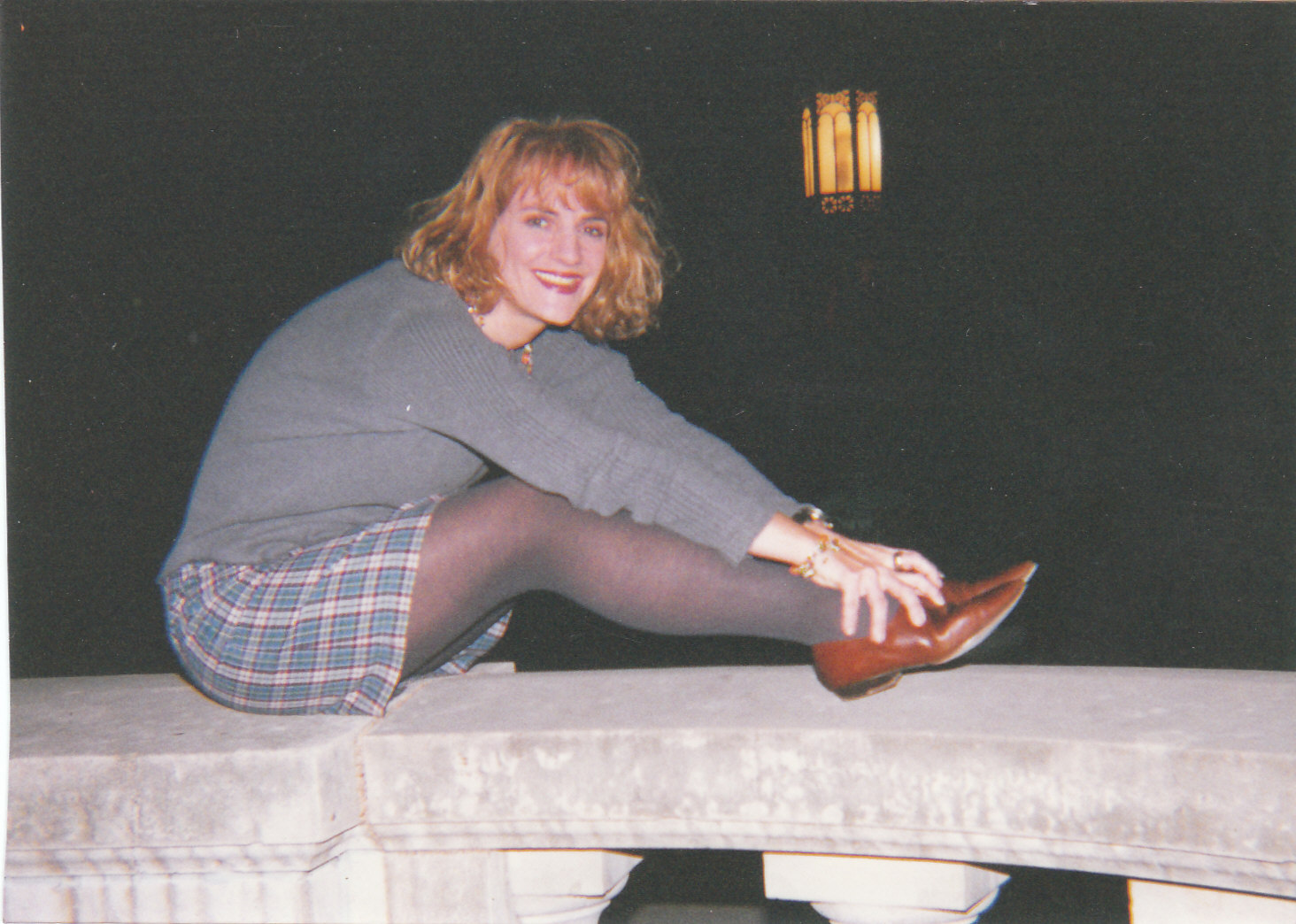
I noted especially that on March 6, 1997, wearing red sweat pants and my hair in a loose bun, I congratulated my therapist on the occasion of her 49th birthday.  I was 35 years old but looked at least 10 years younger than that—thin and toned as I pretzeled myself into a corner of black leather sofa.

what I looked like in 1997

But what I remember about that time, recall without having to watch a video, is the belief that my therapist was rather old—unimaginably older that I could ever imagine myself becoming.

Yet now, in 2011, I am myself 49.  I am the “old” I couldn’t imagine myself becoming.  And this is a hugely strange experience— sitting in a home I own, with my graying hair and gained weight—watching a much younger version of myself, wishing a woman I so respected happy birthday, knowing I was thinking, “Gosh, she’s almost 50.  I can’t imagine being that old.”

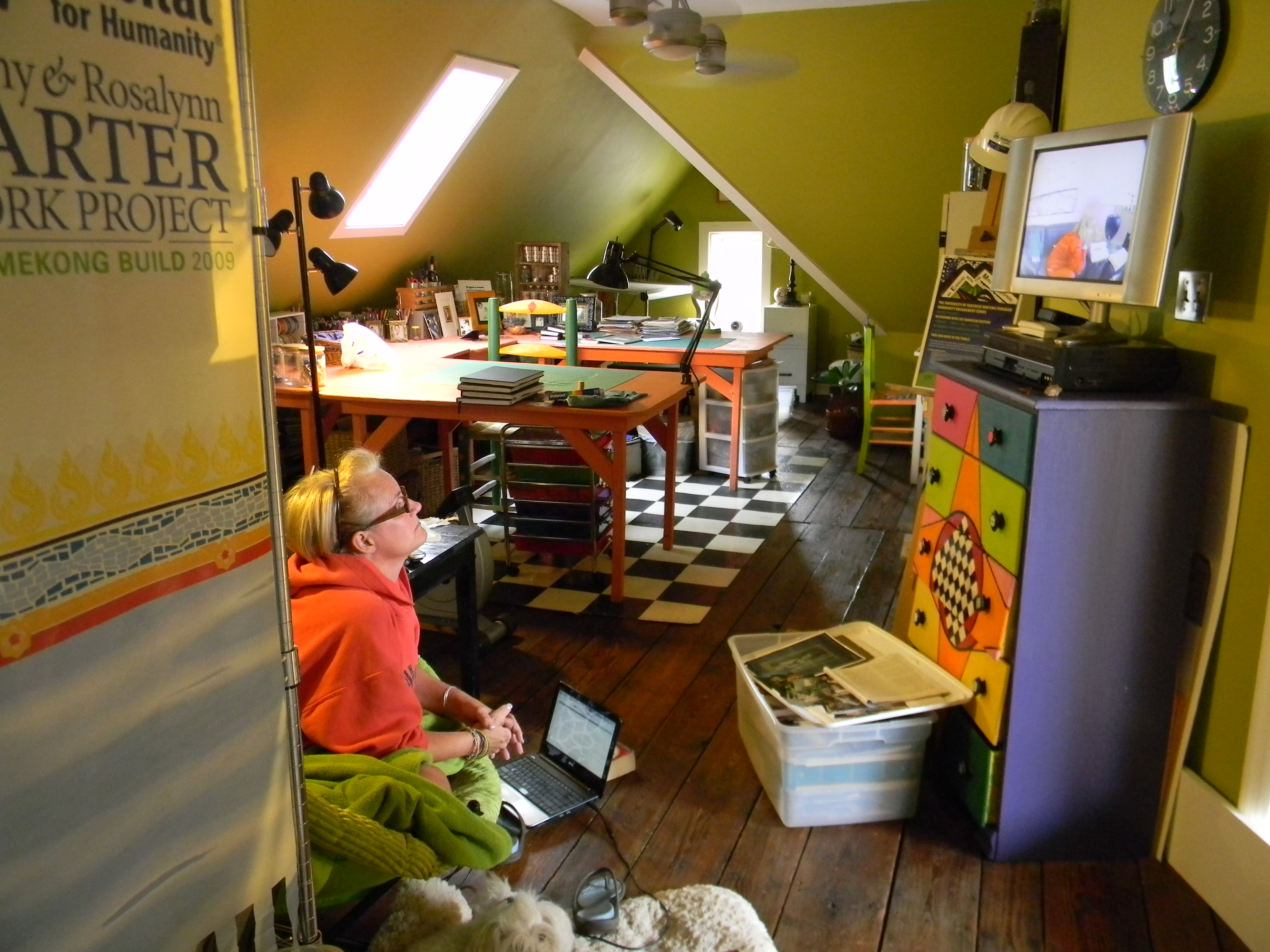
watching videos of myself 14 years later

Not only am I watching myself 14 years ago—seemingly endless hours of myself frozen in time—but also I’m thinking about who I am myself now at this ripe old age—how different I look—how inherently reversed my circumstances are—how much better, richer, fuller my life is—how my experience is now what I only hoped it could be then, what I only dreamed it could be, but never expected it could become.

Clichéd as it sounds—I am now literally living a dream come true—a dream I articulated to my therapist in 1997—a dream about teaching at a university again, a dream about writing—a dream about succeeding—a dream about love.

I don’t know how it happened.  I don’t know how or why I became ill, why my mind deteriorated to the point it could no longer be trusted, how it is that now I am well—at least in relative terms—my symptoms well-managed. 

In 1997 Bill Clinton was just beginning his second term as president; scientists were cloning Dolly the sheep; and in the US we would soon have a balanced budget.  Though Princess Diana and Mother Teresa died, it was a time of hope—a time of new beginnings and relative prosperity.

However, my memory at the time was so poor, my connection to the larger world so tenuous, I recall little of this.  I know most of this from my more recent efforts to go back and fill in the blankness my brain experienced as real life.

Now, as I watch these videos, as I reflect on how I felt 14 years ago, on how it feels now to not remember, I’m amazed that I have come this far.  That I no longer fear homelessness, that I no longer live in government housing, that I now own a home, function well, love an amazingly accomplished woman who loves me even more. 

How did I survive more than a decade of seeming defeat?  How is it that I’ve recovered to this degree?  How did this come to be, this tale of endurance, my narrative of hope?  How is it that this stunning grace has happened?

I hope my memoir can help me share this amazing magic—let others know that what sometimes seems an illusion of recovery can indeed become a solid and shared reality—a Boomer’s madness morphed into dream-come-true.

The Wacky Winter of ’97


I was hospitalized in the winter of 1997.  And from what I can tell about that
time—reading journals, watching video-taped therapy sessions, looking at art—I was unequivocally crazy, insane in every conceivable sense of the word.  Not that I wasn’t exactly that during other hospital stays.  However, during February and March of ’97, my insanity was off the charts.

I’m still trying to understand what happened—still trying to assemble some sense of where I went wrong, what set me off.  And to be honest, I’m not sure I understand any more now than I did before.  I was so insane, none of what I wrote helps me recreate what happened.

I do, however, notice at least two themes I’ve alluded to before—namely my fear of homelessness and my sense that the hospital was home.

I guess this takes me back to the mental health housing series I began a month or so ago but never finished.  The first post in that sequence explores my belief that the hospital was where I belonged, where I felt safe, especially during an inpatient stay during the spring of 1990.  However, that feeling returned during the times I’ve been most ill in subsequent years, as well.  And the winter of 1997 was no exception.

For example, at 8:30 pm on February 2, 1997, three days after being admitted, I wrote:

I want to stay in the hospital for a very long time.  I want this to be my
home . . . .  I’d just prefer to stay here.

I went on to explain that I knew this desire was crazy in and of itself—that it was not normal, nowhere near normal, to want to be locked up in a psychiatric facility.

However, this refrain repeats itself often during the course of my illness—regularly and without fail.  I remember thinking this from time to time, but I hadn’t realized how often I expressed that desire overtly  in the journals I kept.

It’s clear the illness terrified me.  I knew I was sick.  I desperately wanted help and apparently knew on some level that the hospital could keep me safe—not so much from suicide (as I was not often actively suicidal at that time) but from a profound inability to function and  take care of myself.

I’m not sure what precipitated this collapse, though just before this admission, I was obsessed with a fear of homelessness again—seemingly because my social security disability benefits were being reviewed, I feared losing them, and knew I was not able to function well enough to work.  It’s hard to imagine how that fear impacted me, whether that’s what triggered this dizzying psychosis.

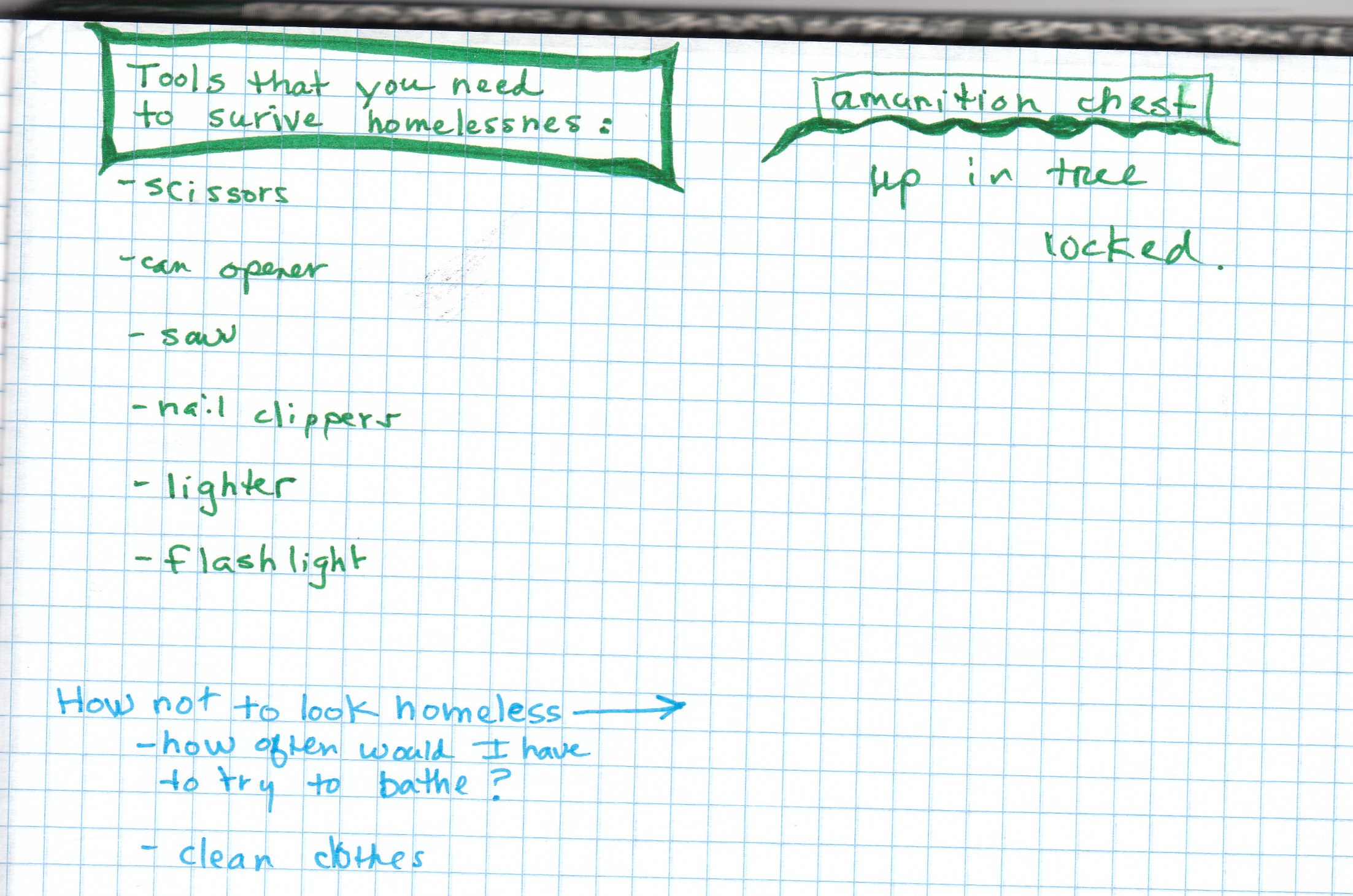
However, just two weeks before being admitted and around the time I began to unravel, I made this list—a seeming attempt to survive should I lose my little apartment in east Dallas:
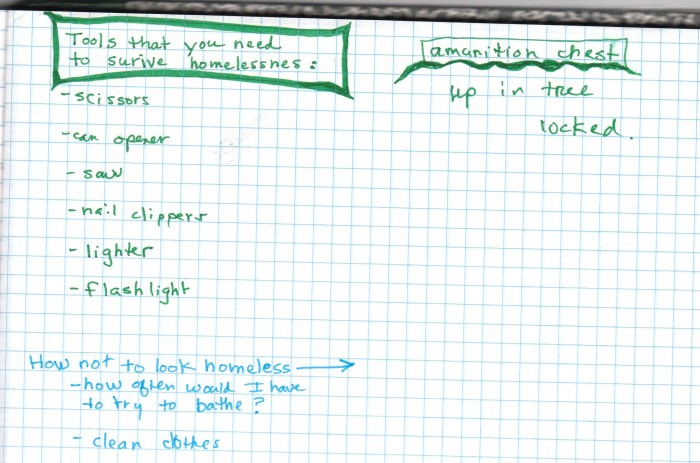
As I review the video-taped therapy sessions, I realize that my therapist repeatedly encouraged me to share my financial struggle with my family—something I refused to do, insisting that the very real possibility that my only remaining parent would respond with indifference to my dilemma, was too
terrifying a risk to take—that my psyche would not be able to tolerate that
degree of rejection, especially since, when I one time needed help purchasing
medication, I had, in fact, met with unwillingness.

So, I don’t know now if that was an accurate perception on my part.  I’d like to think I was wrong.

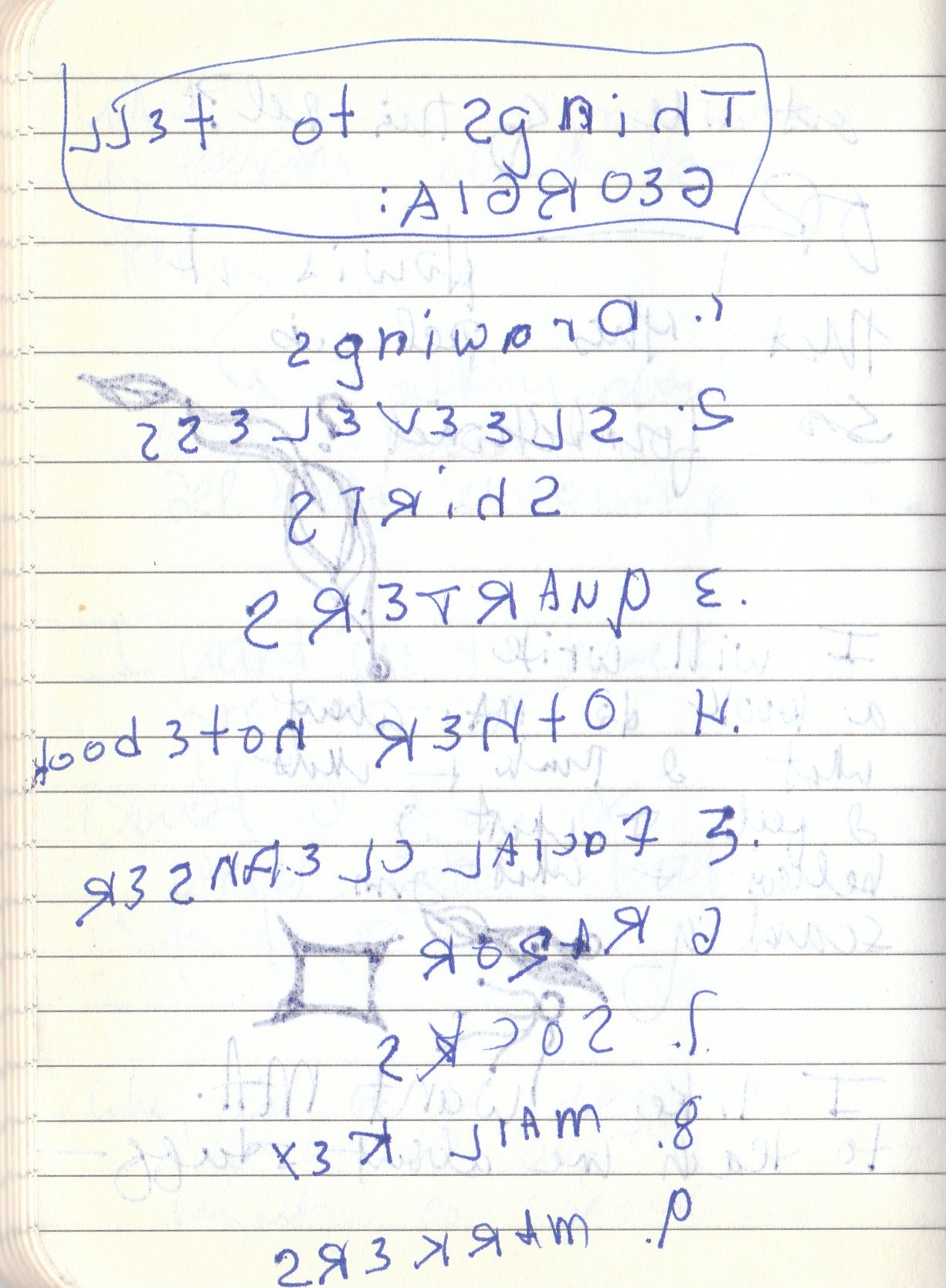
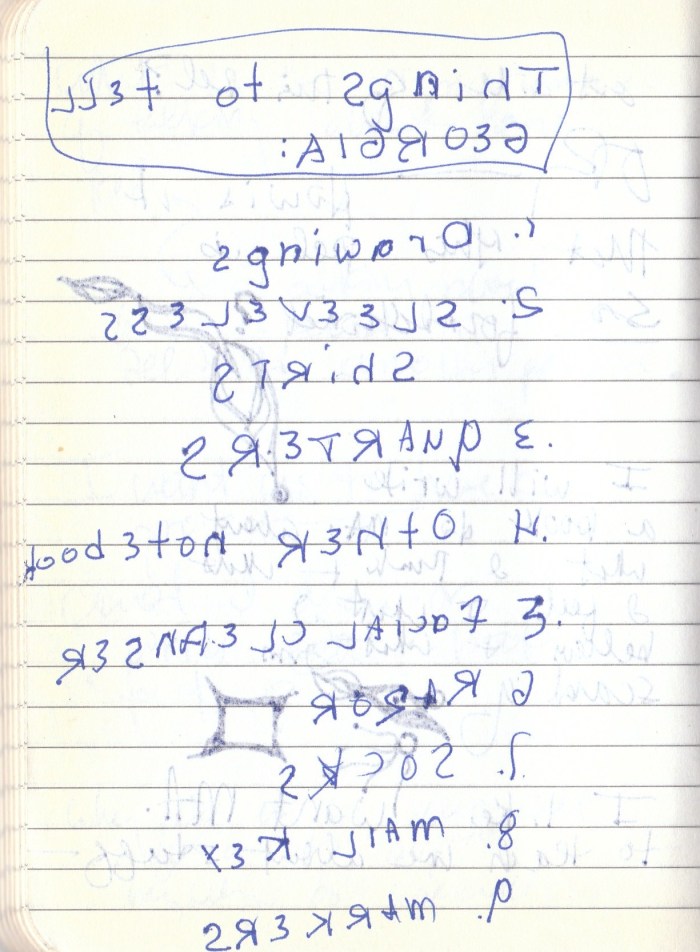
However, during this same hospitalization I also did a decent amount of what I think is called mirror writing–writing words backwards and forming letters in reverse.

In one instance, I was cognizant enough to make a list of things to tell my friend Georgia–to create a list of items I wanted her to bring me, but crazy enough to compose the whole thing in reversed writing:
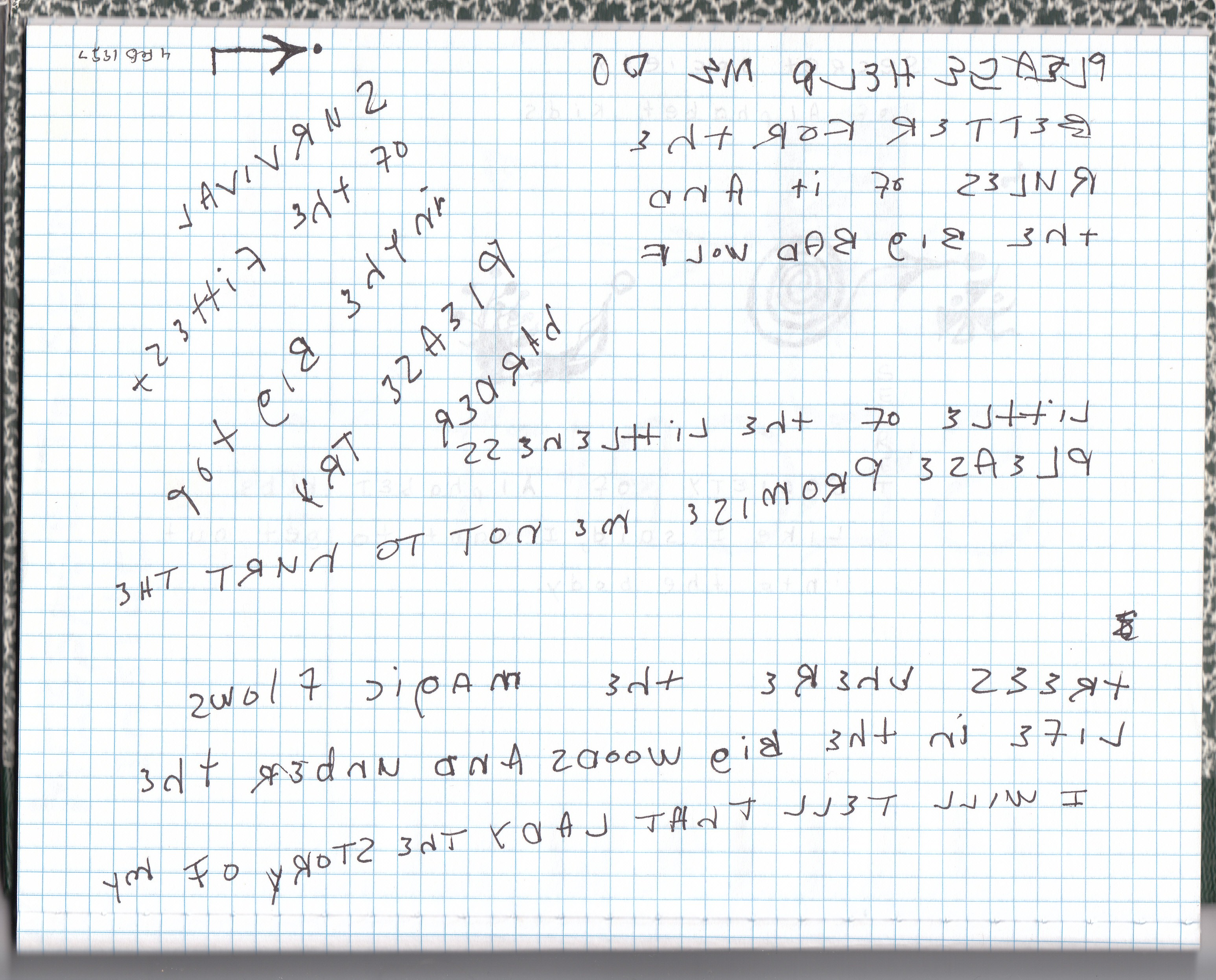
In other instances I would begin sentences in the bottom, right-hand corner of the page–writing from right to left, bottom to top, as I did in the ramble about “woods” and “wolves” below:
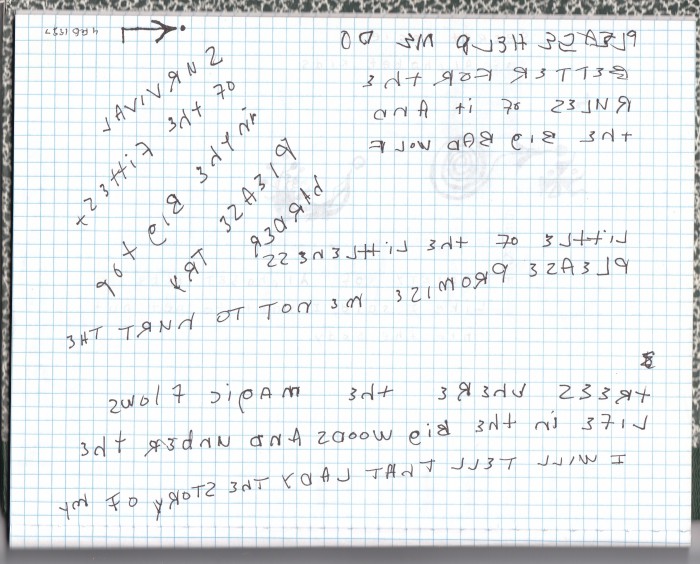
The three lines at the bottom read:

I will tell that lady the story of my life in the big woods and under the trees where the magic flows.

I truly have no idea why I suddenly began writing in reverse, if perhaps it was paranoia that motivated me–fear that someone might read what I wrote.  I’m baffled by this and have not found any explanations in the literature as to why I might have suddenly done this.  I do know that Leonardo da Vinci wrote all of his personal journals in reverse and that left-handed people are more able to do this than are the right-handed.  I don’t understand brain chemistry well enough to offer a reasonable explanation, and don’t know if something neurological might have been happening.  However, the most obvious explanation remains paranoia, I assume.

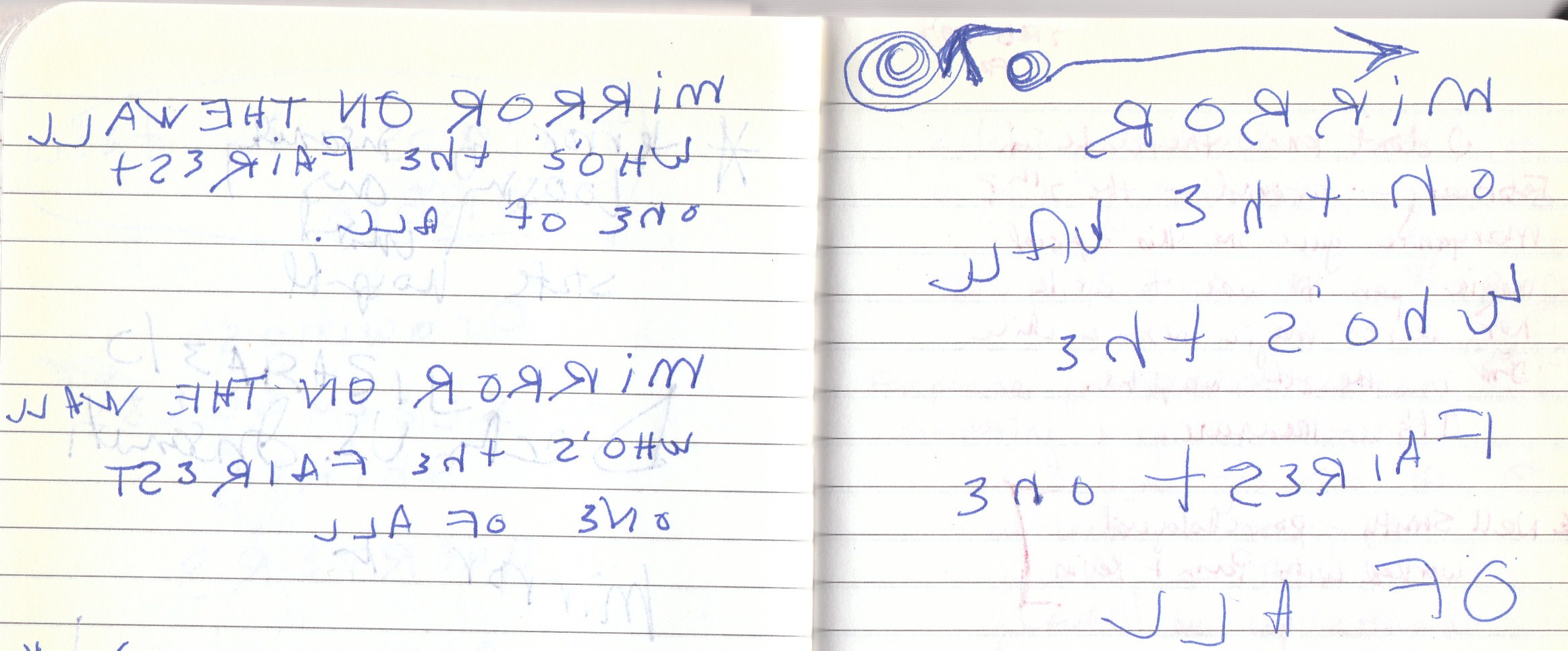
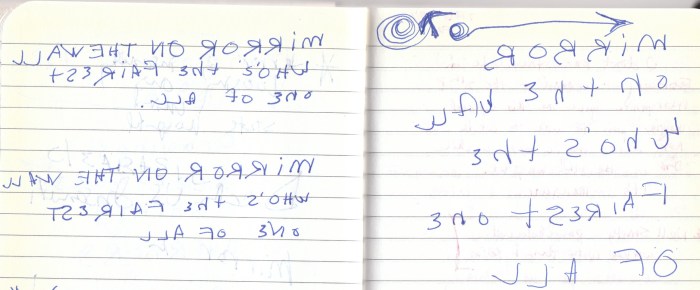
I might also surmise that there was something about this particular psychosis that made me obsess about mirrors and write in reverse as part of that obsession, for some of the mirror writing I did was in fact about mirrors–quoting the line from Snow White, “Mirror, mirror on the wall, who’s the fairest one of all:”
I clearly lack the clinical expertise to explain any of this, though it seems my thinking had the bizarre features associated with a fairly severe psychosis.

The fact remains—I lost my mind.  I lost it in a big way

I expect more evidence of this will follow in subsequent posts, as I think I got worse that winter before I got better—so stay tuned for more detailed descriptions of Kathy’s wacky ways in the winter of ’97— ways weirder than this semi-sane version of me might like to admit.


Dancing the Event Horizon


Blogging a memoir is almost, for sure, slow suicide.  And I swear to God— if it’s not the death of me, it will, at the very least, make me old, make me crazy crazier, make me something I don’t want to be.

graphic by Patrick Spence at http://www.stopthesanity.com

It’s gonna drive me to the brink, beyond that delicate barrier between “then” and “now”—which I guess it’s meant to do—has to do.

But I’ve decided I don’t like to go there—go “then”—peer into the muck and mire of my sometimes depressed, sometimes manic past.

Do these memoirs really help people in the present, anyway?  Do readers really benefit?  Is it really worth the effort?

My partner Sara and I have been discussing these issues over the past several days—discussing my potential book about recovery from bipolar disorder—and this blog, in which I’m testing the waters—tip-toe-ing around the edges of the story, trying not to get my feet wet—

Or so Sara insists.

She says that I’m not trying hard enough—not doing the dirty work of delving deeper than the surface—not forcing myself to swim in darker waters.

And I suppose she’s right. I’m practicing the fine art of avoidance, and this post is a prime example of that maneuver.

So forgive me, folks—

I’m guilty as charged.

I don’t want to deal with the drama that was my past.  I want a story to tell that is less personal, less intimately exhausting—maybe another international assignment for Sara—maybe a story about our efforts to settle again in another crazy place on an equally insane planet—a place different from the madness that was then, from the boredom that is here—that is now.

However, my partner does disaster response—so it’s always tricky wanting work for her—dilly dallying around the edge of dire and all that.  But dire is dramatic.  And sometimes I fear drama feeds my dysfunctional self—as long as it’s not my personal drama—memoir-related—bipolar-driven drama.

However, craving adventure for adventure’s sake is a god-awful motivation—especially when one knows that drama might mean disaster-related misery for someone else.

But maybe it’s not adventure I crave as much as a simple break from memoir—maybe I don’t so much desire drama, as I desire less personal drama.

Whichever it is, I’m far from loving this aspect of myself.

Whether I’m too lazy to do the difficult work of memoir, too weak to relive a painful past, or too in love with the drama-driven life to simply settle for the here and now—none of it is good.  None paints a pretty picture of who I happen to be.

So what I’m wondering is this—

What dysfunction do you like least about yourself?

What behavioral event horizon do you dare dance around or near?