Haiti: The Art of Recovery


I’m a wanna-be artist, a sort-of, almost artist—certainly not by training and clearly not because of craft. 

I’m also an artist who has struggled with bipolar disorder, someone who appreciates the creativity that is often an unexpected gift accompanying the illness.  I’m someone who has not only made art when I was sick, but continues to create even when I am well, as an outgrowth of recovery.  In the art world I’m what would be called an “outsider” artist.  I don’t always know what I’m doing.  I just do.  Art. 

I’m also a writer and artist who has lived in Haiti for the last year with my partner.  Sara has directed an international NGO’s response to the earthquake.  But we are preparing to go home next week, and I’m thinking not only about what Haiti has given me, the gifts I will take home, but also what I’ll leave behind.

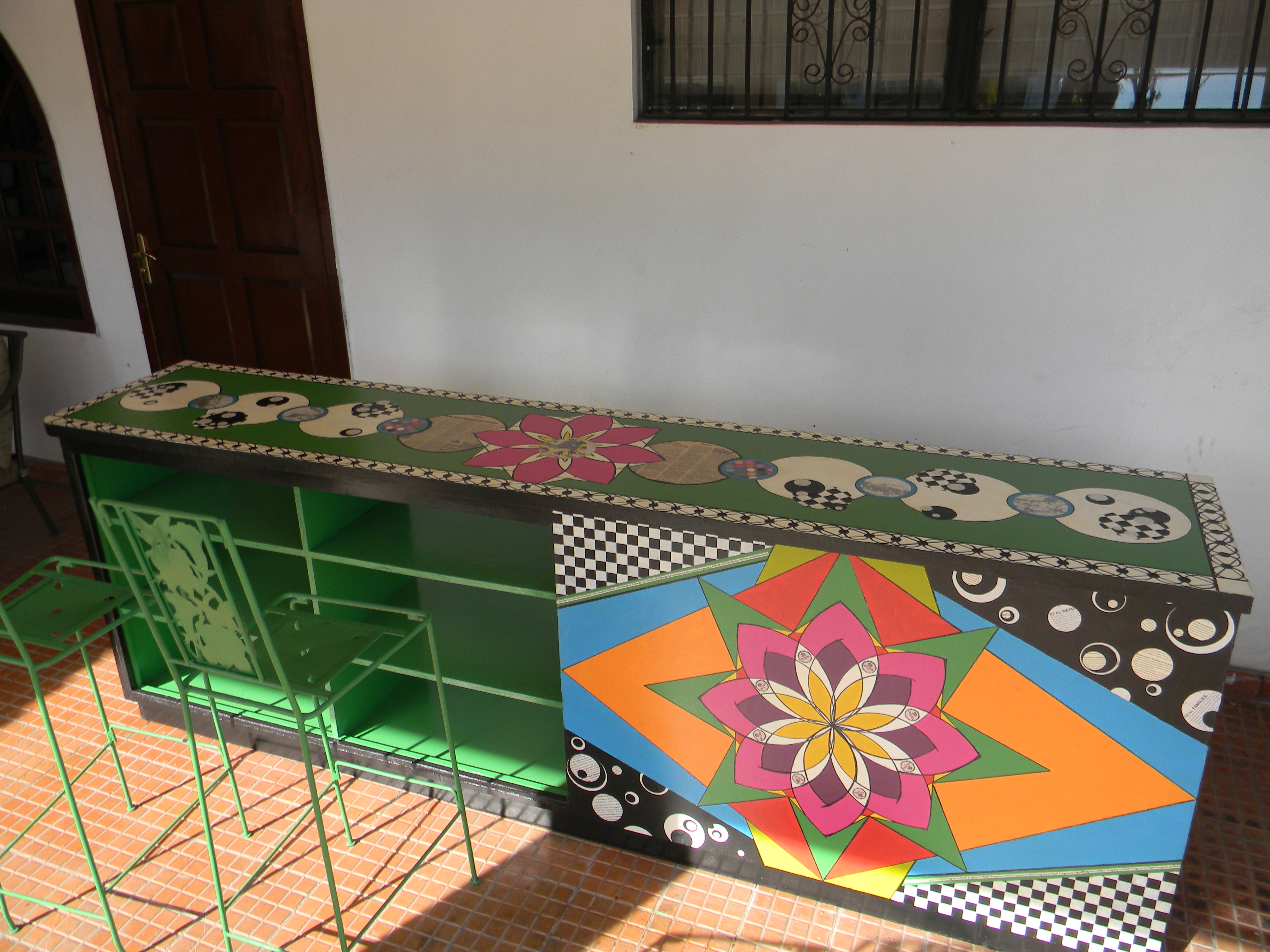
Indeed, one of the gifts I’ve given is a large piece of art, one I created for Sara’s NGO from a throw-away piece of furniture—a huge serving bar I painted last summer.


The bar is nearly 9 and a half feet long and lives on an upstairs patio at Sara’s office in Port-au-Prince.

It was white, ugly, an eye-sore, really.  But Sara wanted to save it.  She thought it, like Haiti itself, should be given a second chance at life, that the bar could be used for receptions, to serve meals on special occasions.  She thought I was the one to midwife this rebirth, that I was the one to take on the task, that as someone who has repurposed art as part of my own recovery, I could gift a born-again bar to the wonderful people who work here.

I loved the idea and took on the project enthusiastically, in the end creating a mixed-media piece—one that incorporates the organization’s logo in strategic places, as well as decoupaged-maps of Port-au-Prince and each location in Haiti the organization works.

I also included stories from the local newspaper, highlighting big events in the news during the months after the earthquake.

I included text from the organization’s 6-month, post-earthquake report, as well as the names of almost all the people who had worked on the NGO’s reconstruction effort—folks from more than a dozen countries around the world.

The front of the bar repeats the organization’s logo above each flower petal:

As well as the names of staff in black and white circles:

The top of the bar includes the maps and newspaper text:

However, soon Sara and I will leave Haiti; soon we’ll leave the places mapped on the bar-top at a bit of a distance, at least geographically.
And though we’ll leave when the organization’s work here is still incomplete, though in many ways it seems too soon, I’ll leave a piece of myself behind, one that I hope will serve the NGO’s mission here well into the future.  I’ll leave not only a piece of my art, but also a piece of my heart, knowing this is not really an end.  We leave but others will come.

Haiti has taught me this lesson: that indeed good things can come from our departure.   It has taught me not only how to birth a new bar, but also  how to hope, how to see potential in seeming destruction,  how to dream a new dream, how to hope a new hope.  It’s reminded me that, if art can come out of sickness, then indeed beauty can come out of the earthquake’s ruin. 

I believe that in every beginning an end is waiting to happen and from every illness or devastation a new beginning will grow.

Peace to people of Haiti—

And thank you!

This is what my head says . . .


 Today I thought I’d share a poem I wrote when my bipolar symptoms were in evidence–one that, I think, illustrates the chatter that, even now, I push aside but hear vaguely in the background–a whisper that back-drops and wall papers my expereince of almost everything–every bowl of cereal I eat, every peice of paper I pick up,  every book,  every door I close or open or slam shut, hoping to silence the sing-song.

This is what my head says . . .

The back of the truck
     is let down and I am
     in the street again
                lines down
          the center of the roadway
                yellow voices
 
The color of a dress I had
     age three
                yellow roses on the bodice
                yellow roses on the table
          where the place is set
                for us to eat zucchini
                and avocado and other vegetables
          with green skin that must be peeled
                away before consuming
 
Before comes earlier than after
               as does the obvious
              preacher talk
     of Jesus saving other people
                from their sin
 
Sin is always in the third person


News from the Asylum


 I don’t know how to tell you this, but I have some crazy news . . .

Sara and I are leaving Haiti— as in “permanently,” as in “forever.”

I’m just as stunned by this as you are, and frankly it seems hard to believe.   But Sara’s NGO is doing what a number of organizations are doing in Haiti—

They’re scaling back—

Why

Because of funding shortfalls—

The fact of the matter is, merely a fraction of the dollars pledged toward the Haitian relief effort just after the earthquake have been delivered to NGOs, because, in reality, donors are reluctant to hand over funds to a country whose political future is uncertain, a country that has a history of corrupt leadership, presidents who funnel dollars into their own deep pockets rather than passing them along to citizens in need. 

What?

You might wonder what this has to do with Sara and me—————

Quite frankly, Sara is a key disaster response resource for her NGO, especially in terms of her ability to drop into the aftermath of a disaster and get projects moving.  She launched the organization’s effort in Afghanistan after the Taliban fell in 2002 and directed its response to the 2004 tsunami in Southeast Asia. 

More recently, she’s worked a year in Vietnam and another in Haiti, without more than 5 consecutive days at home—an effort that has drained and exhausted her.  She needs a break.  She needs to rest.  

And the organization is smart to recognize this.

When?

Sara will have a three-month sabbatical before being reassigned.  This means Spring at home in Lexington—a lovely time of year to be in Kentucky.  And though I’m terribly sad to leave Haiti when there’s so much more of the country to explore and write about, I believe this change will ultimately benefit Sara and her ability to serve more successfully in the future.

Where?


We truly don’t know where we will be headed in another 3 months.  Before the earthquake in Haiti, her NGO had planned to send Sara to South Africa.  I suspect that could actually happen this summer, unless in the next several months there’s a massive disaster in another part of the world.

How?

So, how will this affect the blog—a blog that has largely been about Haiti?

Well, it’s ironic that I began shifting the blog’s focus slightly  even before knowing this larger change was coming—addressing the “event horizon” that is my past, while promising to not ignore the “event horizon” that is Haiti.

It could be that I shouldn’t have made that promise.  Certainly, I don’t plan to ignore Haiti even now, but it inevitably won’t be a part of my day-to-day experience.  Inevitably the focus will shift toward which ever country we live in next.

In the meantime, I intend to address the “event horizon” that was “then”—my personal past, whose story, I think, needs to be told.

Actually, going home to Kentucky will better equip me to research my mental health history—to do it in a way I couldn’t if I were in Haiti.  It will give me actual access to boxes and boxes of journals, video-taped therapy sessions, and medical records I already have on hand.

In practical, blogging terms, I suspect this may mean fewer posts and/or briefer posts over the next several weeks, as we pack up our lives here in Haiti and get resettled in Kentucky.  After that, I intend to spend the Spring exploring my past and sharing it here on the blog.

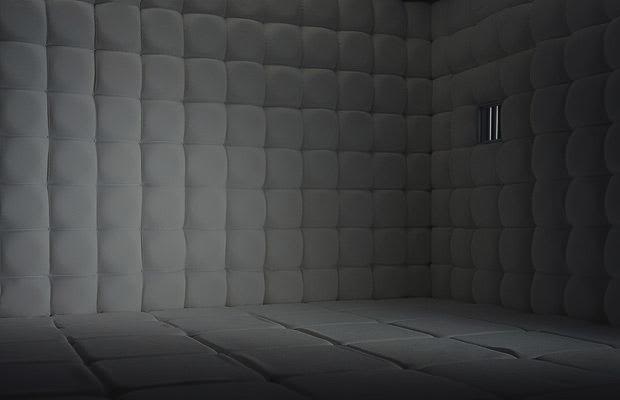
So pad your walls.

Things could get crazy around here.

This insane story’s just beggin’ to be told.

Miscellaneous Monday (and more Mindy to come)


It’s Monday.  And we’re launching another week’s worth of less-than-brilliant (but often, above-average) blogging here at Reinventing the Event Horizon. 

And, in honor of the week’s beginning, I bring you an “inspiring” (at least I’m trying) laundry list of updates:

1.  First, thanks to all of you for your kind and supportive comments in response to last week’s news that I wanted to begin moving my blog in the direction of memoir, not that I would discontinue writing about the event horizon that is Haiti, but that I would also address event horizons from my personal past:  namely my father’s organized crime connections and the black hole that is my battle with bipolar disorder.  (To read these posts click here and here.)

I believe the best writing is inevitably the most honest writing and my not addressing these issues was becoming a form of compositional dishonesty—a way of avoiding the shame associated with my father and the sigma connected to my illness.

One way to lessen stigma is to stop hiding, or, in my case, to boldly address my demons in the blogosphere’s bright light, to share my struggle, to tell my story, both the pain of the past and the hope that is recovery.

2.  Secondly, I’d like to announce an upcoming series of posts from my friend and fellow writer Mindy Shannon Phelps.  (I introduced Mindy last week.  To read her first post click here.)   As she finds time, Mindy will write pieces that address our sometimes serious, sometimes silly misadventures in being human. 

3.  Finally, an update on my dog Lucy’s adventures in Vietnam—her Maltese march, North to South, South to North. 

In last Monday’s post (click here to read) I forgot to include a few of the funniest photos—namely Lucy in Halong Bay . 

(Some of you may have heard of a recent accident in Halong Bay.  A tour boat sank.  12 were killed.  To read about this February 17th incident click here.)

In case you’re not up on the geography of Vietnam, Halong Bay is an UNESCO World Heritage site and hugely popular tourist attraction in northern Vietnam.  According to legend, the Vietnamese were being invaded by the Chinese when the gods sent a family of dragons to protect the bay.  The dragons were said to spit jewels into the water, to build a wall against the invaders, what is, in fact, a series of nearly 2,000 limestone islands that decorate the bay:

   http://www.en.wikipedia.org/wiki/File:Ha_Long_Bay_with_boats.jpg

In fact, a highlight of Lucy’s adventure in Vietnam included a swim with me in Halong Bay:

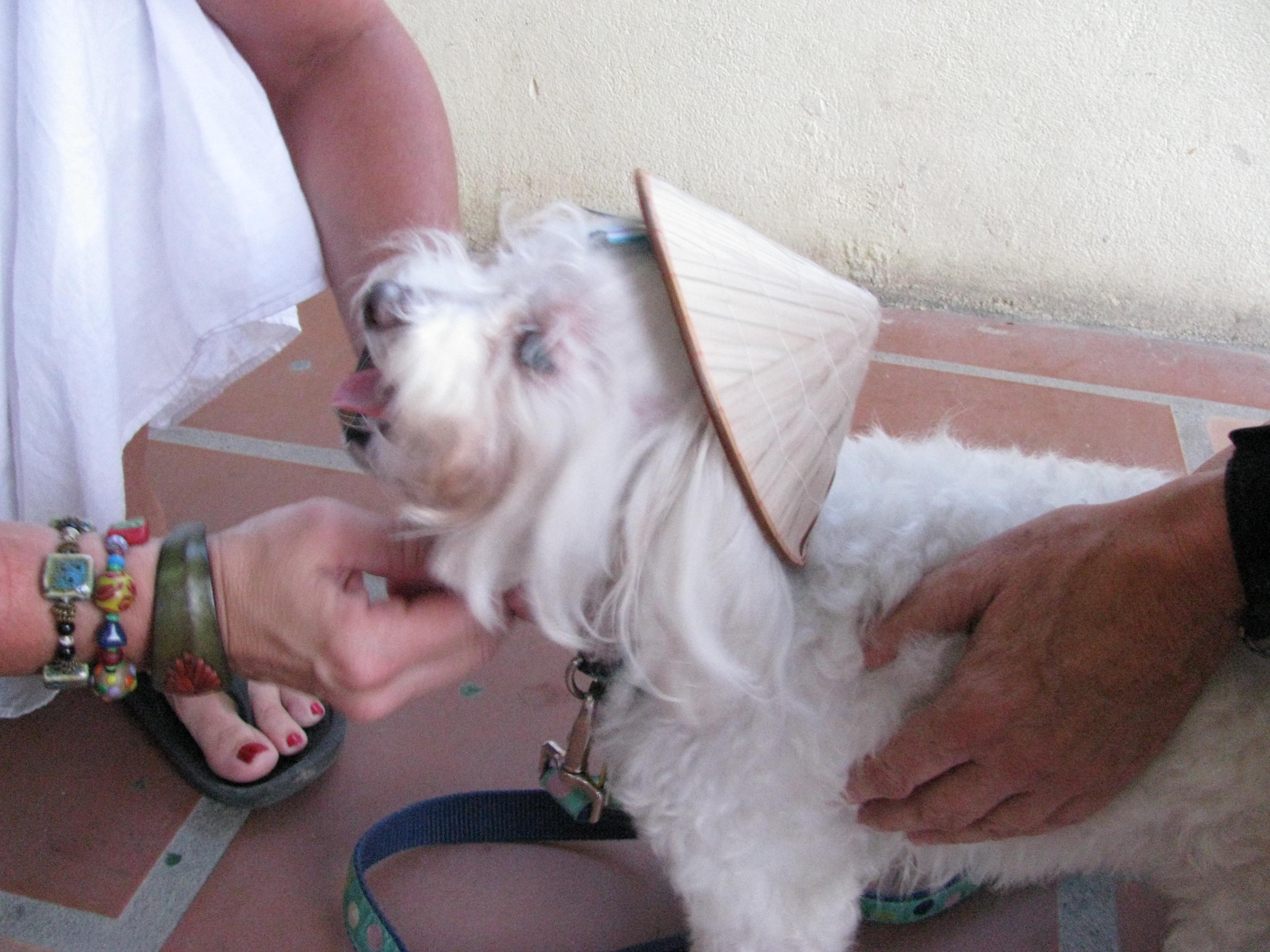
And last but not least, a photo of Lucy dressing for her outing on the bay:

The bottom line is this, a lesson I learned from Lucy:

Sometimes the most over-whelming of crises can be ovecome with the most obvoius of answers.

Indeed, sometimes the biggest of problems can be conquered by the smallest of canines in the most amazing of hats.

Hats off to our struggles. 

Hats off to hope.

Piecing and Pasting: Re-Membering (Part 2)


It’s the forgetting I remember most.  The fact of forgetting.  The past is fuzzy for me, something that will make memoir difficult.

So, for me, re-membering will partly be a process of re-constructing and re-assembling the story, piecing and pasting.  Largely, this is due to trauma.  Trauma around growing up in a dysfunctional family whose front door was broken down by the FBI on way too many occasions.  Trauma around having a mental illness that at times disconnected me from reality and the people I love.

However, I have a strategy for doing this detective work, because I, clearly, need to research and document the parts of my life I can’t recall.

So today I’ll outline the most obvious steps to take in reconstructing both the story about my father’s connection to organized crime and the one about my mental illness—what amounts to a 20 year struggle to win (and sometimes seemingly lose) the battle against bipolar disorder.

Though I don’t know that my family is entirely comfortable with my writing about my father, who, in fact, died in 1981 (when I was still a teenager), I plan to do the following to document my dad’s story:

  1.  File a “Freedom of Information” act, so I can access my father’s FBI file.
  2.  Search news paper indexes to locate articles that were published about my father in the Pittsburgh Press and Pittsburgh Post Gazette during the 1960s and 70s.
  3. Access transcripts of court proceedings, so I can understand why several grand juries indicted my dad and can appreciate the nature of my father’s testimony in court proceedings against him.

And in order to reconstruct the bipolar narrative, I plan to:

  1.  File for copies of in-patient medical records, so I can review notes taken by doctors and nurses during my many hospital stays.
  2. Request copies of notes kept by doctors and therapists during out-patient treatment.  (Some of this I’ve already done.)
  3. Review journals kept from the time I was 15 until the present.  I wrote a lot during the years I was sick.  And though I don’t recall everything about that time, the journals recorded much of what I don’t remember.
  4. Watch video tapes of several years’ worth of out-patient and in-patient therapy.   This will be an invaluable source of information about my symptoms, my behavior, my thoughts and feelings at the time.  (This first involves having the videos transferred to DVDs, so I can bring them back to Haiti.  Frankly, the thought of watching this material terrifies me.  I can’t imagine what it will be like to see myself so sick.  I tried to watch one video a couple of years ago, but had to stop.  It was too painful.)

As I lay out this agenda, I want you to be assured, also, that I am well these days.   No one would ever know I had ever been sick or still carry this diagnosis.  In fact, when I’ve shared this information with folks in recent years, they’ve been shocked. 

My partner can certainly see how moody I remain.  I’m not always easy to live with.  As Sara says, when I feel something, my emotions fill the entire house.  I still hallucinate at times, but you would never know.  I’ve learned to manage the symptoms that remain, the ones that still break through despite the medication.

I hope some of you will help by holding me accountable with regard to the strategy outlined above.  Renee over at “Life in the Boomer Lane” recently posted a two-part series on memoir writing (something you should check out by clicking here and here).  But in the second of those posts Renee suggests assembling a supportive group of friends to keep oneself on track during the process of writing a memoir.  (So, I hope some of you will be willing to “support” me with periodic kicks in my memoir-writing ass.)

Thanks to all of you who read my blog.  Please know how much I appreciate your on-going support.  You all have given me the courage, the faith in myself as a writer, to finally take on this task I’ve been avoiding for years.

Peace to each of you and, as always, hugs from here in Haiti,

Kathy

Re-Membering the Past is Not an Easy Task


And for me it is, indeed, a matter of re-assembly.  Sorting and piecing , cutting and pasting. 

(So, today I have a confession to make.)

From the beginning, I’ve wanted this blog to be an avenue into memoir, since, in many ways, the story of my past is far more interesting than the narrative that is now.  And, in fact, the most significant “event horizons” in my life happened a long time ago.

I know that may be hard to believe, as the life Sara and I have lead over the past several years has been an exciting one—taking me to places like Bangkok, Hanoi, New Delhi, Port-au-Prince.

But in many ways to travel backward in time is the bigger challenge—more over-whelming, more frightening, yes, but also more meaningful, and perhaps even profound.

The story of how I’ve gotten here—how I’ve gotten “now” is one that must be told.  And how I’ve gotten here involves telling at least two stories, requires that I follow two narrative threads.  (There’s actually three but only two I’m even close to comfortable sharing now.)

The first is the story of my father’s involvement with organized crime and the second is the story of my twenty-year struggle with bipolar disorder.

Neither of these is easy to tell.  And honestly I’m afraid.

I still intend to write about Haiti.  I still intend to write about the “now” that is the life I share with Sara on this troubled island.  In fact, I believe the struggles Haiti faces nationally are not dissimilar to the personal challenges I’ve endured.  My story and the story of Haiti both involve sickness and corruption, oppression, endurance, even hope.

In the coming days and weeks I’ll outline my strategy, share my goals, my hopes, my fears.

I don’t know how to tell this story.  I don’t know where to begin.  I feel swallowed by the enormity of the task, dwarfed by it.

So, I’ll pray for peace—and if you’re a praying person, please offer your own prayer; if you’re not, please say you care, please say you’ll share.

I still need that massive infusion of grace.  I still need that holy yes.