Seemingly Selfish, Lesbian Ex-Pats Seek Personal Peace (and some damn, good shopping) in South Florida


Sara and I are planning a weekend trip to Miami and hoping that Haitian streets remain quiet this week, ahead of our planned departure on Friday.  However, recent developments in the news, some even in the past several hours, hint that peace in Port-au-Prince could be short-lived.  Let’s keep all selfish, Lesbian fingers crossed that we gals get gone from Haiti before politics throw an exile-returning monkey wrench into our scheme for peace.

Over the weekend we learned specifically that the Haitian Electoral Council will announce on Wednesday the winners in Haiti’s first round of presidential elections—“winners” being the two candidates with the most votes, who will run-off on March 20th.

The American government, in an effort to persuade Haiti to accept the election outcome supported by the OAS (Organization of American States), revoked the US visas of 12 top political leaders from Haitian President Preval’s Inite party.  An OAS investigation found massive fraud in November 28th’s election and recommended that Preval’s hand-picked candidate, Jude Celestin, be eliminated from the run-off.  Bowing to this pressure late last week, Preval’s party withdrew its support of Celestin, but Celestin himself has refused to concede defeat and remove himself from the process.

However, any potential unrest from Wednesday’s electoral announcement could be complicated further by what Haitian President Preval and his council of ministers decided to do on Monday afternoon—grant former President Aristide a diplomatic passport, so he can return to Haiti.

Clearly, the Obama administration was concerned enough about Haiti’s ability to transfer power away from Preval, whose term ends on February 7th, that it sent US Secretary of State Hillary Clinton to Port-au-Prince on Sunday to meet with the current president and the three presidential candidates fighting for top spots on March 20th’s ballot.  I suspect the US is concerned that Haiti not devolve into the same kind of political unrest we’ve seen recently in Tunisia and Egypt.  US interests in the region depend on peace being maintained in its own hemisphere, especially in a place just 600 miles south of Miami and too close to Cuba for comfort, a goal that Aristide’s return could threaten.

Cuba also came into play on Monday afternoon, as rumors spread that Aristide had already left South Africa, where he’s lived in exile since 2004, and had returned in the Caribbean, in preparation for his arrival Port-au-Prince.  Some reports had him in Venezuela, others in Cuba.  However, Aristide’s attorney has since confirmed that the former president has not yet left South Africa.

Aristide maintains a huge following among Haiti’s poor, and his Lavalas party was not allowed to participate in November’s election.

Today’s New York Times has a story that nicely assesses the Aristide situation, outlining the potential complications.

Clearly, political tensions here in Haiti seem to be heating up   Selfish as it sounds (and admittedly it is selfish), Sara and I hope things don’t boil over before our weekend escape to South Florida.  Though not returning home to Kentucky, we’re looking forward to the comforts of American television (minus Super-Bowl Sunday), foods as heart attack-inducing as McDonald’s Big Mac and fries, and some quiet time to enjoy South Beach and play our part, as gratuitous American consumers, shopping till greed and guilt get the best of us or our wallets are emptied—a little retail therapy to lift our spirits and boost the lagging US economy.

Somebody’s got to do it; might as well be this pair of globe-trotting, dog-loving lesbians, who need a little personal peace, as well. 

(Apologies for the Super Bowl snub; we expats like our football better in the form of World Cup action.)

Haiti needs to be HGTV’d!


Like many Americans, I love HGTV (Home and Garden Television).  When I go home to the US, I can’t wait to watch kitchens upgraded, bathrooms remodeled, landscapes transformed.

Whether I’m cooking with the ease of Lean Cuisine, laundering with the convenience of Kenmore, or cleaning with the miracle of Mop & Glo, I appreciate the perky background chatter of “Divine Design” (to learn more about the show click here) and “Design on a Dime” (to learn more about the show click here).

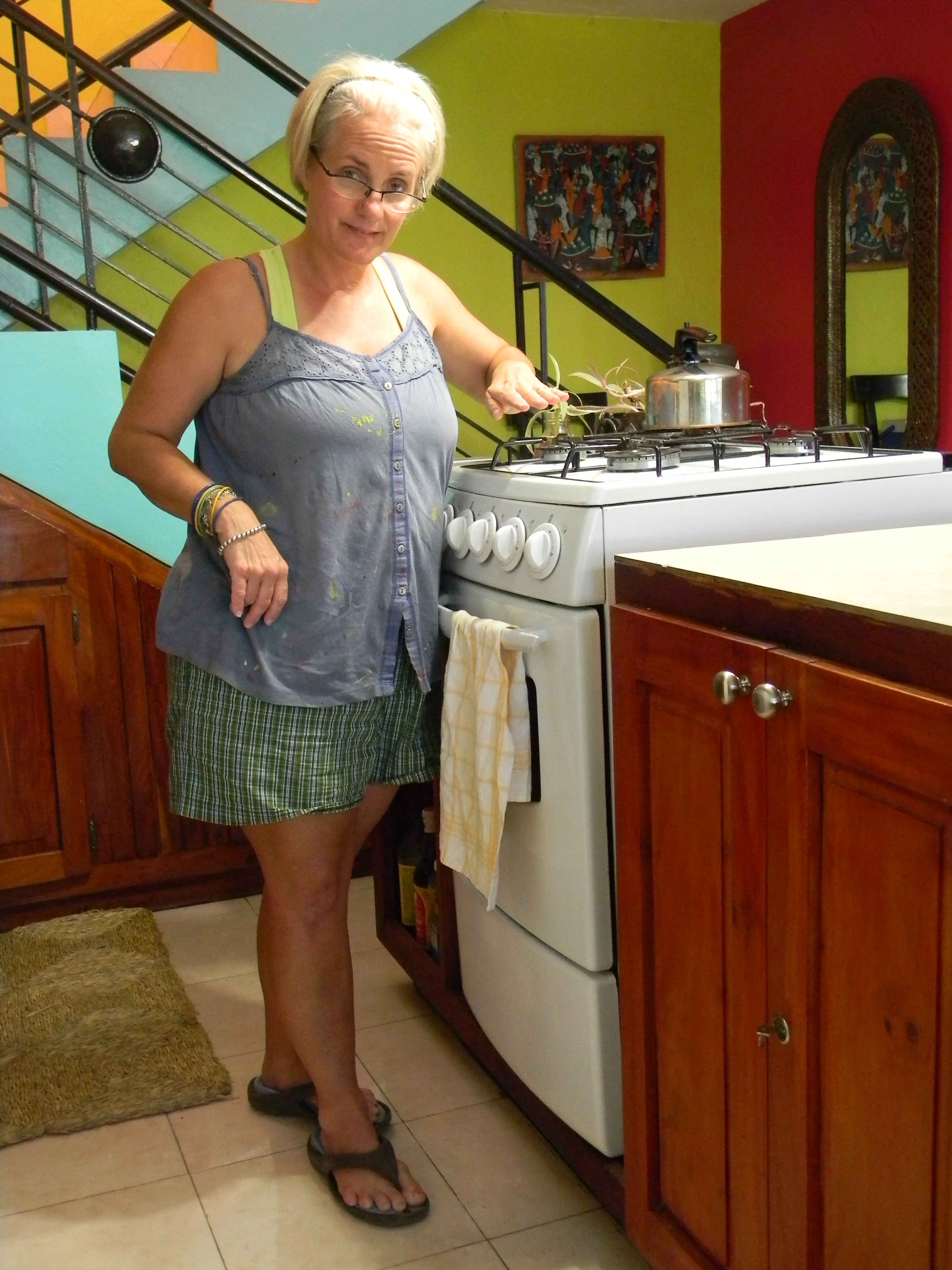
I enjoy segments on how to install bamboo flooring at a diagonal as much the next surface-obsessed, granite-loving, domestic goddess in North America.  Even when I’m at our house in Haiti, I complain about our stove, our oven, our cook-top.

It’s so small:

So tall:

—so not the stainless steel I have at home in the States.

But—(and this is a big BUT)

This past week I went with Sara to Leogane, a coastal town about 30 kilometers west of Port-au-Prince, close to the epicenter of the January 12th earthquake.  A United Nations assessment team deemed Leogane “the worst-affected area” in Haiti, with 80 – 90% of buildings damaged and nearly all concrete structures destroyed.

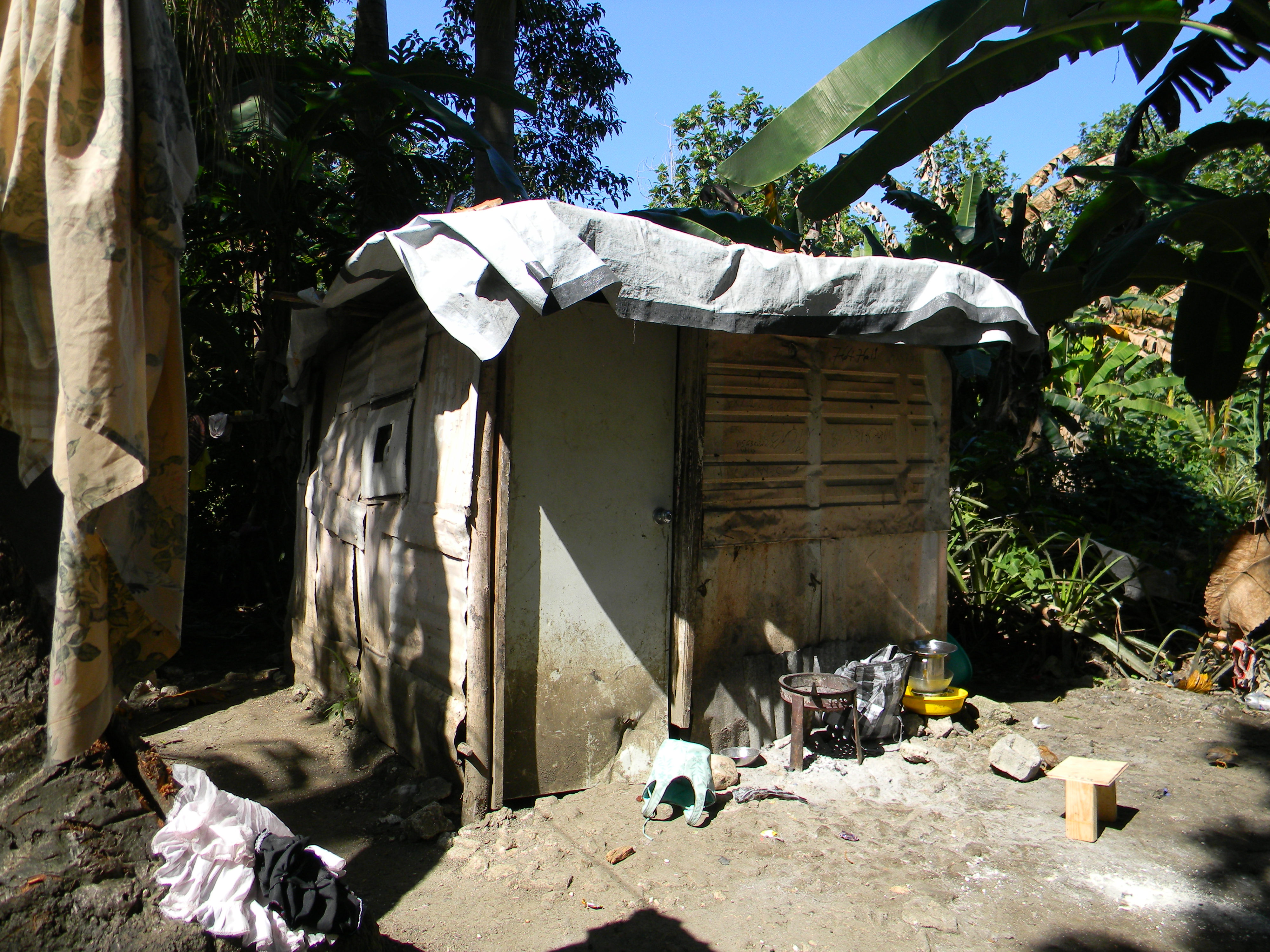
Just outside of Leogane I visited a community called Nolivos—

Where the houses look like this:

a "Desperate Space?"

(To learn more about the show, “Desperate Spaces,” click here.) 

The washing machines look like this:

doing laundry for a family of 7 children

The kitchens look like this:

a "Sizzling Outdoor Kitchen?"

(To learn more about the show, “Sizzling Outdoor Kitchens,” click here.)

The sinks look like this:

the community well

And the stoves look like this:

a "Kitchen Impossible?"

(To learn more about the show, “Kitchen Impossible,” click here.)

Watching a woman cook dinner for seven on  a stove of sticks and stones, I wondered whether Vern Yip would be willing to bring a “Deserving Design” to this mother or another mother in the Port-au-Prince slum of Cite Soleil.  (To watch an episode of “Deserving Design” click here.)

I wondered whether David Bromstad would splash some color a little south of Miami.  (To watch an episode of “Color Splash: Miami” click here.)

I thought:

Haiti needs to be HGTV’d!  (To learn more about the show, “HGTV’d,” click here.)

(and I thought I needed a kitchen remodel.)

What’s up with the stats! (at certain times of the month)


Poor Sara!

I swear to God, the woman is a saint.  She should be winning the “my-partner-is-a-pain-in-the-ass-and-I-am-the-picture-of-patience” award any day now.

I’m emotional.

Overly emotional—

Big-time, ranting and raving, tantrum-throwing emotional—

At certain times of the month.

When Sara walked in the door from work yesterday, I accosted her with worries about my blog.

“Only 78 people have read so far today.”  No “hello”—no “how was your day.”

“It’s still early,” she offered in consolation.

“But I had over 200 readers nearly every day last week.”

“Haiti’s not in the news as much this week.” She put down her bag and walked to the frig.

“My writing has gone to hell.  I have nothing else to say.  Yeah, I had a good post on Monday about the stump, but it’s all been down-hill since then.  I have no idea what I’m going to write about for tomorrow.  I planned on doing a graffiti piece as part of my Haitian art series, but I don’t have all the photos yet and I can’t deal with hours trying to upload them this evening.”

“Why don’t you write about your driving?”

“What about my driving!”

“Richard said you hit a parked car as you were pulling out of the office this morning.”

I’m stunned.  Utterly and completely not believing what I’m hearing.

“That’s not possible.  I would have know if I’d hit a car.”

“I’m just telling you what he said.” 

She’s not mad that I may have damaged our car.  She genuinely thinks I should write about this.

And the fact of the matter is, she’s probably right.

I’m not a good driver.  I hate to drive.  I think owning a car is way, way over-rated—especially in a country where the “roads” (if you want to actually dignify them as such) boast craters the size of swimming pools—canyons that could swallow a mid-sized SUV, then take on an economy car for dessert.

But I promised yesterday to emphasize the positive about Port-au-Prince, and this post is not so much about highway maintenance (and streets that double as public toilets), as it is about my pathetic driving and Sara’s pending sainthood.

When I was an undergraduate and drove to visit a friend for the first time at her home, I was so focused on getting there, that at one point the police pulled me over for running three stop signs.

The officer approached my car in disbelief.

“Lady, you just ran three stop signs.  You didn’t even slow down.”

I wanted to justify myself by asserting that, of course, I hadn’t stopped, I was busy counting. (My friend had told me to turn right after the third sign.)  Not exactly the queen of multi-tasking—at least not on the road.

When I was driving from Kentucky to Oklahoma a few years later, I asked my friend in the seat next to me, if the lights on the car were, perhaps, not working properly.  It was just past dusk.

“It just seems so dark!” I insisted.

“That’s probably because you’re still wearing your sunglasses.”

Oops!

So, it’s true.  I’m not the best driver in Port-au-Prince, but I’m also far from the worst, in a place where driving skills may be the worst I’ve encountered on the planet.

Yes, it’s possible I hit a car without noticing—busy as I was trying to prevent the road from swallowing  my vehicle whole).

And, yes, Sara is saintly in her tolerance of both bloggerly rants and driverly mishaps.

But, honestly, what’s up with the stats?

(at certain times of the month)

Haitian Street Art: A “Good Report”


Most mornings in Haiti I drive past displays of “street art”— a common sight in and around Port-au-Prince.  In most instances, hundreds of paintings are attached to walls that line the roadways, a collage of folk art images quilting the street.

In Petion-ville, just down the mountain from where we live, art is sold across the street from a camp of earthquake survivors, and in fact, some paintings now for sale along the road have selected the disaster itself as their subject.

Below is a video about street art that was produced about a month after the earthquake.  In it two artists are interviewed, the first lamenting the loss of his mentor in the disaster, the second discussing his own earthquake-focused paintings.  Despite the language barrier, try to appreciate the images and emotions shared here:

Responding to the same depth of emotion expressed above, Sara and I, over the last year, have purchased a number of paintings from the street.  We love the stuff and have bought 5 or 6 pieces, not only because of the emotionally charged nature of the work, but also because the art is highly affordable and equally portable.  (Canvases can be removed from frames, rolled up, and packed away in suitcases when we return to the US.)

The first piece we purchased in March of 2010 depicts a market scene, a common motif in Haitian folk art and an especially popular one in street art:

We enjoy the bold colors in this painting by A. Emmanuel and are struck by the featureless faces of the market women.  Notice the women wear the head coverings common in the Haitian countryside.

Still other paintings feature religious themes, as in this image of the Madonna:

Notice the mirror images of the Baby Jesus.  Twins are especially important in voodoo, and sometimes even Christian paintings include elements of it.

However, other street paintings more overtly explore voodoo, this other side of religious life on the island.  Some offer heavily painted symbols of the loa, the deities of Haiti, such as the “vever” (design) for Agwe, the voodoo water spirit:

Sara and I have none of the “vever” paintings, but we do have the one below that is, at least obliquely, associated with voodoo:

Still other street art paintings, like the one below, explore rural village life:

I think it’s important to remember, that street art, like the painting above,  like those sold adjacent to the camp in Petion-ville, not only humanizes situations that might otherwise seem hopelessly inhumane, but also dignifies these places, in some instances almost encircling the camp with images of loveliness and grace, embracing the Haitians encamped there, culturally reinforcing messages about beauty’s ability to triumph over pain.

So the next time you think about Haiti—the earthquake, the cholera, the political corruption—remind yourself, and others for that matter, that though things here might seem singularly hopeless, they are, in fact, neither simple nor beyond repair.

Remember that over 200 years ago Haitians defeated the French, becoming only the second country in the Western hemisphere (after the United States) to gain independence from a colonial master—a nation of slaves strong enough and determined enough to refuse oppression even its most imperial form.

Remember, as well, that Haitian folk art in general and street art in particular articulate the daring of a people determined to overcome.  Remember that Haiti is not a hopeless place, but is, in fact, one whose people have endured centuries of mistreatment, first from a colonial system of servitude, then from a social and political elite whose wealth has depended for decades on the poverty of so many.

Indeed, the future may look bleak, prospects may seem poor, but Haitians are rich in emotional resources,  their creative spirit screams from street corners where art echoes centuries of grief and centuries of hope, decades of determination, and ages of insight, wisdom, and strength.

Haitians remember the Biblical imperative to think on “whatsoever things are true, whatsoever things are honest, whatsoever things are just, whatsoever things are pure, whatsoever things are lovely, whatsoever things are of good report.”  (Thank you, Jane, for the reminder!)

Haitian art indeed reminds us that things are lovely–

That beauty  paints a “good report.”

Carpe Diem


Much to my good fortune and hopefully the readers of my blog next week, I have the unexpected opportunity to visit Leogane, one of the towns west of Port-au-Prince, closest to the epicenter of the earthquake.  Because of this, I’m having to interrupt my series on Haitian art for a day or two.  Sorry about this, but please understand I almost never have the opportunity to visit the field and expect this travel with positively impact posts next week.

Thanks you for your patience also, if I do not read your blogs for the next couple days, as I try to maximize this opportunity.   See you soon—-

Make Green, Not Greed: Sustainability in Haitian Art


When you think “island music,” you most likely think “steel drums” and the almost bubbly music they produce—happy notes.

But here in Haiti, the 55 gallon oil drums recycled for music-making have yet another artistic application—one I learned about last spring on my first trip to Haiti.

In March of 2010, I traveled to Port-au-Prince to celebrate a birthday with my partner Sara, who had already been in Haiti for nearly two months.  Nine weeks after the earthquake, the place was not exactly a “vacation destination”—the city was largely a landscape of rubble and debris—remnants of a city that used to be.

But Sara had recently moved into a house expected to be home for the next several years.  So in an effort to make it feel more like “home” and less like a house of a hill seeking its soul, Sara and I decided we wanted our home to mirror the cultural landscape of the city, to fit with the creative lay of the land, so to speak.  And it seemed easiest to accomplish that with art, or whatever remained of it here after the earthquake.

In fact, last January’s earthquake dealt Haitian art a devastating blow, severely damaging the Centre d’Art, which launched Haiti’s art movement in the 1940s, and collapsing the Musee d’Art Nader, which had housed the country’s largest private collection of more than 12,000 pieces.

But even so shortly after the earthquake that nearly leveled the city, in March artists were back at work, perhaps, partly because Haitian art is largely a study in sustainability, and artists use whatever materials they have on hand to make creative statements, sometimes even hammering them from the steel remains of oil drums, the same material on which musicians mallet out their melodies.

Ever since the 1950s Haitian artists have been pounding cultural messages into steel—a tradition of metal art that owes it origins to a blacksmith from Croix-des-Bouquets named Georges Liautaud, who began fashioning simple metal crosses to mark graves in his village, since so few Haitians could afford tombstones.  

In fact, the first piece of metal art Sara purchased and had hanging in our home when I arrived last March was such a cross.  Yes, they’re still being made some 60 years after Liautaud began the tradition.  The cross Sara had hanging on our bedroom wall looks like this:

However, the piece of metal art we purchased that Saturday in March was done in the African mask style, a stunningly beautiful Haitian woman with bold spiraling hair and DNA-ed dangles hanging from either ear:

When I returned more permanently to Haiti in June, we purchased our lovely lady a mate—a warrior, whose long, stern face guards our entrance way with steely spikes of hair and sadly serious eyes:

Since then, Sara selected and purchased a spritely angel who hovers in our bedroom—a circling girlish figure, a feminine compliment to the more masculine cross that still hangs on an adjoining wall:

So what’s one to make of this art being pounded out in Port-au-Prince?

In the US some still accuse the Bush administration of entering Iraq for oil, but it’s unlikely Obama will make war in Haiti for empty barrels of the same black gold, so Haitian artists will use the rubbish from the rest of the world’s over consumption, its gas-guzzling greed and extravagant excess, to hammer home a message other countries had better learn, learn before it’s too late.

Haiti reminds us that maybe we should sing a different tune, beat our drums not for more oil, but make do with what remains.

The pied piper of Haiti may make his music on metal drums, but will the world follow a Haitian example of green consumption over greed?

Stumping for Haitian Art: Gorgeous Gardens in Port-au-Prince


I had a close encounter with garden art last week—

An unexpected one at that.

Regular readers of my blog know that I’m a visual artist—of sorts—self-taught, poor, and living in exile on a Caribbean island, where electricity is in short supply, political stability is even harder to come by, and cholera is spreading like good gossip in a gaggle of girls.  I’ve shared my work in previous posts.  I love art, support art, enjoy it in all its incarnations, shapes, and sizes.

But it surprised even me last week, when an artistic enterprise unfolded in my own Port-au-Prince back yard—one uninitiated by me.

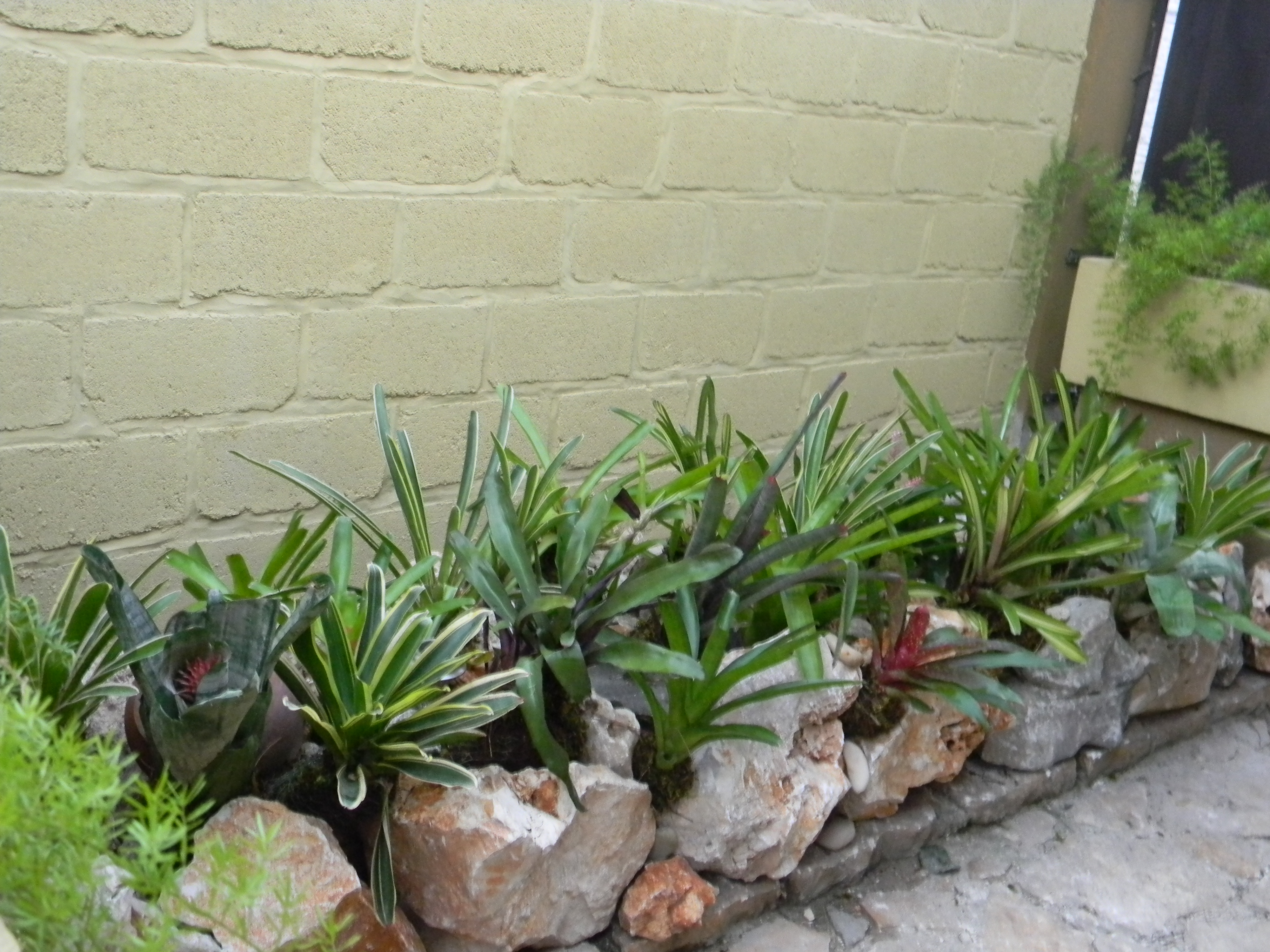
Ever since last spring when Sara moved into our house on a hill—Morne Calvaire (where we’re told a new neighbor is Baby Doc Duvalier), the land-lady has promised a garden, and last week she delivered, arriving with a landscape artist who installed a stunning rock garden near our front door.

We were happy.  We were actually thrilled.  However, we were not prepared for act two, which unfolded the following day.

It was morning; the sky was clear, blue bold enough to brighten even the most bored of bloggers.  I was writing, enjoying light that angled through my wall of windows.  While I was working, however, the dogs alerted me to a noise outside, one I might have otherwise ignored. Thank God for canine clamor.

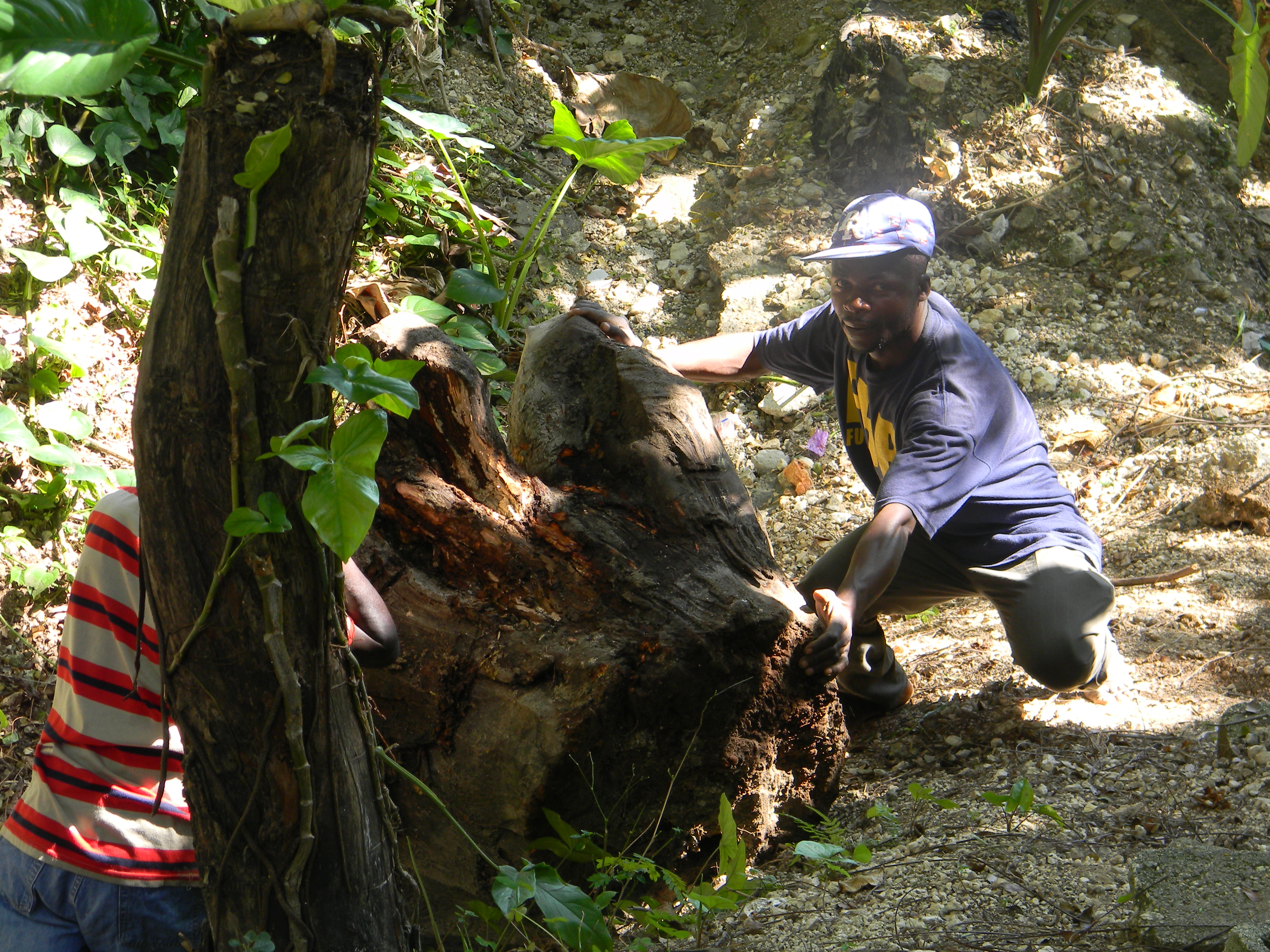
There on the hillside that slants down and away from our house, three men, our landscape artist included, pushed and pulled, grunted and groaned the most massive of stumps toward a wall and fence that border the back of our garden.

I couldn’t imagine why.  What was the purpose behind this effort?  Why had Sisyphus himself shown up on my Haitian hillside?

What concerned me most, however, from my interpretation of signs and signals being gestured below, was an apparent plan to heave the stump over the wall and through the fence cemented into it.  I watched and wondered, watched and wondered some more till I was sure the plan indeed involved such fence bull-dozing, before running out to get our security guard to intervene and interrupt this planned assault.  Within seconds Sonny came running, riffle gesturing the men away from ruining our fence.

It was soon discovered via a phone call to our landlady that, having forgotten the fence was attached to the top it, she had asked the men to remove the stump by pushing it over the top of the wall.  Our stump-movers extraordinaire interpreted her instructions quite literally, intending to force the tree through the fence in an effort to accomplish the task.  So much for common sense.

Stump removal ceased for the day.

The men then returned the following morning, removing a section of fence, forcing their burden over the top of the wall, lowering it with ropes into the back of a truck on the other side, and replacing the offending section of fence, before departing—

I assumed forever.

However, the following morning, while I was again writing, a horn honked outside our gate, the dogs barked like insane caricatures of canine companionship, and I soon heard the shouting of what turned out to be seven men.  Within minutes massive crashing commenced on the deck above, more shouting, still more housing-rattling crashes, shouting and crashing, shouting and crashing, until I simply had to investigate.

The stump had returned.

It was now living on our patio, puzzling me, puzzling indeed.  I like trees as much at the next semi-green ex-pat on the island, but REALLY, did we want this stump on our patio?

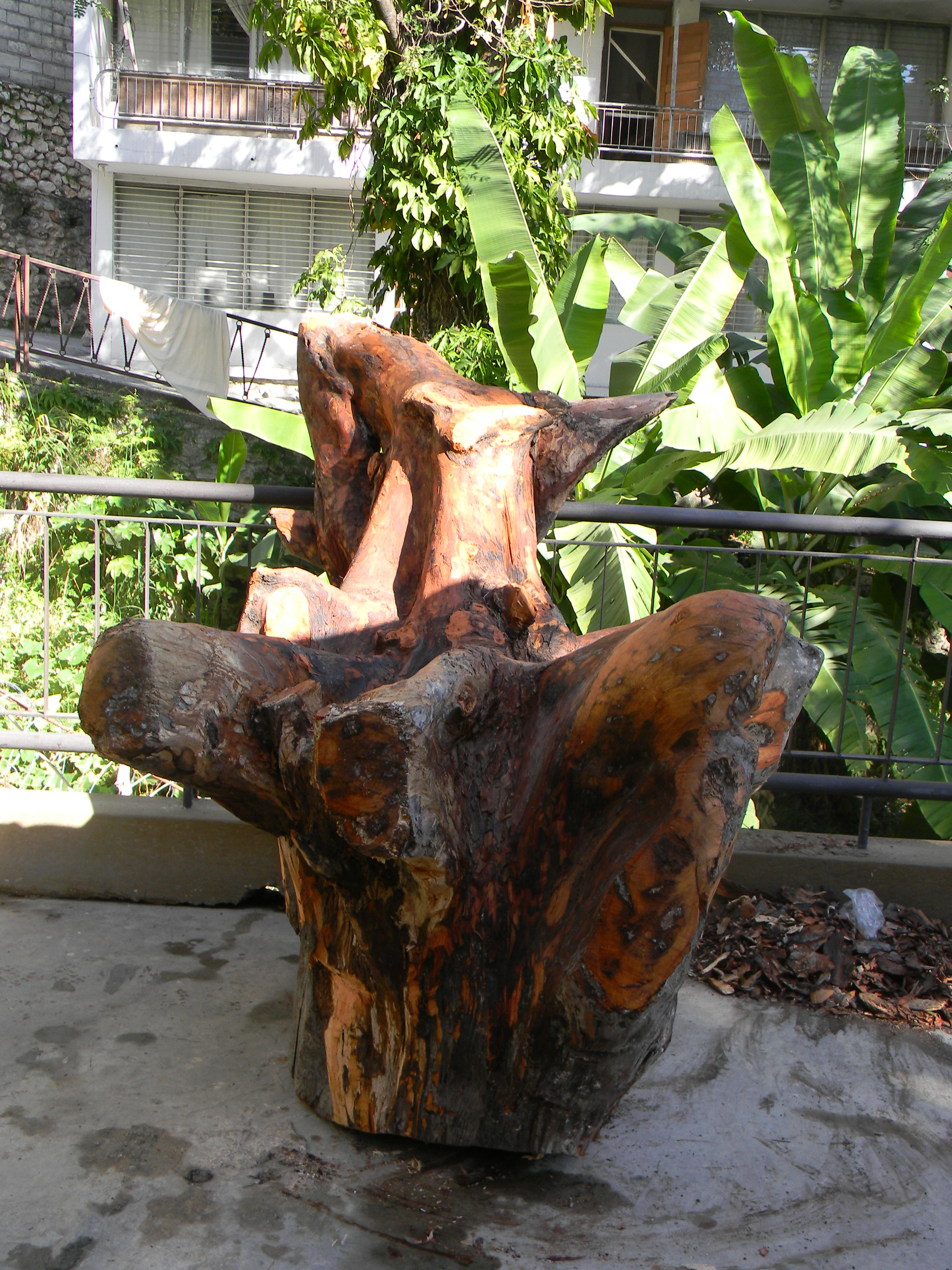
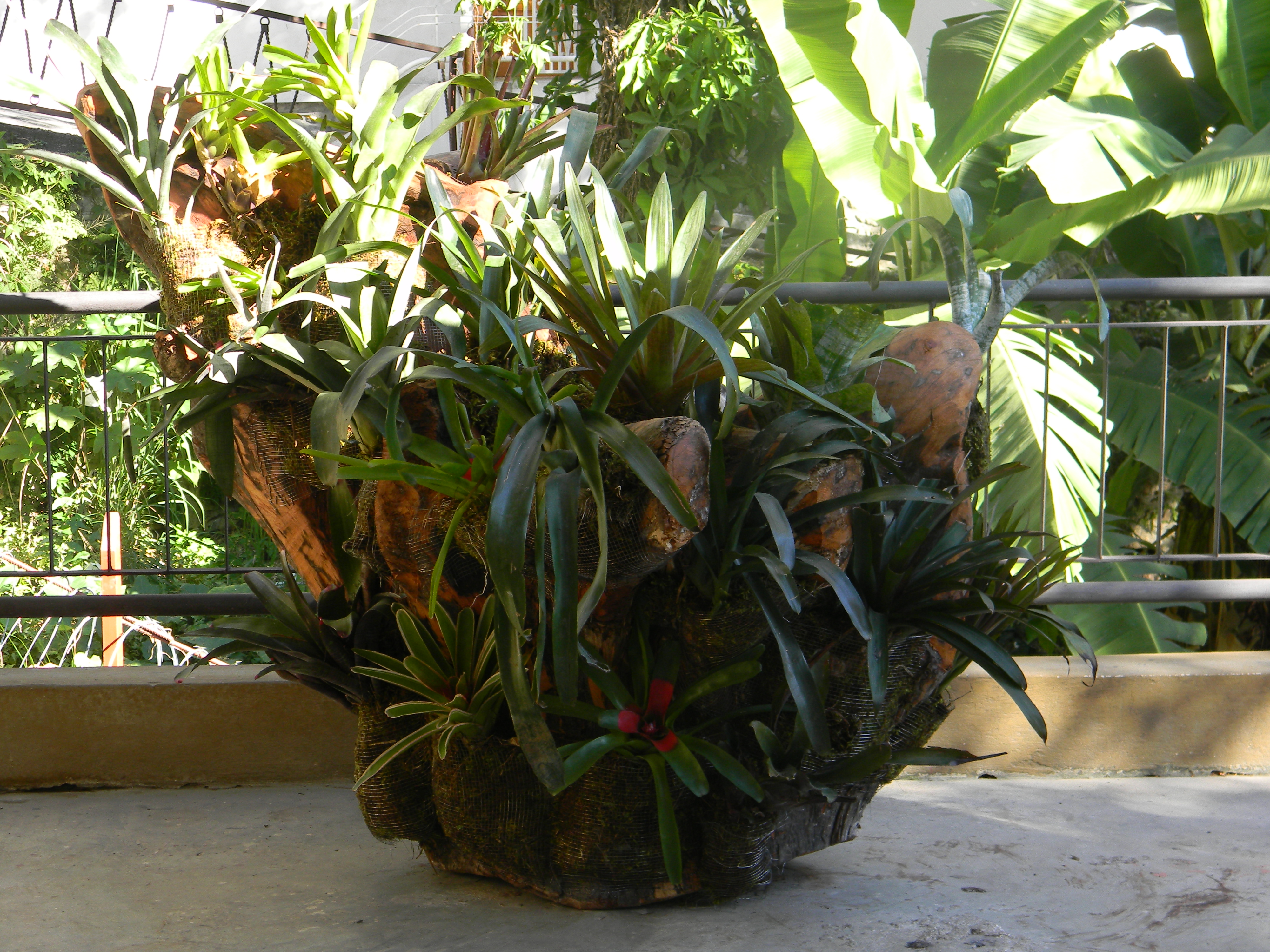
Over the next several days, however, Dicton Gaston, our new gardener guy answered that question for me, proving more and more a sculpting savant, as the stump morphed from this:

Into this:

Dicton Gaston is a gardening genius.

Dicton Gaston proves art emerges from even the most unlikely places.

Dicton Gaston proves that in Port-au-Prince, though ex-dictators may show up unannounced at airports, though they’ll be arrested and released and move onto the mountain where you live, art can come from equally surprising places, in delightfully surprising packages.

So, this week, as long as the ex-dictator can maintain his EX-dictator status, as long as protesters don’t take to the streets and shut down the city, as long as posts can go as planned, this week I’ll bring you a series on Haitian art, hoping to remind you—

Port-au-Prince may be leveled, reduced to a dead stump of its former self, discarded on a hillside, in ruin.  Haiti may be broken, lost, and nearly forgotten, but still, like Dicton’s stump, it can occupy a prominent place, a patio blooming, green, and living once again.

A work of genuine genius.

Bargaining for the Good Life: Duvalier and the Haitian Elite


As I’ve struggled over the past several days, trying to make even minimal sense of Jean-Claude Duvalier’s return to Haiti Sunday evening, and worked even harder attempting to understand the Duvalierists I’ve discovered in my life since then, I’ve remembered why art is such a good way for me to grapple with complex issues, ones for which there are no easy answer.  When slugging through the muck and mire of not knowing remains the only way through a particular darkness, I, like both Aristotle and Shakespeare, find comfort in art and literature’s ability to “imitate nature,” be like the thing that’s bothersome, while, at the same time, not being the thing itself.

 So, in the midst of my Duvalier-induced dementia, I remembered a short story by Ursula Le Guin, “The Ones Who Walk Away From Omelas.”  I’ve often taught this piece to composition students when wanting to demonstrate how “showing,” rather than merely “telling,” makes for stronger writing.  But yesterday Le Guin’s story reminded me why and how literature can become a way through confusion, especially in a place where more than a million remain homeless, cholera continues to kill, and ex-dictators come home to roost. 

“The Ones Who Walk Away From Omelas” describes a seemingly ideal city that hides a dark and disturbing secret (a dystopia, in literary terms).  Happiness and peace in Omelas depend on the suffering and misery of one small child, dungeoned in filth and despair.  According to Le Guin’s narrator, coming of age in this seemingly perfect place involves visiting this child and realizing, for the first time, the price Omelas pays for peace.

Clearly Omelas is not a perfect parallel to Port-au-Prince, since here the wealth and luxury enjoyed by an elite minority depend on the suffering of millions.  My Duvalierist friends may long for the good-old-days of Papa Doc and Baby Doc, an era when the lights stayed on and the streets were clean, but even now in Haiti the balance is shifted in favor of the privileged few.

 In the story’s final paragraph (click here to read the story in its entirety), Le Guin tell us about a few citizens of Omelas, but only a few, unwilling to accept this “bargain,” unwilling to exchange the suffering of an innocent child for their own well-being, to trade conscience for comfort.  These are, indeed, “The Ones Who Walk Away From Omelas.” 

Night falls; the traveler must pass down village streets, between the houses with yellow- lit windows, and on out into the darkness of the fields. Each alone, they go west or north, towards the mountains. They go on. They leave Omelas, they walk ahead into the darkness, and they do not come back. The place they go towards is a place even less imaginable to most of us than the city of happiness. I cannot describe it at all. It is possible that it does not exist. But they seem to know where they are going, the ones who walk away from Omelas.

 For the same reason these few in Omelas walk away, here in Haiti some have come and  decided to stay, refusing, in their own way, to accept the bargained-comfort that is life back home.  But this situation is extreme. 

I wonder how this same unwillingness to compromise conscience plays itself out in your life.  What do you sacrifice, what do you say “no” to, because doing so is good and fair and just? 

 How is conscience alive and well in your life?

I Encountered a Duvalierist: Haitian Atrocities Then and Now


It’s getting to me folks. 

Really, really rubbing me the wrong way and getting this Confused and Befuddled Foreigner all up in arms and ready to kick some Duvalier ass.

Oops!  Did I just say that with my outside voice, my typing voice, my public, face-to-the-world voice?  Did I just threaten to kick ex-dictator-dying-to-be-dictator-again ass?

I’m what my grandmother would call “all riled up,” and “in a tizzy” over some Haitian’s seemingly laissez-faire attitude toward Baby Doc–

The attitude of at least two upper-middle class Haitian’s I talked with this week.

But what strikes me as odd is that both of these acquaintances shared a frighteningly similar perspective—one that scared the pro-democracy socks off of my oh-so middle-class American sensibilities. 

Obviously it’s important not to generalize from this small sample, but what amazed me was that both said the same thing—something I thought I wouldn’t hear—especially from well-informed and well-educated Haitians.

Both were pro-Duvalier.

I encountered a Duvalierist, two of them.

Both were not just neutral, both clearly supported someone who makes Saddam Hussein look like a Sunday school teacher.

Both said life was better during the Duvalier Era.  The streets were safer.  There was better infrastructure, more electricity, the lights stayed on longer at night.

“Okay,” I said, “but what about the oppression, the arrests, the torture, the killings?”

“That’s exaggerated,” both claimed, both in separate conversations.  Neither knew the other.

“Okay?” I said, half rhetorical question, half affirmation that I had heard them—heard the words at least.

I was dumb-founded.  I literally couldn’t come up with something to say. 

I still don’t know what to say, how to write about this, how to think.

But the stunned silence I’ve felt inside myself since those conversations has been telling.  I’m thinking, as I suspect most well-informed North Americans like me might, “So the numbers are inflated.  Then what’s a more accurate estimate?  Some say 30,000 Haitians lost their lives.  What would have been an okay number to have imprisoned, tortured, killed?”

Quite frankly I’m more than just confused.  I’m irritated.

Angry. 

Yes, I’m angered that people think this way. But I’m more angered by my own ignorance, my own naivety, my own not knowing how to talk or write about it.

How could I assume so wrongly?

Am I wrong to believe democracy is always best?  Are there indeed places on the planet where it won’t work?

I’ve long thought the Bush mandate to “export democracy” expressed many of the faulty assumptions Americans have toward the rest of the world.  I’ve known that Thomas Jefferson, one of America’s founding fathers, insisted Democracy depended on an educated citizenry—that the uneducated and ill-informed are poorly equipped to think about, let alone make decisions about good government.

But how does that apply here in a country where so few have gone to school, so many remain illiterate?  If education is the key—then which education, what kind, who decides?

I beginning to believe I am indeed in a place where other rules apply.  Life’s lived differently, and I don’t have the How-To Manual.

For so long Europeans and Americans have imposed their perspectives on Port-au-Prince.  Since the days of Columbus and the original “colonizing,” the conquerors have been wrong—

Done wrong.

Who’s the real dictator here?

Which are the true atrocities?

An Event Horizon for Haiti? Baby Doc’s Mind-Bending Return from Exile


As events unfold here in Port-au-Prince around Jean-Claude Duvalier’s return from exile on Sunday, his being detained and charged with corruption by Haitian prosecutors yesterday, only to be released last night and returned to the Karibe Hotel having had his passport confiscated, I can’t help but repeat how surreal it feels—like living on the edge of a bizarre Caribbean twilight zone where reality contorts itself into a banana republic parody of all things right and just and  good.

In the midst of this twisting of right and wrong, caring and corruption, goodness and greed, I’m reminded of why I began this blog in the first place and why I called it “reinventing the event horizon.” I’m reminded of the quote from T. D. Allman’s After Baby Doc I cited in my first post back in November.  It bears repeating, as Allman associates Haiti with the same “convoluting” of reason we see happening here this week:

Haiti is not simply one more of those tropical dictatorships where to rule is to steal, and headless bodies are found by the road.  Haiti contorts time:  It convolutes reason if you are lucky–and obliterates it if you are not.  Haiti is to this hemisphere what black holes are to outer space.  Venture there and you cross an event horizon. (After Baby Doc, 1989)

Wrap your brain around that statement and you may begin to understand how Haiti feels this week—how this warping of the already absurd, not only wearies me, but worries folks the world over.

Remember, an event horizon is the edge of a black hole, a bending in the space/time continuum beyond which no light can escape—in many ways, a point of no return.

Was the earthquake an event horizon for Port-au-Prince?  Will cholera bend time and space so there’s no escaping the dis-ease that’s plagued this place for centuries?  Will fraudulent presidential elections and now Baby Doc’s return from exile push the Haitian people into further darkness?

Is there light for Haiti?