“Writing” a Stereotype Wrong


I understand where the stereotypes come from, the ones that say government-subsidized housing is the black hole of shelter options, that filling out an application at the local housing authority is an event horizon beyond which one will never emerge regular renter, let alone home owner.

Yet, the problem with this stereotype, as with most others, is that they’re wrong—impressions formed in ignorance about issues most of us would rather ignore.  And frankly—it was an impression I shared—that is until poverty and illness forced me into this option, a worst case scenario I’d been determined to avoid at any and all conceivable costs.

I’ve shared in a previous post the benefit of friendship I found via the housing authority in Dallas.  However, the gifts I gained through government housing here in Kentucky were even more significant and life-changing.

The apartment complex I moved to in September of 2001 was  designated Section 8, a kind of subsidized housing that shelters more than welfare moms.  Some section 8 only accepts residents who are elderly or disabled.  Briarwood Apartments in Lexington is one of these.

Briarwood boasts 4 white brick buildings, three stories a piece.  Each has 51 one-bedroom apartments, its own library, laundry room, and lobby—as well as a community room where folks can socialize—a space residents can reserve for free, if they hope to host a family reunion or some other non-profit-making activity.  I use the word “library” loosely, as these were actually called “craft rooms.”  However, I never saw a single craft done in these spaces, and there were way more games and puzzles than books.  Still the craft room/library was a quiet, air-conditioned place to read Harry Potter or Sylvia Plath on hot and humid summer afternoons.

But what matters most about Briarwood is that it became a kind of haven for me, a place from which I emerged 4 years later nearly whole and healthy.

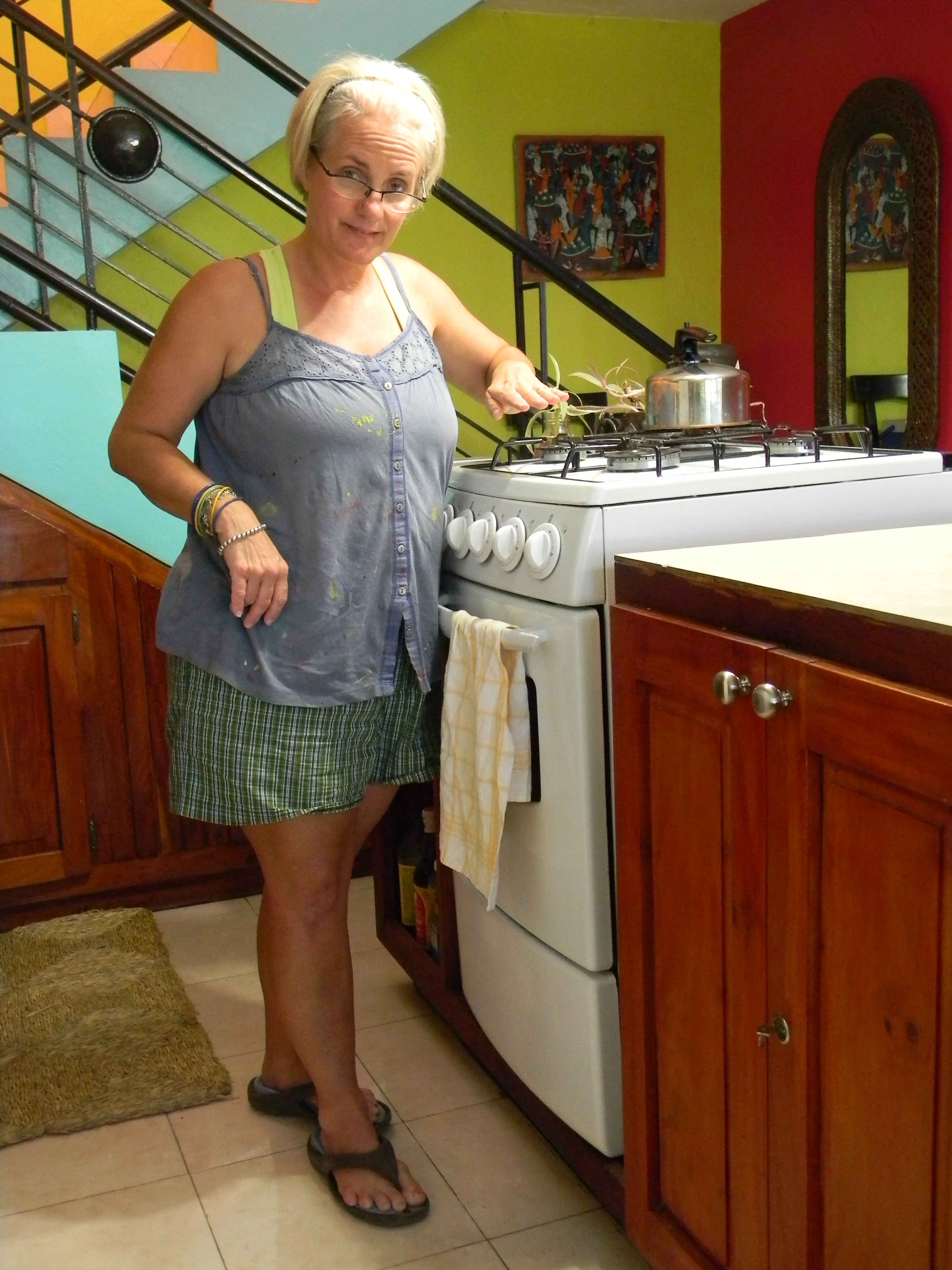
Kathy's Briarwood apartment, art table in foreground

I use the word “haven” here purposefully, as that’s exactly what the place was for me—one that sheltered and nurtured—a place I still think of fondly—one I would recommend to anyone needing an affordable and safe place to live, especially during difficult times.

It may have helped that I like old people—anyone aging who even remotely reminds me of my maternal grandmother—but then nobody ever really dislikes senior citizens, do they?  I mean, there aren’t exactly a lot of knife-wielding geriatrics wrecking havoc at local nursing homes. 

What I’m trying to say is that this was an easy group to get along with.  No crime, no noise—not even any walker or wheelchair races in the hallways.  If anything it was too quiet—a place where the biggest event of the day was the arrival of the mail carrier, who was greeted 6 mornings a week like a cancer-conquering hero—the bearer of tidings from the outside world.  Clearly, this was not a demographic that emailed much or got their news, medical or otherwise, via smart phone—not a tweeting, googling kind of group, for the most part. 

Kathy, Briarwood community room, building A, 2005

At any rate, I hope you’ll  tune in over the next several weeks, when, among other things, I’ll share some highlights about my years at Briarwood, introduce you to some residents who changed my life for the better, and maybe even dispel some housing myths, some misunderstandings folks naturally have about a kind of home they only see stereotyped on TV.

The elderly and disabled may not consistently rock the world of social media, but, this little-blogged-about demographic deserves our attention,  our willingness to share their stunning stories of wisdom, endurance, and daring.

Only then can we “write” a stereotype wrong.


Sanity Sucks (even on a Good Day)!


I’m not nearly  as crazy as I used to be.  Now you could say I’m even semi-sane–though I’m not sure that’s always an advisable way to survive the madness that is image-obsessed, media-driven, fast-food-consuming  middle America.

We may all be better off a little more crazy and a lot less obsessed with success.

However, and this is an over-sized qualifier indeed, my head has never quite figured out how to do sanity full-time.  If only it were 9 to 5 instead of 24/7.  That’s a lot more normal than I’m able to manage–even on a good day.

Too often still, my brain looks like this:


I feel the surreal that is this:

Eclipse
 
I enter the tangle
     of sleep
                    walk
     beside you into the thick
     of camel hair
                    coarse
     and without water
 
the hand, a sudden
     five-pointed mutiny
     against the decay
 
                    a nightmare
of folded sheets
 

So don’t worry if the dishes aren’t done, the laundry looms.  The kids are bound to grow into semi-civilized adults despite your best efforts.

Normal’s not all it’s cracked up to be.  So go a little crazy today.

Do something radical and off the wall:  GIVE YOURSELF A BREAK!

HGTV Premiers New Show (Does Haiti need to be HGTV’d?)


On Monday, June 6, 2011, HGTV (Home and Garden Television) premiers its new series, “HGTV’d.”  The network’s website says the show is for anyone who has ever wanted an HGTV makeover and that in each episode an HGTV designer “will arrive at the home of a viewer, surprising them with jaw-dropping makeovers and over-the-top transformations.”

Back in February, however, having read about this upcoming series (while still living in Port-au-Prince), I posted a piece called “Haiti needs to be HGTV’d.”

So, it seems only appropriate, since earlier this week I wrote about the Food Network and its disconnect from the “food insecurity” so much of the world endures, that today I share the February post again and comment (in light of this premier) on HGTV’s own culpability in not addressing the housing crisis so much of the planet faces.

(Please be aware that I’m a big fan of HGTV.  I watch it daily, at least when I’m in the US and near a television.  You should also know that the network does
support Rebuilding Together—”a nonprofit working to preserve affordable homeownership and revitalize communities” here in the US.   And I appreciate this effort.)

However, the network—though it airs shows such as “House Hunters International,” which follows the house hunts of ex-pats seeking to
relocate abroad–does nothing to share how the less-privileged
citizens of places like Costa Rica or Ecuador actually live, and it, moreover, does nothing to support housing projects in these countries—ones that would improve the standard of living endured by the poor in developing countries.

Perhaps, it’s not the responsibility of the network to do this.  Perhaps, this kind of programming wouldn’t sell.  Perhaps, people wouldn’t watch.

However, it seems reasonable to raise this question—especially in light of the series premier on Monday.

So, take a look at what I posted several months ago—photos of the housing crisis I witnessed when I visited a small Haitian village outside of Leogane—and tell me if you think HGTV has any responsibility to help a community like it:

Like many Americans, I love HGTV (Home and Garden Television).  When I go home to the US, I can’t wait to watch kitchens upgraded, bathrooms remodeled, landscapes transformed.

Whether I’m cooking with the ease of Lean Cuisine, laundering with the convenience of Kenmore, or cleaning with the miracle of Mop & Glo, I appreciate the perky background chatter of “Divine Design” (to learn more about the show click here) and “Design on a Dime” (to learn more about the show click here).

I enjoy segments on how to install bamboo flooring at a diagonal as much the next surface-obsessed, granite-loving, domestic goddess in North America.  Even when I’m at our house in Haiti, I complain about our stove, our oven, our cook-top.

It’s so small:

So tall:

—so not the stainless steel I have at home in the States.

But—(and this is a big BUT)

This past week I went with Sara to Leogane, a coastal town about 30 kilometers west of Port-au-Prince, close to the epicenter of the January 12th earthquake.  A United Nations assessment team deemed Leogane “the worst-affected area” in Haiti, with 80 – 90% of buildings damaged and nearly all concrete structures destroyed.

Just outside of Leogane I visited a community called Nolivos—

Where the houses look like this:

 a “Desperate Space?”

(To learn more about the HGTV show, “Desperate Spaces,” click here.) 

The washing machines look like this:

doing laundry for a family of 7 children

The kitchens look like this:

a “Sizzling Outdoor Kitchen?”

(To learn more about the HGTV show, “Sizzling Outdoor Kitchens,” click here.)

The sinks look like this:

the community well

And the stoves look like this:

a “Kitchen Impossible?”

(To learn more about the HGTV show, “Kitchen Impossible,” click here.)

Watching a woman cook dinner for seven on  a stove of sticks and stones, I wondered whether Vern Yip would be willing to bring a “Deserving Design” to this mother or another mother in the Port-au-Prince slum of Cite Soleil.  (To watch an episode of Yip’s series, “Deserving Design,” click here.)

I wondered whether David Bromstad (the designer featured in the premier of “HGTV’d”) would splash some color a little south of Miami.  (To watch an episode of  Bromstad’s show,”Color Splash: Miami,” click here.)

I thought:

Haiti needs to be HGTV’d!  (To learn more about the series, “HGTV’d,” click here.)

(and I thought I needed a kitchen remodel.)

Variations on my America (Excuse the Stereotypes, Please)


My partner Sara and I visited Southern Georgia last week—a town called Americus–a place that’s stereotypically small town America–America  in miniature–a place that, for me, is about  friendship, service, and fabulous feasting!

For many years Sara’s belonged to a group of female friends who call themselves the Breakfast Club—an assortment of bright and talented women who at one time or another worked in the world of international NGOs but originally met for breakfast on Saturday mornings at a place in Americus, Georgia called Kings Restaurant.

When Sara and I got together 5 years ago, I was inducted into this group of omeletpancakebacon-eating women, whether I wanted to be or not.  And, I must admit, I’ve never laughed harder or louder than I have with these funny and fun-loving female friends.

Though I’d gathered with members of the Breakfast Club in a number semi-exotic locations, before last week I’d never visited Americus, the group’s original home—something Sara and I refused to tolerate any longer.

But Americus, Georgia’s bigger claim to fame is Habitat for Humanity—an international NGO founded 35  years ago by Millard Fuller, an organization that builds decent, affordable homes in close to 100 countries around the world—an organization I’ve worked with closely: having my university students help build houses locally in Lexington; volunteering personally with the Jimmy and Rosalynn Carter Work Project in the Mekong; taking another group of writers to the slums of New Delhi where we worked with Habitat for Humanity India.

Habitat is an organization I’ve worked with around the globe, but one whose US home I’d also never seen—until last week.

(But I don’t want you to miss Americus either.)

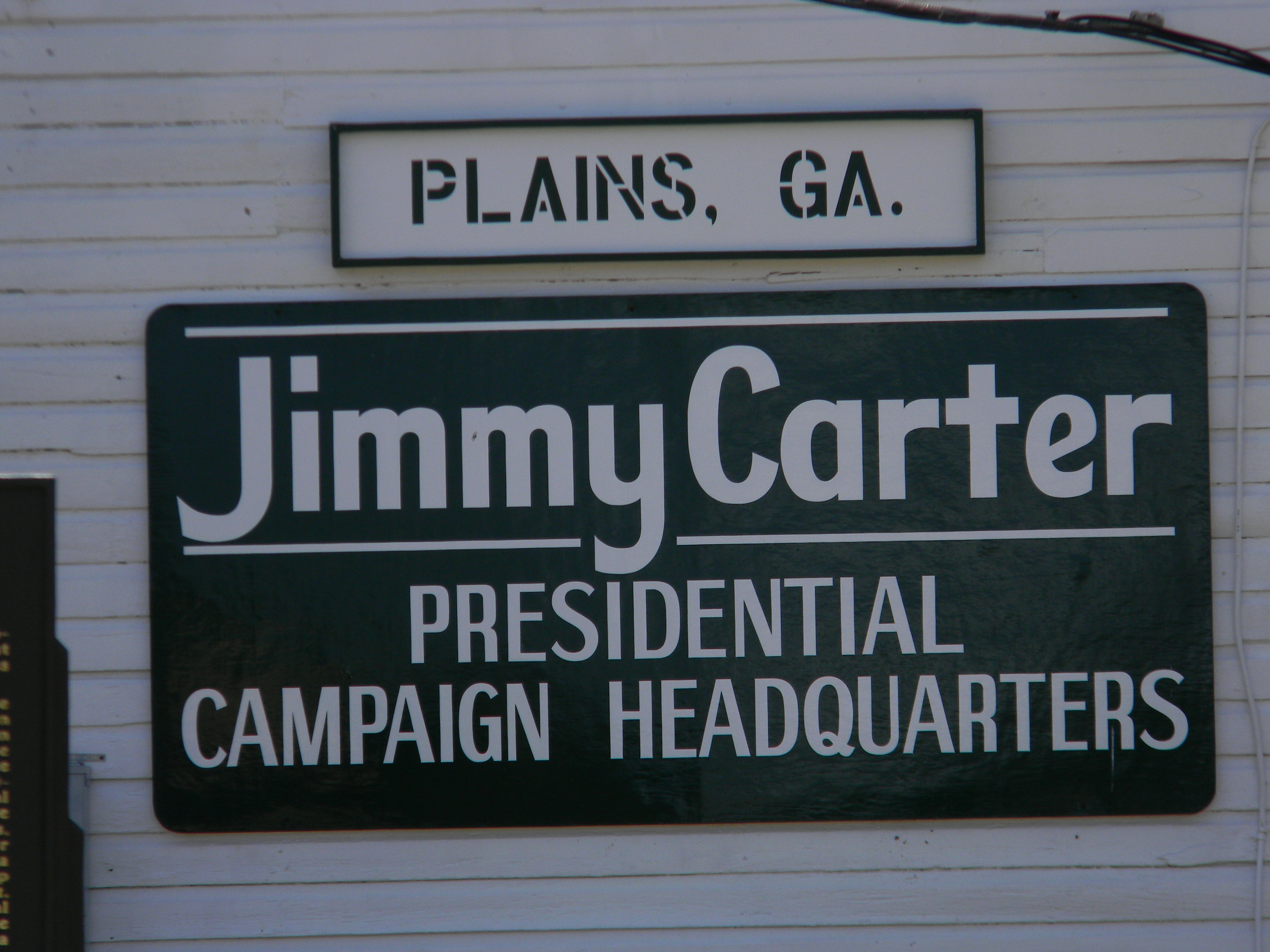
So, today I offer a pictorial tour of Americus as I experienced it—a sleepy, Southern town of 17,000 near Plains, Georgia, still the home of former US president Jimmy Carter— in many ways a tour of stereotypical America in miniature.

First, the charming Victorian hotel, the 53 room Windsor, where we stayed, an image of Main Street, USA:

The Breakfast Club’s Saturday morning meal is now eaten at Granny’s Kitchen:

There a group of strong American women gather around one big table:

Later that evening we had dinner at Donna’s, a small ranch home common in American suburbs–something my non-American readers may never have visited.  Notice the mailbox:

We had a ball:

I also got to hug the famous peanut in Plains.  Remember, Jimmy Carter, who still lives there came from a family of peanut famers:

I discovered that one of the many buildings in Americus that houses Habitat for Humanity, the Rylander, used to be a car dealership.  Is there anything more stereotypically American than baseball, apple pie, and Chevrolet?

I also learned that Habitat for Humanity industriously and ecomically prints all of its own publications—a massive work ethic in operation at the Sheffield Center:

We extended out stay in Southern Georgia by visiting Savannah and the seashore on Tybee Island:

But the best part of visiting Georgia remains returning to Kentucky.

So–as Sara’s sabbatical at home will soon be ending and we will soon be moving on to another (yet unknown) international location, I’m reminded that the best part about being away always involves returning home.

Though I know my America is not the America of many, for me, home remains American— as narrow as that America may be.

So, please excuse the stereotypes; I’m just enjoying home.

Saint Sara’s Celery and a Broth Debacle Averted


As Sara, the dogs and I struggle  to “suitcase”  a year’s worth of Haiti into a less-than-large shipping container (all in an effort to return to the US next week), please notice how our dog Lucy “assists” with the effort.  She has her paw in the sorting and boxing, packing and wrapping:

Lucy "helps" with the packing!

Lucy’s romp through our packing not withstanding, today, in the spirit of looking back and celebrating some of our biggest adventures  in Haiti, I bring you Part 2 of my Thanksgiving post.  (To read part 1 click here.)  Enjoy!

Yesterday, promising a series of posts this week about the difficulties Sara and I face trying to celebrate Thanksgiving from Port-au-Prince, I outlined what I called the “oven-related challenges” that could jeopardize our thankful feasting this Thursday.

Today, however, shopping-related issues take center stage—the consumer-driven hazards that could take down even the most well-intended and tradition-centered of holiday celebrations.  In fact, it may be that the more one tries to model any Thanksgiving feast in Haiti on the one Grandma would have catered, the larger the obstacles threatening it loom.

So, buyer beware.

Wisely, Sara and I anticipated some of these issues and brought back from the US several Thanksgiving menu items we thought might be needed—imagined we wouldn’t find here, even in the expat-oriented grocery stores in Petion-ville. 

But as you might expect (those of you who know my pathetic track record when it comes to poor packing), I anticipated incorrectly—finding here in Haiti what I did bring back but not bringing what I didn’t find.  Just my bad Thanksgiving luck!

Except for canned pumpkin—that is. 

Here I hit the pie-filling nail on its not-so-proverbial-pie-filling head.  I swear there’s not an ounce of Libby’s to be had on the whole of this damn island—cherry pie filling, yes—canned yams, yes—canned pumpkin in time for Thanksgiving pie-baking—no sir—none of it—anywhere.  And believe me, I have looked. 

But we need not worry.   I may not have a thermostatically controllable oven to bake the pie in, but I have a full 29 ounce can of “America’s Favorite Pumpkin” to put in it.

Now about the celery—

Here I should mention having a bit of scare yesterday morning trying to find this vegetable, almost as essential to stuffing as sage itself.  Standing in Giant Market (right here in Petion-ville), I came so close to a celery-induced heart attack, I was imagining, “What would Jesus do?”  What would the son of God himself (assuming he were a turkey-stuffing kind of carpenter) use in his stuffing were the stalks of stringy stuff not available?  If he turned water into wine, could he turn carrots into celery?

But, again, you need not fear, as Saint Sara herself performed the miracle, finally finding what she called a “not very robust” celery (but a celery-looking substance nonetheless) in the grocery store near her office. 

Catastrophe averted.  We are that much closer to a celery-ed stuffing inside our bird that’s to be roasted at a temperature the Father, Son, and Holy Spirit will themselves determine.

Then there’s the chicken broth—

Yesterday Sara sent me to the super market for some cans of it, among other things.   Actually, Giant carried the item in both the Swanson and Campbell’s variety—the Swanson, carton-ed with no added MSG and the Campbell’s, canned with all the blood-pressure-raising MSG one would ever want.  And being a health-conscious, not-wanting-to-consume-excessive-amounts-of-salt American, I selected the broth without MSG.  In fact, I tried to check out with three cartons of the stuff, since Thanksgiving dinner calls for broth in both the gravy and as a moistening agent in any well-celery-ed stuffing.

Here’s the hitch.  Though the store stocked the Swanson’s (over-stocked it, in fact)—they wouldn’t sell it to me.  And, if sheer quantity were any indication, wouldn’t sell to anybody, for that matter.  They couldn’ t figure out the price.  So, when, after thirty minutes of trying to determine one, no member of the sales or management staff could still settle on the number of Gourde to make me pay, I suggested they charge me anything. 

“Over-charge me,” I even offered—a concept they seemed not to grasp—though they seem to get it well enough when selling products on the street and doubling the price when any non-Haitian tries to buy.

But undeterred and unwilling to waste any more of my time-is-money American minutes, I gave up, bought the cans of Campbell’s, and headed home, risking ill-health all the way.

So the bottom line is this— the shopping obstacles, though they were multiple and at times bizarre, did not obstruct in any hugely significant way.  These were more imagined obstacles than obstacles of real substance—

So Saint Sara, the wise and proper packer, was (as she is in all things) probably right about this, as well–

—Since the anticipated shopping obstacle was, like the celery itself . . .

. . . “not a very robust” obstacle after all.

Have you had any strange, even borderline bizarre, shopping experiences?

The Butterball Challenge (Haitian Style)


As Sara and I continue to pack up our lives here in Haiti, and I continue to reflect and reminisce about some of Haiti-related “challenges” we’ve faced over the last year, I simply must share, for those of you who may have missed it, the following about our effort to prepare a sit-down Thanksgiving dinner for 24 under, shall we say, less-than-ideal conditions:

In honor of the upcoming holiday, I’ve decided to share, over the next several days, a few of the challenges we’re facing trying to prepare Thanksgiving dinner from Haiti.  So stay tuned all week for the sometimes amusing, sometimes maddening, sometimes mind-numbing complications that inevitably arise when celebrating this most American of holidays in the least American of locations.

Today I give you the oven-related challenges.


Is my Haitian oven up to the Butterball challenge?


I told Sara when we were looking for a house here in Haiti, that I simply had to have an oven.  Neither of the two homes we had in Vietnam had anything other than a cook top in the kitchen, which bothered me to no end, since I like to bake—cookies, cakes, biscuits, pies, muffins.  The only thing I like more than making them is eating them, but that’s another post for another day.

 So Sara did what any Tollhouse-cookie-loving partner would do.  She got us an oven—a real honest-to-goodness gas oven—minus the thermostat.

 I kid you not.  There’s no way to set any specific temperature on this most essential of kitchen appliances, any temperature either Fahrenheit or Celsius.

 Now, I love Sara more than anything, even more than my daily dose of cake and cookies, and those of you who know my inclination toward carb-consumption, know that’s saying quite a bit.  But sometimes she misses the most obvious of details.

 “Oh, that’s not that important.  You’ll figure that out.”

 Twelve attempts and twelve burnt batches of cookies later, I’m still figuring. 

 Which brings me to the matter of needing an oven this week, a temperature controlled oven, I might add.   In America we can’t celebrate Thanksgiving without pumpkin pie.  It’s the most Thanksgiving of Thanksgiving desserts—even when celebrating from here in Port-au-Prince—especially when celebrating from any far-away, cholera-sickened, earthquake-toppled part of the planet!

 A pumpkin pie likes to bake for the first 15 minutes at 425 degrees Fahrenheit and the final 45 to 50 minutes at 350, temperatures too precise even for the oven thermometer I brought back from the US.  It only seems to get me in the ballpark of a particular temperature, give or take 100 degrees. 

 But what about the turkey Sara plans to roast, what about the thermostatic requirements of the old Butterball?

 Oh, that’s not that important.  She’ll figure that out.

Have you had any memorable Thanksgiving dinner disasters?

Top 10 Things to Remember about Letting Go


For whatever reason, I don’t do well with change.  I don’t do well with uncertainty.  I don’t do well with loosening my white-knuckled grip, that over-my-dead-body,  I’ll-be-damned grip on absolute control of almost everything.  I like to know what’s coming and where I’m going because of it. 

Bottom line:  I’m kind of a control freak in this regard–not good–and something I’m far from proud of.

But when your partner works in disaster response, life is almost always about change, adjusting to change, to sudden shifts, loosening that grip.  That’s the thing about disasters.  They’re so, well, disastrous.  And you never know when they’re coming.  You never know where.  You never know when.

So in honor of my own issues with uncertainty and in anticipation of Mindy’s post tomorrow about accepting change, today I bring you the “Top 10 Things to Remember about Letting Go.”

  1. That letting go is about control and a willingness to give it up.
  2. That letting go is about strength.
  3. That letting go is about tomorrow.
  4. That tomorrow is coming soon.  (Remember Little  Orphan Annie’s anthem to tomorrow:  “Tomorrow, tomorrow.  I love you tomorrow.  You’re only a day away.”)
  5. That letting go means waiting willingly for what’s to come.
  6. That it sometimes means “good-bye.”
  7. That it often means “adjust.”
  8. That it forces us toward faith.
  9. That it requires us to trust.
  10. That it nudges us toward tomorrow, that it requires us to trust that God, or the universe, or the kind hand of a friend will take us where weeed to go.

The bottom line is this:  I can no longer be a tip-toed toddler teetering toward tomorrow.  Neither, at the other extreme, can I be a control freak, forecasting my own future,  frothing to make it less frontier and more toddler-friendly.

I need to remember what Joseph Campbell said: “We must be willing to let go of the life we have planned, so as to accept the life that is waiting.”

So, yes, letting go is often about waiting.

And it’s also always about accepting–

Letting go, letting love.

She Sheltered Me (In the Shelter of One Another, Part 2)


Today I’d like to welcome my friend and fellow writer Mindy Shannon Phelps to “Reinventing the Event Horizon.”  Mindy’s  guest post is also about “sheltering,” a topic explored in yesterday’s poem and one inherent to the recovery effort here in Haiti.  Mindy’s narrative negotiation of this issue–an event horizon of its own–is stunningly poised and powerfully moving.  (Mindy’s bio is below and her post “She Sheltered Me” just below that.  Mindy will personally respond to comments, so feel free to ask questions.) 

A journalist by training, Mindy Shannon Phelps is a project management and communications specialist.

Over the past 17 years, her clients have ranged from Habitat for Humanity 
International and the US Department of Justice to the FEI World Equestrian Games and the Henry Clay Center for Statesmanship, which she launched in 2007.  As a consultant, she focuses primarily on not-for-profit organizations.

As a wife and mother, she says she is humbled by the grace and love of her two daughters and husband, who encourage her to “write it down.” She does write – prose and poetry – and she is an editor, as well.

Her maxim: “Woman hath no greater satisfaction than editing someone else’s copy.”

________________________________________________________________

She Sheltered Me

It was the spring of 2004 in one of the worst years – work wise – of my life. I had been hired to transform a well-known non-profit organization from an affiliate of the national group to a state-only organization.  The group’s mission was completely embraceable – justice and fairness for all – but the group was hamstrung by about 60 long-time stakeholders – board members and advisors and founders – who each decided to be my boss. I also had an entrenched staff that I simply could not manage.  My associate director made Machiavelli seem like a decent person.

I could not win for losing. 

One morning, on the drive to work, I stopped at Starbucks and stood in line behind a very odd person.  She was very colorful.  A black lady whom you could immediately recognize as being from Africa or the Caribbean.  Not used to the chill March weather.  Bright knit cap and scarf. Bangles and rings and clothing that seemed to surround, rather than actually fit, her body. Sneakers and thick socks. Carrying a knapsack and a small pair of bongo drums, she was about to beg the barista for coffee for one dollar. Before she got to the counter, she turned around to me and told me I was a “rainbow child” and that I blessed her with my smile. 

She turned to the counter and the barista refused her request.

She hurried out the door. I was troubled that I did not quickly step in and get her some coffee. But I could see that she frightened the clerk and the customers. And she, herself, was frightened.  So I got my own coffee and went on my little way.

She walked across the street and I overheard her asking for directions to Main Street. I really wanted to pick her up and debated with myself through a light change, then crossed lanes and stopped and offered a ride. 

We sat for a minute and chatted and she explained how she had traveled from Jamaica to live with her sister – had sold $2000 worth of jewelry that she makes – and her sister had taken her money. My passenger was headed to the Hyatt Regency downtown to stay the night.  Her sister had a reservation. 

You know, I like to think I at least try to take people at face value. But I’m just as shallow as they come, really.  I wasn’t sure I believed this woman’s story. Making it even more difficult were comments that interspersed her narration, such as, “but, you know, I am not worried because God takes care of me.  We are all His children and He loves us.  I used to be a rainbow but now I am here.” I was with her on God’s love but the rainbow metaphor was beyond my ken.

Then she told me something I had always believed. 

“We need to continually stay in prayer.” With that, she began reciting the Lord’s Prayer and I headed the car down the road.

When I got to Main Street, I pulled into a parking lot next to a bakery. I don’t know why I didn’t just take her all the way down to the Hyatt. It was as if I was dreaming and did not have control of the car. This is what she told me in that lot.

“God bless you.  Be on your guard. Satan has demons driving on the streets today.  You are under attack and you don’t know it.  You need to call on Michael. Do you know Michael, the archangel? He’s my angel and he will be your angel, too.  You are God’s child and He loves you. You and I will see each other soon in paradise. We’ll be so happy then!”

All of this, she repeats, several times.

I began to weep because she touched something I didn’t know needed comforting. My heart.

The lady from Jamaica had blessed me and she was of God; that I knew. And I think God was there in the car with us and so was Michael, the archangel.

Before she got out of the car, I fished into my wallet and gave her a fifty-dollar bill. It was my two-week “allowance.” I felt as if I were giving it to God.  

She cried when I handed it to her.

I never saw her again.