




We have weird television habits at our house on Fourth Street. Sara and I are tunnel-visioned and singularly focused, like my nephews, watching Star Wars incessantly—Hans-Solo-ed and Darth-Vader-ed to death. Except for us it’s not science fiction we’re obsessed with, but rather all things HGTV for me, and equally everything Food Network for Sara —each of us bleeding decorating and duvets or butter and broth.

For example, when we’ve been home in the US in recent years, my partner has watched entire seasons of “Top Chef”—appetizer to dessert—beginning to end—over and over—till the next-to-last chef packs her knives, and I am able to quote entire dinner dialogs off the top of my head, guest chef judges sound-tracking our complete Christmas visit, critiquing candied carrots and pickled beets till we are out the door again, and back to Port-au-Prince, where, thank God, we were without TV, and Sara was forced to download podcasts on how to cook the perfect omelet, and we ate eggs, well-whisked and gorgeously prepared, morning, noon, and sometimes even night.
Aha, you say, “Top Chef” is not a Food Network series, but that fact conveniently leads to my next television insight—namely that each of us has a secondary network of choice. And Sara’s second best is Bravo.
“Flipping Out” and “Tabitha’s Salon Takeover,” with their hard-core management styles and bad ass attitudes toward employees are two of her favorite, which amazes me, as she is kind and mentoring toward her staff and doesn’t generally try taking over, even at home. Instead she leaves domestic commandeering and flipping out for me.
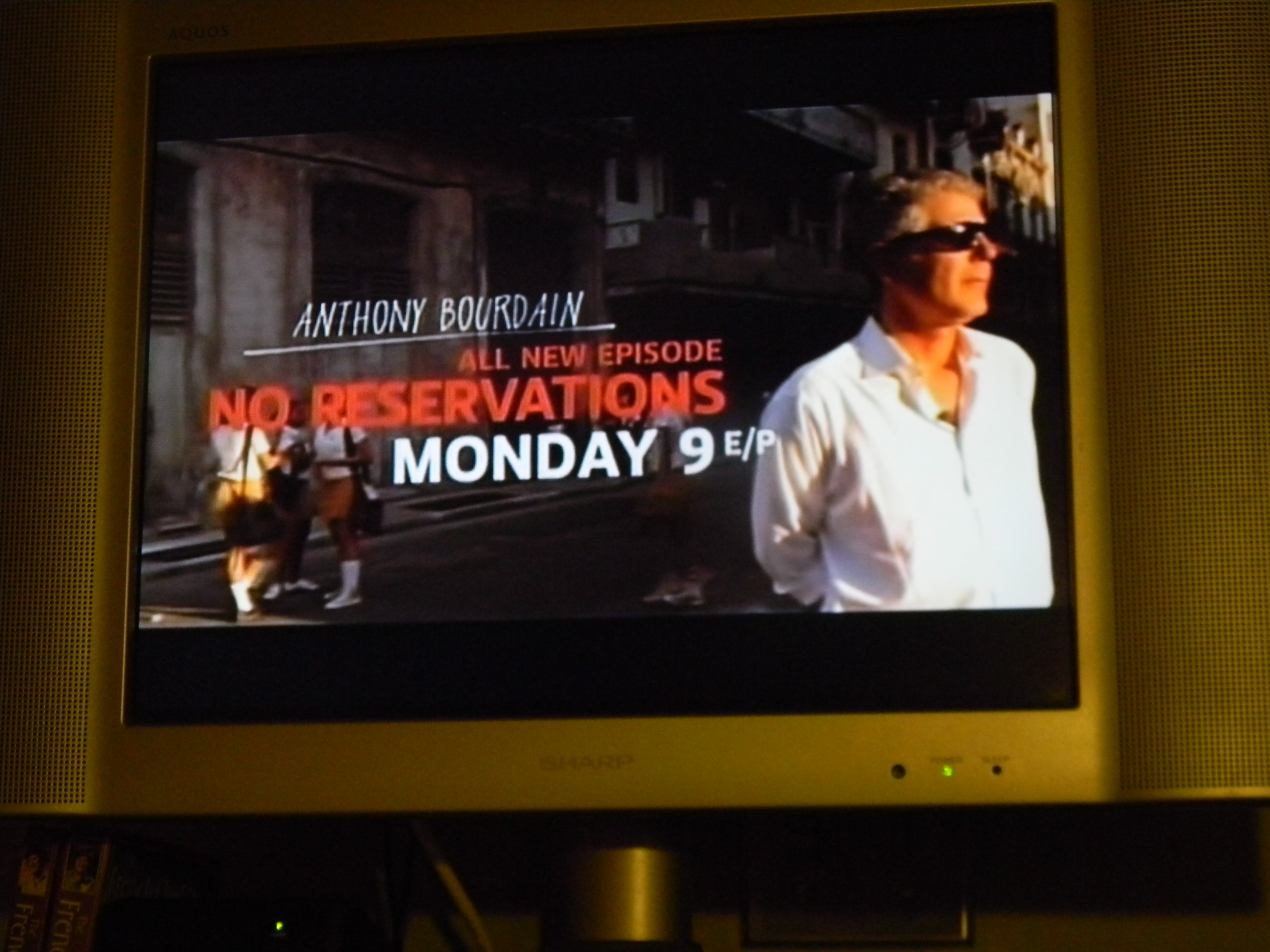
Admittedly, Sara has more well-rounded television interests than I. She deviates from food-related programming more than I do from HGTV. In addition to Bravo, she enjoys the Travel Channel, especially Anthony Bourdain’s “No Reservations.” But then I like Tony, as well. Somehow his vulgarity adds drama to our aging, early-to-bed, lesbian lives.
Sara also watches “Bizarre Foods”—the series, in which Andrew Zimmern travels to exotic places and eats things most of us would try to avoid in everyday life—things like grasshopper and rattlesnake, cricket and caribou—mostly creepy-crawly things and things with wings. He eats bats, for example, and tons of testicles, the balls of almost any mammal worthy of having his private parts sautéed in olive oil or lots and lots of butter.
However, if you knew my taste in television you would understand that I am way, way weirder than Sara—more singular in focus and borderline bizarre—willing to watch only two kinds of programming—those related to homes, and others nearer to news.
I’ve indicated before on this blog that I’m a fan of HGTV. However, I’ve not yet confessed just how decorating-obsessed I happen to be. For example, I live to see David Bromstad splash color from one end of Miami to the other—South Beach to Bal Harbor—Dade County dripping—a decorator’s delight. (To watch an episode of “Color Splash Miami,” click here.)
By far, however, my favorite HGTV series is “House Hunters International,” as it has, in recent years, paralleled my own ex-pat experience—going abroad, searching for housing, deciding what it takes to settle down domestically in a place far from home. In some cases, I’m fascinated by cost—or the lack thereof—the hugely affordable urban apartments of Bangkok, the fabulous beach front flats in Ecuador, the Dominican Republic. I fanaticize. I dream. Life by the sea at give-away prices.

an episode of "House Hunters International" in the Dominican Republic
At the same time, however, I’m also a huge fan of cable news—especially CNN—an obsession that kicks in especially during US presidential election years and massive natural disasters. Largely CNN is for me what Bravo is to Sara—background noise—but in my case, at least not meaningless chatter—rather information and discussion of globally impactful issues—or in my case, regionally focused narratives what will affect me in distinctly global ways.
Since my partner Sara works in disaster response, sometimes stories about earthquakes or tsunamis become personally significant. The Haiti earthquake, for example, meant leaving Hanoi, the place we called home at the time, and eventually settling in yet another remote location—Port-au-Prince. Since Haiti has nearly non-existent or non-functioning infrastructure, perhaps, I watch cable news, and even “House Hunters International” to figure out what will make me a happy camper in similar locations, or happy camping, as the case may be.
So, given our globe-trottingly eccentric lifestyle, perhaps, both Sara’s and my programming choices are understandable and not as weird as I’d thought. In fact, maybe it’s not our approach to television that’s exceptional, but rather our disaster-responding lifestyle that is borderline bizarre—living without screens in malaria-plagued places, surviving without electricity in countries infernally hot, locations where fans, not to mention air conditioning would have made worlds of difference.
But then again, that’s what we want our lives to be. Living in comfort is second-rate compared to making meaning and making a difference.
And the year we lived in Haiti, we had no television except when we came home on holiday—so maybe that fueled our viewing eccentricities. “Top Chef” droning non-stop in the background at least gave my partner a break from poverty housing and humanitarian aid, the ups-and-downs of responding to disasters in distant places.
So, maybe, this post is less about television and more about living life on the edge, less about meaningless programming and more about making meaning in a stressed-out, crazy world, where sometimes the earth shakes in places like Haiti, buildings collapse and lives are lost—but sometimes babies are saved, sometimes families survive, sometimes dreams can endure—hope pulled like prayer from the rubble—
—television or not.


 Kathryn M. McCullough