Blogging Buddies mean Blogging Bliss


Surprise!

Surprise!

Surprise!

Sorry to sound like a bad echo of Gomer Pyle, but gosh, darn—comments to yesterday’s post, a news update about Haiti, did indeed surprise me.

So today’s post poses some questions I’d most like my readers to answer—please—I’m down on blogging hands and knees begging for feedback!

First a bit of background—some random notes on how my thinking about blogs is evolving, thoughts that I think will put my questions in context.

(Please know I’m new at this whole blogging thing—so if you’ve been around the blogosphere for ages and all of this to you is old hat—then this post probably isn’t for you.  But, I’m a relative newbie, so bear with me.)

Yes, in 2009 I started a blog meant to follow the adventure we began when Sara returned to international disaster response work and I stopped teaching, followed her into the field, attempting to tell our story.  However, that material (archived on this site) was only read by friends and family.  I did nothing to attract outside readers—rarely more than 10 people read each post.  If we don’t count that—I’ve been doing this for a mere 2 months, so please forgive my naïve enthusiasm, my gawking and gaping—a country girl on her first trip to the big city of blogging.

But truly, what amazes me most about blogging is the sense of community I feel.  I know I’ve mentioned this before, but surely not all bloggers experience the kind of connectedness I feel with those who read my blog and with those whose blogs I read.  If so, WordPress wouldn’t be setting up a blogging buddy-system of sorts—because no one would need it—everyone would already be connected and buddied and belonging.

(I sometimes wonder if I was just lucky enough to stumble into the right group.  Cause I’m new and I feel fully embraced.  Several bloggers have emailed me over the last month or so—offering unsolicited words of caring, kindness, and down-home neighborliness.  I’ve been welcome-wagoned into blogging bliss.)

However, the following questions have come out of this evolving awareness of community and reader involvement in the blogging process.  I pose them to you whether you’re a regular reader here or just stopping by for the first time:

First, I wonder what among the issues I’ve raised, the many topics I’ve explored (a truly eclectic range) would you like to know more about?

I’ve shared some of my art, some of my poetry, some of my personal history, some about the evolution of my relationship with Sara, some about Sara’s work, a bit about my work in India, some thoughts about writing.  But what interests you the most?  And do you have any specific questions I might be able to answer in a post or a series of posts?

I realized for the first time from some of your comments yesterday, that the media in the US and other countries is likely not covering Haiti adequately, that you are not getting the news that you need, the news you deserve, the news Haiti needs you to hear. 

What else do you need to know, or what else would you simply like to know?  What kinds of posts would like to see more frequently?

Please know how much I appreciate your taking the time to read my blog.  I’d just like to know how I can even better serve your reading needs.

In the meantime, I hope you’ll continue to surprise me with your comments, your questions, your care and concern for a country in crisis.
If only I (k)NEW(s)!


Earlier this week my friend Lisa at “Notes from Africa” suggested I begin periodic news updates about Haiti.  I thought that a fine idea, as most of Lisa’s are, so today I’m here to deliver news, of sorts.

“Why ‘of sorts’?” you might ask.

A reasonable question—

For here in Haiti, the fact remains, it’s hellaciously hard to get good news.  And by “good news” I mean accurate news.  More often than not, I’m misinformed, ill-informed, or not informed at all.  More often than not I’m confused.  More often than not I throw my hands in the air and exclaim in utter and complete newsless-ness, “C’est la vie, la vie.”  Indeed—whatever will be will be—cause I’m not gonna be able to change it and I’m sure as hell not gonna know about it ahead of time.

In Haiti I think we have accurate news about like we have free and fair elections—rarely, if at all.

But here goes.  Here you have—

Haiti’s Week in Review:

Earthquake anniversary

If you’ve been reading this blog, you should know that January 12th was the one year anniversary of the earthquake that devastated Port-au-Prince, an event which, I hear, got significant coverage in the US and around the world.  (I know the national director for Sara’s NGO here in Haiti was interviewed on CNN the night before last.)

–At least 230,000 were killed.

–More than 300,000 were injured.

–Only 5% of rubble has been cleared in the last year.

–Still 1.3 million are homeless in and around Port-au-Prince.

A couple of great articles on the anniversary have appeared at Time.com this week.  I suggest you take a look at:

                “Who Failed on Haiti’s Recovery?”

                “Haiti’s Quake, One Year Later: It’s the Rubble, Stupid!”

 Cholera

Not as much in the headlines this week, but I heard in an interview on NPR this morning that we are officially in the epidemic phase of the disease. 

–The death toll as of yesterday was 3, 759 according to the Haitian Health Ministry.

–Officially 181,000 have been sickened to date.

For more news on the cholera outbreak I recommend an article from the Montreal Gazette:

                “Haiti cholera toll tops 3,750”

Haitian Presidential Elections

Here’s where things get complicated and more than a little fuzzy.  And here’s where I wish I knew a whole lot more, not only because it’s important to the democratic process, but also because, in purely practical and selfish terms, what happens here over the next several days will impact my life most significantly.

First a bit of background in case you’re new to this issue: 

–On November 28th Haiti held nationwide elections, with 18 candidates running for president.

–Ballot boxes arrived at polling places stuffed with votes for the candidate from the ruling political party and soon-to-be son-in-law of current Haitian president Preval—Jude Celestin—causing most of the other candidates to accuse the government of fraud.

–Rioting broke out when election results were announced a week later and the top two vote-getters were Mirlande Manigat and Celestin—excluding hugely popular musician candidate Michel “Sweet Micky” Martelly from a run-off between the top 2 vote-getters on January 16th.

–Port-au-Prince streets calmed down when Preval’s government agreed to a recount of votes by the OAS (Organization of American States).

–The announced results of that recount have been delayed multiple times since December 20th, when they were originally to be made public, so the January 16th run-off has been delayed.

–Official results of that recount have yet to be announced.

However—and this is a big “however,” indeed—

–Monday results of that OAS recount were leaked to the press.  And BBC News reports that the OAS will recommend that the candidate from the ruling political party be disqualified from any run-off.  If this story interests you, check out the BBC piece,

                “OAS to give Haiti presidential election verdict.”               

 What does this all mean? 

There was actually some debate about this at a dinner party Sara and I hosted the other evening, but I will mention an idea discussed by folks who had just left a meeting with presidential candidate, Lesley Voltaire.

Our dinner guests mostly speculated which announced outcome would result in the most violence on the streets of Port-au-Prince and when that announcement might be made.  Some thought that announcement could come as early as last night, which didn’t happen, but was more likely on Sunday evening, January 16th.

Surprisingly to me, most agreed that more violence would result from Jude Celestin being left out of the run-off, since Preval’s government would pay protesters to take to the streets, despite the fact that few in the country actually support Celestin’s candidacy.  They said the omission of Martelly from the run-off would cause problems and likely riots, but fewer problems than Preval could pay the poor to incite on the streets.

So, there you have it, folks, the news from Port-au-Prince, as I know it.  Yes, I wish I  (k)NEW more—but I don’t.  We’ll just have to see what happens Sunday, whether an announcement is made then, and if so, who will be allowed to participate in a run-off.

The last time an announcement came, we were stuck in our house for 4 days because of city-wide violence.  For descriptions of that rioting and how it affected our lives you should click here and here  and here .

I’ll keep you posted———-

Blogging with Conscience: How Your Voice Can Make a Difference


I have a confession to make—

I’m at a loss—

A complete, honest-to-goodness, in-a-good-kind-of-way loss—cause I have no idea—no earthly idea (in a world where sometimes bad things happen to good people) how to thank those of you who reached out and supported Haiti yesterday.  Whether you yourself posted about the earthquake that leveled Port-au-Prince a year ago, commented on my blog, or simply read any other Haiti post, whether you’re reading for the first time today or for the twenty-seventh, I thank you.

Whoever you are, where ever you are, if you are reading this, you are, at least indirectly, supporting the recovery effort in Haiti.  And, good God, please know how grateful I am for that—so truly thankful for your caring, your sharing, your giving voice to the voiceless!

I’m one of those people who believe writing has the ability to make a difference in the world.  In fact, I created a program called “Writers without Borders” that took a group of university writing students to India, where we completed a service learning project with Habitat for Humanity.  We spent two weeks in the slums of New Delhi this past May, interviewing families and creating promotional material that Habitat India could use on its website.  We wrote feature articles, photo essays, even created an audio slide show.  It was a profound experience for all of us, but more importantly it was an opportunity to realize how writing, in very practical ways, can make the world a better place.  It was an opportunity to be that difference.

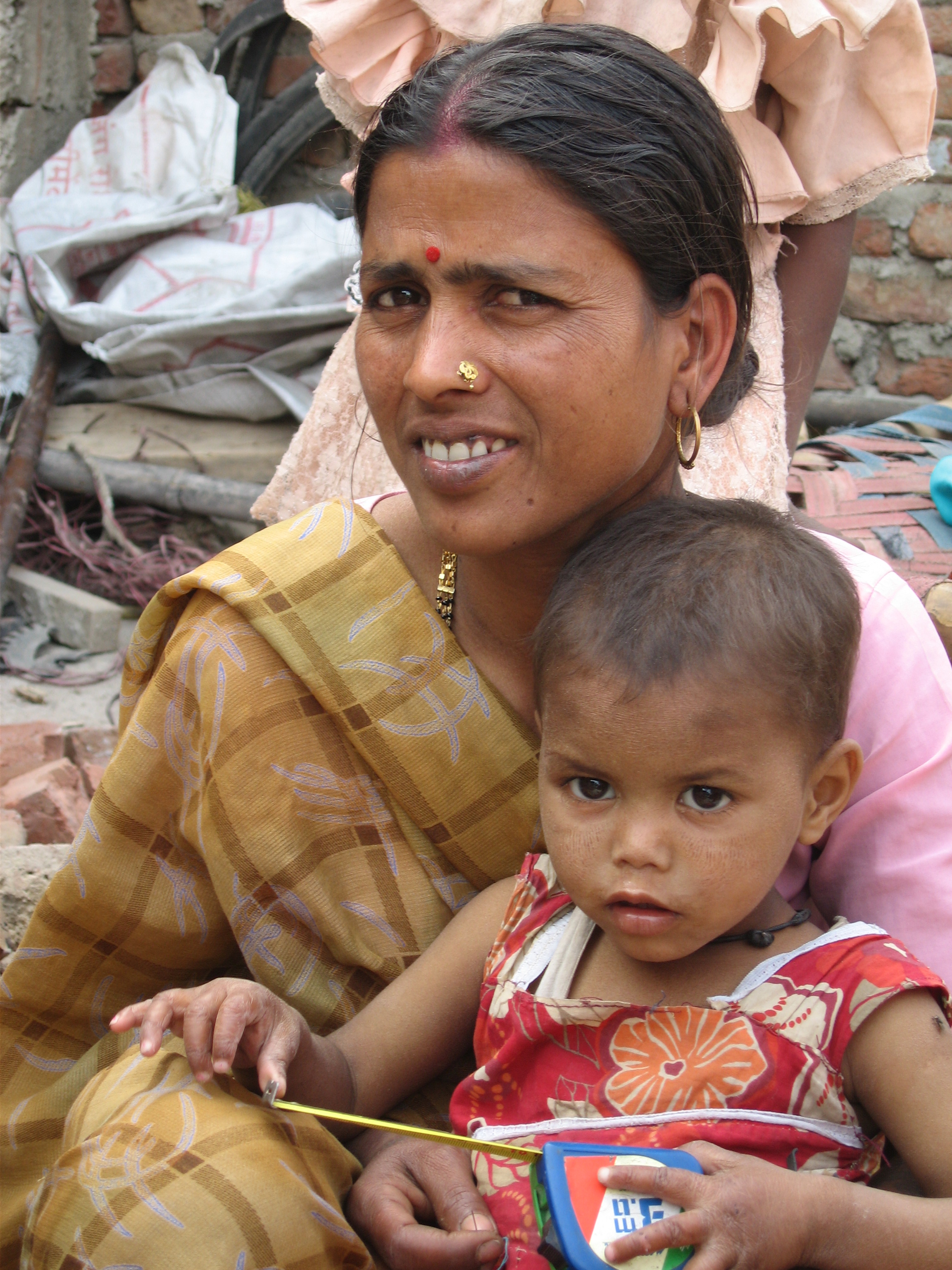
Mother and child in New Delhi slum (photo by Kathryn Reid)

As someone who teaches composition, I believe it’s important to emphasize to students (and by extension to all of us who write), that good writing amounts to more than style, that quality writing can also be a matter of conscience, that we, as writers, are obligated to use our gifts wisely and sometimes that means using words to benefit others, to speak for those who are otherwise silent.

Given this, I’d remind those of you who blogged for Haiti yesterday, and all of you who write for any reason, that words have power—power to change the world—power to make Port-au-Prince a better place—power to make a difference in your home town, on the street where you live.

I don’t know exactly what we as bloggers can do for Haiti, how concretely we could organize to make the world a better place, but I’d love to hear your thoughts.  Do any of you have ideas, dreams, strategies?

Alone, I am only one voice, but together we’re a chorus capable of greatness.

Haiti’s 35 Second Tragedy: a Second Chance for Peace


A mere 35 seconds nearly sealed the fate of Haiti. 

At 4:53 pm on January 12, 2010 an earthquake lasting just over half a minute devastated Port-au-Prince, killing close to a quarter million, injuring hundreds of thousands more, and leaving, still one year later, more than a million homeless in and around the Haitian capital.  The earthquake may have leveled Port-au-Prince  in half a minute, but cholera continues to kill Haitians by the thousands.  Every 35 seconds more are sickened.   More die needless deaths.

It’s not a pretty picture.  There’s nothing pretty about Port-au-Prince.

And as an outsider, clearly, I know nothing about the real suffering of the Haitian people.  I know nothing of a mother housing a family of 14 children in a tent the size of a suburban bathroom, nothing of another mother trying to quiet a baby crying in the dark, while torrential rain turns the ground beneath her tiny tarp to liquid mud.

How can I, a privileged white woman from a wealthy nation, speak of Haitian pain with any real authority?  

The fact of the matter is I can’t.  I have no right.  I have no knowledge of not enough food to eat or no clean water to drink.  I can only speak of what I see—

And what I see—every 35 seconds—is a city still in ruin.  I see the weary but not teary eyes of human beings too stunned to grieve even colossal losses. 

I may indeed presume too much, but I am here in Haiti on this historic day and I will take 35 seconds to pray for Haiti—

To pray for peace in the mountains that circle Port-au-Prince this morning.

Please take 35 seconds to share this prayer with me.  Take 35 seconds and pray for peace in Haiti.

Please Post for Haiti: Pressing Port-au-Prince


As many of you know, tomorrow is the one year anniversary of the Haiti earthquake and accordingly huge numbers of media and NGO big wigs are here in Port-au-Prince to commemorate the event.  The streets, still strewn with 95% of the original earthquake rubble, are more crowded and crazy than ever, which is saying a lot for a city whose roads boast potholes the size of swimming pools and mounds of debris that dwarf the SUVs that try to travel them.

So, I’m back in this city I love, hoping to participate in some small way—hoping to commemorate along with many others, both here and around the world, a catastrophe that shook this nation to its historic core, killing nearly a quarter million and leaving, still today, more than a million homeless in Port-au-Prince, entire families living in tents and under tarps that remap the landscape, blanketing the city in a patchwork of sadness and resignation–the hillsides and former parks of Port-au-Prince quilted in the aftermath of tragedy.

Tomorrow the American Refugee Committee is organizing an event called “Bells for Haiti”—asking churches, schools, and city halls across America to ring their bells for 35 seconds, beginning at 4:53 pm EST—the time it took the earthquake to topple Port-au-Prince one year ago.

Likewise, I’m asking those of us at WordPress to somehow remember the Haitian people in our blogs tomorrow.   

Please post for Haiti on January 12th

I don’t know how.  I can’t tell you what to say, since I myself fell muted by the enormity of what we face here.  I’ll post my part, but it won’t be enough.  My voice isn’t loud enough.

But I know the blogosphere can raise a collect cry against the pain and suffering that still cripples Port-au-Prince, still haunts all of Haiti.

So, please press your words for Haiti tomorrow.

Post!  Pray!  Remember!

(And if you’re willing, please re-post this request to your own blog to help spread the word.)

Haiti in your Face


I’m pleased to share——-(drum roll)—————

I will be heading back to Haiti Saturday, after 3 weeks in the US—21 days so far since my American Airlines flight landed in Miami and I had my first night in several months with an uninterrupted supply of electricity.  I guess Friday will be my last for the next 90 days or so.

Which raises the question—

What comforts from home will I miss most in Haiti?  Over the next several days, I’ll share them here, a way to gear up for this transition.

Clearly, however, electricity tops the list.

Now, I’ve been without power before in the US, without the luxury of electricity for 6 days straight during an ice storm in Kentucky some years ago.  But being without this utility here at home is entirely different from being without in Haiti. 

For example, no electricity for several days means near disaster in most of North America.  No one knows what to do or how to manage the tasks of daily living, so folks function on the adrenaline panic produces during times of crisis.  Citizens of Kentucky jump into fully fueled cars, drive to Lowes or Home Depot, grab all the batteries, flashlights, and candles money can buy this side of Port-au-Prince.  Normal life is temporarily interrupted. 

It takes several powerless days to shift into “picnic mode” and celebrate with neighbors round a fireplace, all hoping to stay warm on icy February nights.  

People play games.  They pop popcorn on the stove top (gas, of course).  They become families and neighborhoods once again–helping one another survive this bout of being without. 

The local utility company may take longer than they’d like to get things up and running, but folks maintain a basic faith in the system, a security that only a strong and stable infrastructure provides. 

They believe.  They know. 

The lights will come back on and all will be right with the world—a reality interpreted largely in terms of how well one sees at night. 

Eventually, neighbors go back to FaceBooking  in the evening, doing status updates out the ass—rather than playing Monopoly or Clue around the kitchen table—really seeing the shadows candles cast on the faces of their children—the shades of gray and flickering light—Sally’s chin that’s strong and Bobby’s dimples winking in the nearly dark. 

In Haiti it’s an entirely different affair. 

If we happen to have power when we wake up in the morning and even less likely happen to have it when we fall asleep at night, Sara and I marvel to one another:

“Do you think we REALLY had city power all night?” (What in Haiti we call electricity that comes from something other than a generator)

“Well, was it on when you fell asleep?”

“Yeah, it was.”

“And you’re sure you didn’t just forget to turn the generator off?”

“No, if you didn’t turn it on, I didn’t either.  Had to be city power!”

Craziness—

We marvel at the having rather than the not.

But Sara and I are spoiled.  Though we often face the threat of diesel running low—at least we HAVE a generator.

Most folks in Port-au-Prince, on the other hand, truly DEAL with darkness every night.  Without the ability to generate power, they struggle to help children with their homework—that is, if they can actually afford tuition, if they can actually afford to buy a candle for their kids to study by.

Eyes adjust to lesser light—the dim of half-light becomes a way of life.

But now—

As I prepare to return to friends on our Caribbean island—now that I once again have grown to expect bright light at night—20 good evenings in the US—it’s time to return again to the dimly lit faces of my Haitian neighbors.

To look them fully in the face at night—

And see the contours courage carves.

Risk Management in Port-au-Prince: a note of clarification


My blogging buddy Lisa (again at “Notes from Africa”) raises an important point in a comment to yesterday’s post—one, in fact, that helps me realize just how lost I sometimes am inside my own perspective—looking at Haiti from the inside out—(not that I’m a real “insider” by any means).  It’s just that, as the name of this blog suggests (“reinventing the event horizon”) to come to Haiti is, in many ways, to cross a virtual “event horizon.”  Things get twisted here, turned inside out, spit out, inverted, and reinvented!  So I should try untangling a few details for the sake of clarity.

More specifically, Lisa notes how casually I mention someone from security, namely Samuel, not meeting my plane and how that makes me sound like some kind of celebrity. 

Now the fact of the matter is—when Samuel escorts you through the airport you do FEEL like a celebrity—by-passing the lines at immigration and security check points.  However, this perception has more to do with how well Samuel does his job, than anything about my status as a 5” 2’-artist-writer-nobody hoping, sometimes even praying, to get through the chaos, the outer edge of insanity, that IS the Port-au-Prince airport. 

And even more importantly to do with the insanity itself, the degree of danger, the security risks Sara’s NGO cannot afford to take, and the willingness of my partner herself to forgo as much risk as possible where MY safety is concerned.  In other words, the woman loves me.  What more can I say?

But about the risk itself—

Port-au-Prince is a dangerous place.  The risk-management folks at Sara’s NGO, for example, won’t allow her to travel through the traffic, streets still clogged with rubble from the January 12th earthquake, to the airport itself without an armed escort, in addition to a driver.  In fact, any expat working for the organization is NOT allowed to drive outside of Petion-ville—never supposed to drive alone—even in the relative safety of our upscale suburb where President Preval himself lives.  We drive with seatbelts on, windows up, doors locked.  It’s harder to be pulled from a car that way.

To violate these rules would be to face the wrath of Richard, head of security for the organization’s operation in Haiti, the one responsible for the safety of a few ex-pats too many, someone we affectionately refer to as “Papa Bear.”  Not to mention the wrath of Jack at headquarters in Atlanta!  (Jack sometimes reads my blog, so I need to give him the credit he’s due.)

On average—there’s a kidnapping a day in Port-au-Prince—usually of foreigners, often of expats working for NGOs on earthquake reconstruction.  And in fact, a number of these kidnappings actually happen in Petion-ville itself, since most NGOs have set up their operations from this location.  

Though most of Port-au-Prince proper was left in ruins following the earthquake, much of our small suburb was still left standing.  The actual earthquake only measured a magnitude 7.0, but because there’s no building code, to speak of, in Haiti, people take engineering shortcuts to save money and establish shelter without “excess” expense.  These kinds of structures pancake in the face of earthquakes. Remember the earthquake in Chile soon after the one here.  It was a magnitude 8.0, but because of rigidly enforced building codes, the country ultimately suffered far less damage than Haiti did.  

In Petion-ville, however, people have the funds to build safer structures.  These more stable buildings survived the earthquake with far less damage, so it’s in these that NGOs have set up offices to oversee the recovery process.

But about the danger itself—back to the risk of kidnapping—

I should specifically mention an “attempted” but soon failed abduction that took place outside the gym where I work-out most mornings.  In this instance, the Haitian driver was let go because he supposedly “had no money” to pay a ransom, while the “foreigner” (as they’re referred to here) was essentially car-jacked (but soon escaped)—physically unharmed, thank God—though I’m sure emotionally quite unsettled by the event.

Around the same time, the wife of the Petion-ville chief of police was assassinated just yards (meters) from her house and another NGO employee was shot and killed by gunmen while working “in the field”—essentially anywhere outside of Petion-ville where reconstruction is taking place.

The bottom line, actually, is this—

Sara oversees operations, on the ground here in Haiti, for a large NGO that works in almost 100 countries around the world—one that, for legal reasons, is forced to manage risk quite closely—so the security protocol is extensive.

It means that every day I live with two armed guards outside my door—in shifts that rotate every 12 hours.

It means sometimes a security escort at the airport.

Why the airport specifically, you might ask.  Ah—that “outer edge of insanity”—that’s tomorrow’s story to tell—

—“Adventuring at the Port-au-Prince Airport:  Another Event Horizon Redefined.”