As Sara and I continue to pack up our lives here in Haiti, and I continue to reflect and reminisce about some of Haiti-related “challenges” we’ve faced over the last year, I simply must share, for those of you who may have missed it, the following about our effort to prepare a sit-down Thanksgiving dinner for 24 under, shall we say, less-than-ideal conditions:
In honor of the upcoming holiday, I’ve decided to share, over the next several days, a few of the challenges we’re facing trying to prepare Thanksgiving dinner from Haiti. So stay tuned all week for the sometimes amusing, sometimes maddening, sometimes mind-numbing complications that inevitably arise when celebrating this most American of holidays in the least American of locations.
Today I give you the oven-related challenges.
Is my Haitian oven up to the Butterball challenge?
I told Sara when we were looking for a house here in Haiti, that I simply had to have an oven. Neither of the two homes we had in Vietnam had anything other than a cook top in the kitchen, which bothered me to no end, since I like to bake—cookies, cakes, biscuits, pies, muffins. The only thing I like more than making them is eating them, but that’s another post for another day.
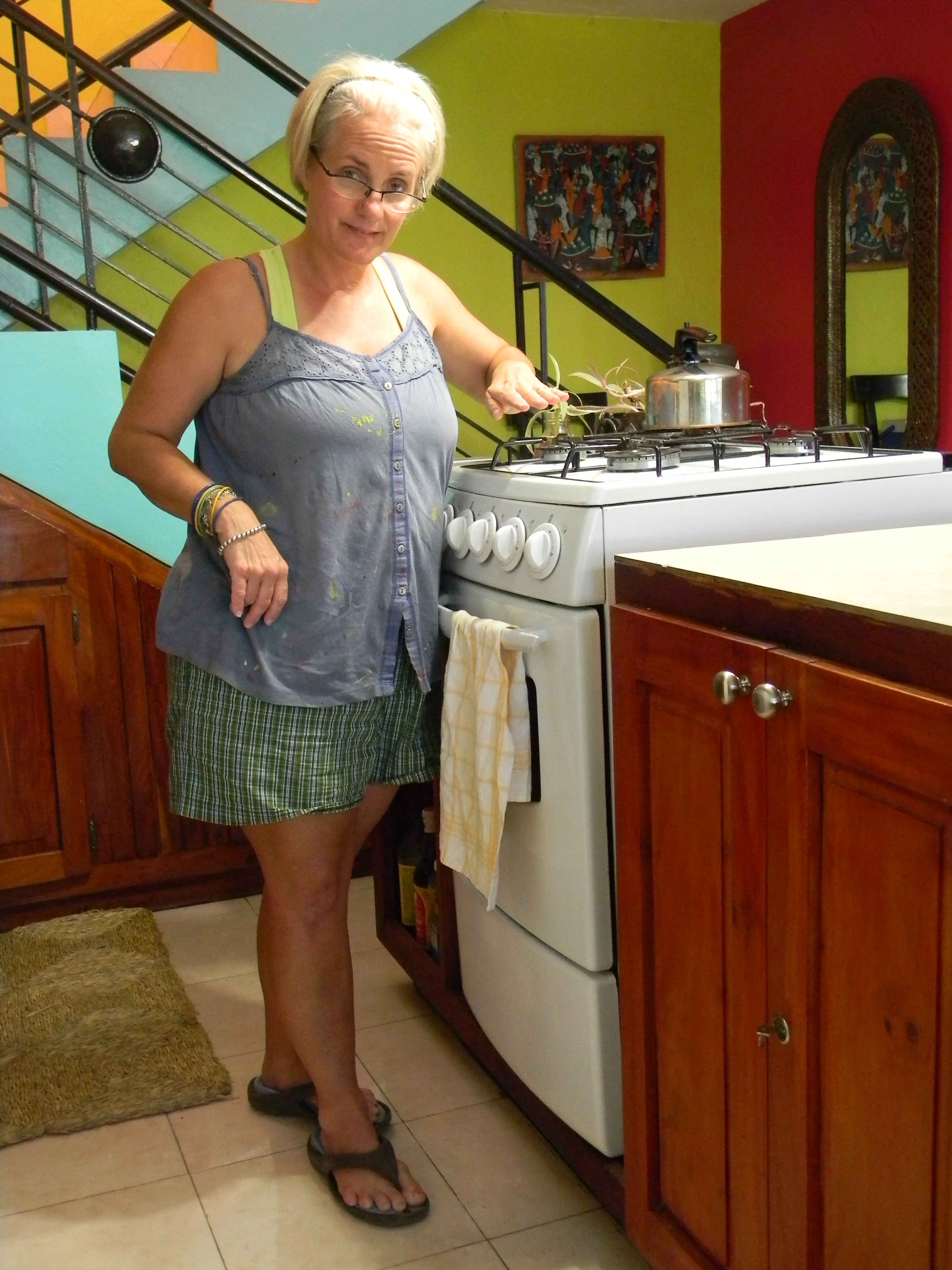
So Sara did what any Tollhouse-cookie-loving partner would do. She got us an oven—a real honest-to-goodness gas oven—minus the thermostat.
I kid you not. There’s no way to set any specific temperature on this most essential of kitchen appliances, any temperature either Fahrenheit or Celsius.
Now, I love Sara more than anything, even more than my daily dose of cake and cookies, and those of you who know my inclination toward carb-consumption, know that’s saying quite a bit. But sometimes she misses the most obvious of details.
“Oh, that’s not that important. You’ll figure that out.”
Twelve attempts and twelve burnt batches of cookies later, I’m still figuring.
Which brings me to the matter of needing an oven this week, a temperature controlled oven, I might add. In America we can’t celebrate Thanksgiving without pumpkin pie. It’s the most Thanksgiving of Thanksgiving desserts—even when celebrating from here in Port-au-Prince—especially when celebrating from any far-away, cholera-sickened, earthquake-toppled part of the planet!
A pumpkin pie likes to bake for the first 15 minutes at 425 degrees Fahrenheit and the final 45 to 50 minutes at 350, temperatures too precise even for the oven thermometer I brought back from the US. It only seems to get me in the ballpark of a particular temperature, give or take 100 degrees.
But what about the turkey Sara plans to roast, what about the thermostatic requirements of the old Butterball?
Oh, that’s not that important. She’ll figure that out.
Have you had any memorable Thanksgiving dinner disasters?
Please know I do not allow Mindy to publish what she does below with any sense of comfort. In fact, I do so with fear and trembling, not wanting anyone to think, for a minute, that I believe the life Sara and I lead deserves Lenten comparison.
Sara and I have chosen our path purposefully, but it, in fact, gives to us more that we give to others. The sacrifice is reciprocal and then some, making our lives meaningful, challenging, sometimes even fun.
Please know the words below are those of a friend, a friend who has loved us for many years and may speak with a bit of bias—but a bias based in love. As such, I am humbled and try to accept the gift with grace—acknowledging that though it may be too much, it’s a gift given from the heart.
And the gift of love, the gift of grace, after all, is what the Lenten/Easter season is all about. God only asks for our hearts and gives us grace in return.
So thank you, my dear friend. Thank you!
Dear Readers:
Kathy has taken the day off.
While she finishes a myriad of tasks related to her move home to Kentucky, she let me talk her into publishing the following post I wrote about her and Sara.
This week Kathy is looking back and reevaluating the experience she and Sara have had in Haiti. I hope this post will help them see how brave they’ve been.
I know I speak for many who have come to respect and admire these good people. And though I speak about them in the context of Christianity, I believe good works are apparent in and of themselves, regardless of religion, creed or belief.
As I reflect on Sara and Kathy and the lives they lead, I am reminded of the story in the Bible about the widow’s mite. “She gave extravagantly what she couldn’t afford…she gave her all.” (Luke 21-4)
The Jews had been instructed to give to the Temple and to the poor as part of their service to God. One day Jesus sat at the Temple and watched people putting money into the offering boxes. Some were rich and gave lots of money. Some gave money, but were unhappy about it. Then a poor woman, a widow, came up to the boxes.
The poor woman put two small coins in the offering box. The disciples with Jesus weren’t very impressed, but Jesus said this woman had given more than any other that day. How could that be? Jesus said it was because it was all she had.
I reflect on the selflessness of my friends because they inspire me on this first day of Lent to “give my all.”
I’m Episcopalian and have always observed Lent by giving up something for the 40 days or so that lead up to Easter and the celebration of the risen Lord. When I was a child, I was instructed not to give up something I disliked, like spinach, but to give up something I loved, like chocolate.
The physical act of fasting is meant to remind us to allow the Spirit of God to reshape the way we think, act and live. I know this as an adult. As a child, it was just something we were expected to do.
It was a practice that was meant to become a habit and, then, a life lesson.
The apostle Paul explained the lesson very neatly in his letter to the Philippians:
Think of yourselves the way Christ Jesus thought of himself. He had equal status with God but didn’t think so much of himself that he had to cling to the advantages of that status no matter what. Not at all. When the time came, he set aside the privileges of deity and took on the status of a slave, became human! Having become human, he stayed human. It was an incredibly humbling process. He didn’t claim special privileges. Instead, he lived a selfless, obedient life and then died a selfless, obedient death – and the worst kind of death at that – a crucifixion. (Philippians 2:5-8 – The Message)
This is how Sara and Kathy live. They go from disaster to disaster, at great expense – professionally, emotionally, physically, psychologically – giving extravagantly what they can’t afford…giving their all.
Now, I want Kathy to run this blog post and if she does, you must know that it’s because I’ve asked her to do it on my behalf.
Because I thank her and Sara for reminding me, in this season of Lent, to allow the Spirit of God to reshape the way I think, act and live not only by giving up something I love, but by giving my all.
As Sara and I prepare to move back to the US next week, leaving behind in Haiti a year’s worth of work, challenge, periodic victory and sometimes defeat, it’s a time for me to reflect, reminisce, think about where I’ve been over the past year, in an effort to figure out where I am going in the one to come.
In the reflective spirit of Lent* (which begins tomorrow), I thought that over the next week I’d revisit some of my earliest posts to the blog, remembering the lessons learned, even the questions left unanswered.
So–since I’m busy packing up one life and moving into another, and since, at the blog’s beginning, most of you weren’t reading yet, I’ll resurrect the first post below and give you a glimpse of how it all got started 4 months ago:
So–the old blog is reincarnated here under a new name! It is, indeed, the Vietnam version “reinvented” from yet another edgy location–this time Haiti, where a cholera epidemic has spread to Port-au-Prince–my home for the next couple of years.
But before I address the big issues faced here on the western half of Hispaniola, I should clarify why I’ve chosen this new title. For my less geeky readers, an “event horizon” is the edge of a black hole, a boundary in the space/time continuum beyond which no light can escape—in many ways, a point of no return. You’ve taken physics; you know this; you’ve just forgotten.
Bottom line–it seems to me, that the far-away places Sara and I have been over the last couple of years have formed a kind of “event horizon” in my mind–taking me to the outer limits of my own comfort zone, shaping new perspectives in me about both the world around me and about this time in my life–a bending of my personal space/time continuum, if you will—–mind-bending for me, at the very least.
However, Haiti itself offers a kind of event horizon–a comparison I first found when reading Paul Farmer’sbook “The Uses of Haiti.” Farmer begins his chapter of the same name with the following epigraph by T. D. Allman:
Haiti is not simply one more of those tropical dictatorships where to rule is to steal, and headless bodies are found by the road. Haiti contorts time: It convolutes reason if you are lucky–and obliterates it if you are not. Haiti is to this hemisphere what black holes are to outer space. Venture there and you cross an event horizon. (After Baby Doc, 1989)
Wrap you brain around that statement and you may begin to see why I’ve renamed the blog–because this place, this location has forced me to rethink my beliefs, not only about myself, but also about big issues such as poverty and hunger–and disease, for god sake! We’re in the midst of a cholera epidemic!
But even without cholera sickening folks by the thousands, we had an earthquake here last January, a hurricane last week, and a million and a half people homeless in Port-au-Prince today.
Was the earthquake an event horizon for Port-au-Prince? Will cholera bend time and space so there’s no escaping the dis-ease that’s plagued this place for centuries?
Is there light for Haiti?
Now, fast-forward 4 months.
Do you think the blog is fulfilling its mission so far?
And, even more importantly, if you have one, what task does your blog accomplish? What is its purpose? Tell us about it in the comments and leave a link. You might attract some new readers!
And don’t forget that tomorrow we’ll have our “Mid-Week Mindy,” tomorrow a reflection on Lent*. Mindy will be covering for me, answering questions, responding to comments.
* On the Christian calendar, tomrrow, Ash Wednesday, begins the season of Lent, 40 days of reflecting and fasting, leading up to Easter Sunday. For a beautiful mediation on the meaning of Lent, check out this post by my friend Jane over at PlaneJaner’s Journey.
I’m a wanna-be artist, a sort-of, almost artist—certainly not by training and clearly not because of craft.
I’m also an artist who has struggled with bipolar disorder, someone who appreciates the creativity that is often an unexpected gift accompanying the illness. I’m someone who has not only made art when I was sick, but continues to create even when I am well, as an outgrowth of recovery. In the art world I’m what would be called an “outsider” artist. I don’t always know what I’m doing. I just do. Art.
I’m also a writer and artist who has lived in Haiti for the last year with my partner. Sara has directed an international NGO’s response to the earthquake. But we are preparing to go home next week, and I’m thinking not only about what Haiti has given me, the gifts I will take home, but also what I’ll leave behind.
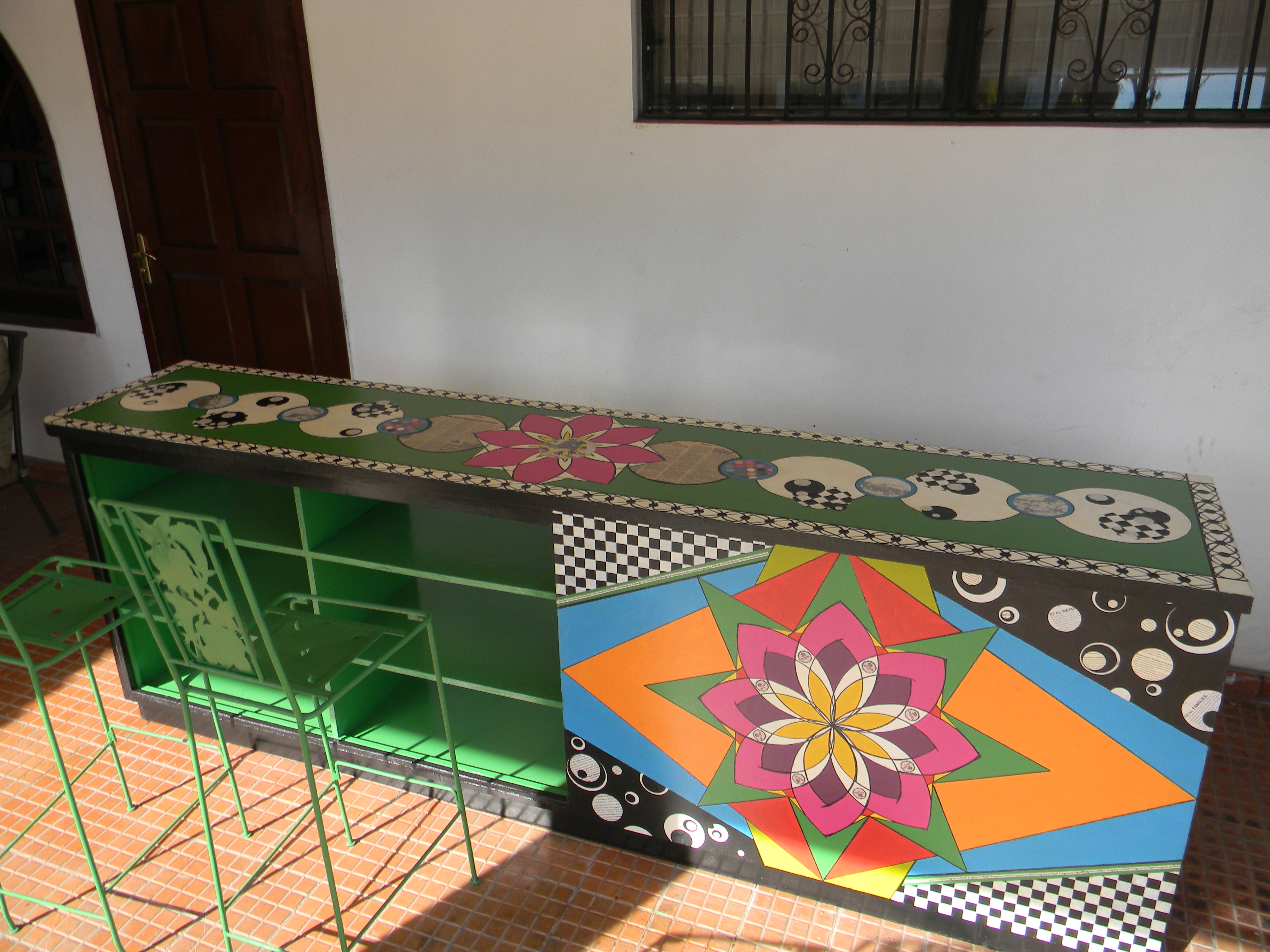
Indeed, one of the gifts I’ve given is a large piece of art, one I created for Sara’s NGO from a throw-away piece of furniture—a huge serving bar I painted last summer.
The bar is nearly 9 and a half feet long and lives on an upstairs patio at Sara’s office in Port-au-Prince.
It was white, ugly, an eye-sore, really. But Sara wanted to save it. She thought it, like Haiti itself, should be given a second chance at life, that the bar could be used for receptions, to serve meals on special occasions. She thought I was the one to midwife this rebirth, that I was the one to take on the task, that as someone who has repurposed art as part of my own recovery, I could gift a born-again bar to the wonderful people who work here.
I loved the idea and took on the project enthusiastically, in the end creating a mixed-media piece—one that incorporates the organization’s logo in strategic places, as well as decoupaged-maps of Port-au-Prince and each location in Haiti the organization works.
I also included stories from the local newspaper, highlighting big events in the news during the months after the earthquake.
I included text from the organization’s 6-month, post-earthquake report, as well as the names of almost all the people who had worked on the NGO’s reconstruction effort—folks from more than a dozen countries around the world.
The front of the bar repeats the organization’s logo above each flower petal:
As well as the names of staff in black and white circles:
The top of the bar includes the maps and newspaper text:
However, soon Sara and I will leave Haiti; soon we’ll leave the places mapped on the bar-top at a bit of a distance, at least geographically.
And though we’ll leave when the organization’s work here is still incomplete, though in many ways it seems too soon, I’ll leave a piece of myself behind, one that I hope will serve the NGO’s mission here well into the future. I’ll leave not only a piece of my art, but also a piece of my heart, knowing this is not really an end. We leave but others will come.
Haiti has taught me this lesson: that indeed good things can come from our departure. It has taught me not only how to birth a new bar, but also how to hope, how to see potential in seeming destruction, how to dream a new dream, how to hope a new hope. It’s reminded me that, if art can come out of sickness, then indeed beauty can come out of the earthquake’s ruin.
I believe that in every beginning an end is waiting to happen and from every illness or devastation a new beginning will grow.
this is a country we come to
only in grieving
only in leaving
cheek of child
left open
to the rain
Port-au-Prince
a city of edges
all middle America thinking
all forms of ceremony
and white cheese
gone
with the dying
lilacs
Would you all mind if, every once in a while over the next couple of weeks, I share some of my favorite things with you?
I’m not going to have tons of time. In fact, I may have very little of it—in which case I could wrap up some special treats—foiled paper, beautiful bows—and give you periodic peaks—sort of, my special wishes for while I’m away.
Because every reader is a gift and every comment a surprise--
Now, I won’t literally be “away”—just preoccupied with moving out of Haiti and home to Kentucky:
me,
one disaster-response refugee,
two dogs,
and a whole house full of stuff.
(Good God, the task is daunting!)
So—
Today, in honor of this get-the-hell-out-of-Haiti-favorite-things series, I offer you—
(steel drums playing)
a medium box
calico paper
butterfly bow—
My absolute, favorite movie as a child,
The Sound of Music and (appropriately enough)—
“My Favorite Things”—(now, aren’t you surprised!)
What was your favorite movie as a child?
And, what’s one of your favorite things?
Okay–I apologize.
I woke up to this morning to, “You mean to tell me you build up a readership, and then you throw your audience my “Favorite Things!”
She insists this was a throw-away post, that I would have been better to post nothing.
So, I promise–no more soft posts! I will write, write, write–even through the move! I’ve got a monster in the bed next to me insisting, I don’t dare let you down again–especially if indeed “every reader is a gift and every comment a surprise!”
Sara won’t stop mockingly singing “My Favorite Things!”
I don’t know how to tell you this, but I have some crazy news . . .
Sara and I are leaving Haiti— as in “permanently,” as in “forever.”
I’m just as stunned by this as you are, and frankly it seems hard to believe. But Sara’s NGO is doing what a number of organizations are doing in Haiti—
They’re scaling back—
Why?
Because of funding shortfalls—
The fact of the matter is, merely a fraction of the dollars pledged toward the Haitian relief effort just after the earthquake have been delivered to NGOs, because, in reality, donors are reluctant to hand over funds to a country whose political future is uncertain, a country that has a history of corrupt leadership, presidents who funnel dollars into their own deep pockets rather than passing them along to citizens in need.
What?
You might wonder what this has to do with Sara and me—————
Quite frankly, Sara is a key disaster response resource for her NGO, especially in terms of her ability to drop into the aftermath of a disaster and get projects moving. She launched the organization’s effort in Afghanistan after the Taliban fell in 2002 and directed its response to the 2004 tsunami in Southeast Asia.
More recently, she’s worked a year in Vietnam and another in Haiti, without more than 5 consecutive days at home—an effort that has drained and exhausted her. She needs a break. She needs to rest.
And the organization is smart to recognize this.
When?
Sara will have a three-month sabbatical before being reassigned. This means Spring at home in Lexington—a lovely time of year to be in Kentucky. And though I’m terribly sad to leave Haiti when there’s so much more of the country to explore and write about, I believe this change will ultimately benefit Sara and her ability to serve more successfully in the future.
Where?
We truly don’t know where we will be headed in another 3 months. Before the earthquake in Haiti, her NGO had planned to send Sara to South Africa. I suspect that could actually happen this summer, unless in the next several months there’s a massive disaster in another part of the world.
How?
So, how will this affect the blog—a blog that has largely been about Haiti?
Well, it’s ironic that I began shifting the blog’s focus slightly even before knowing this larger change was coming—addressing the “event horizon” that is my past, while promising to not ignore the “event horizon” that is Haiti.
It could be that I shouldn’t have made that promise. Certainly, I don’t plan to ignore Haiti even now, but it inevitably won’t be a part of my day-to-day experience. Inevitably the focus will shift toward which ever country we live in next.
In the meantime, I intend to address the “event horizon” that was “then”—my personal past, whose story, I think, needs to be told.
Actually, going home to Kentucky will better equip me to research my mental health history—to do it in a way I couldn’t if I were in Haiti. It will give me actual access to boxes and boxes of journals, video-taped therapy sessions, and medical records I already have on hand.
In practical, blogging terms, I suspect this may mean fewer posts and/or briefer posts over the next several weeks, as we pack up our lives here in Haiti and get resettled in Kentucky. After that, I intend to spend the Spring exploring my past and sharing it here on the blog.
It’s Monday. And we’re launching another week’s worth of less-than-brilliant (but often, above-average) blogging here at Reinventing the Event Horizon.
And, in honor of the week’s beginning, I bring you an “inspiring” (at least I’m trying) laundry list of updates:
1. First, thanks to all of you for your kind and supportive comments in response to last week’s news that I wanted to begin moving my blog in the direction of memoir, not that I would discontinue writing about the event horizon that is Haiti, but that I would also address event horizons from my personal past: namely my father’s organized crime connections and the black hole that is my battle with bipolar disorder. (To read these posts click here and here.)
I believe the best writing is inevitably the most honest writing and my not addressing these issues was becoming a form of compositional dishonesty—a way of avoiding the shame associated with my father and the sigma connected to my illness.
One way to lessen stigma is to stop hiding, or, in my case, to boldly address my demons in the blogosphere’s bright light, to share my struggle, to tell my story, both the pain of the past and the hope that is recovery.
2. Secondly, I’d like to announce an upcoming series of posts from my friend and fellow writer Mindy Shannon Phelps. (I introduced Mindy last week. To read her first post click here.) As she finds time, Mindy will write pieces that address our sometimes serious, sometimes silly misadventures in being human.
3. Finally, an update on my dog Lucy’s adventures in Vietnam—her Maltese march, North to South, South to North.
In last Monday’s post (click here to read) I forgot to include a few of the funniest photos—namely Lucy in Halong Bay .
(Some of you may have heard of a recent accident in Halong Bay. A tour boat sank. 12 were killed. To read about this February 17th incident click here.)
In case you’re not up on the geography of Vietnam, Halong Bay is an UNESCO World Heritage site and hugely popular tourist attraction in northern Vietnam. According to legend, the Vietnamese were being invaded by the Chinese when the gods sent a family of dragons to protect the bay. The dragons were said to spit jewels into the water, to build a wall against the invaders, what is, in fact, a series of nearly 2,000 limestone islands that decorate the bay:
And for me it is, indeed, a matter of re-assembly. Sorting and piecing , cutting and pasting.
(So, today I have a confession to make.)
From the beginning, I’ve wanted this blog to be an avenue into memoir, since, in many ways, the story of my past is far more interesting than the narrative that is now. And, in fact, the most significant “event horizons” in my life happened a long time ago.
I know that may be hard to believe, as the life Sara and I have lead over the past several years has been an exciting one—taking me to places like Bangkok, Hanoi, New Delhi, Port-au-Prince.
But in many ways to travel backward in time is the bigger challenge—more over-whelming, more frightening, yes, but also more meaningful, and perhaps even profound.
The story of how I’ve gotten here—how I’ve gotten “now” is one that must be told. And how I’ve gotten here involves telling at least two stories, requires that I follow two narrative threads. (There’s actually three but only two I’m even close to comfortable sharing now.)
The first is the story of my father’s involvement with organized crime and the second is the story of my twenty-year struggle with bipolar disorder.
Neither of these is easy to tell. And honestly I’m afraid.
I still intend to write about Haiti. I still intend to write about the “now” that is the life I share with Sara on this troubled island. In fact, I believe the struggles Haiti faces nationally are not dissimilar to the personal challenges I’ve endured. My story and the story of Haiti both involve sickness and corruption, oppression, endurance, even hope.
In the coming days and weeks I’ll outline my strategy, share my goals, my hopes, my fears.
I don’t know how to tell this story. I don’t know where to begin. I feel swallowed by the enormity of the task, dwarfed by it.
So, I’ll pray for peace—and if you’re a praying person, please offer your own prayer; if you’re not, please say you care, please say you’ll share.
I still need that massive infusion of grace. I still need that holy yes.
My partner Sara and I are beginning to lose touch—
Lose touch with what it means to be an even remotely “normal” American couple. Some might say that’s not such a bad thing, but I promise you, we have gotten so far from the center of the bell curve, we can’t find the bell any more. We can’t even hear it ringing in the distance.
So–in light of this loss, today, I bring you the top 10 ways you too can be the most un-American of American couples:
#10. Station armed guards outside your house.
This is sure to eliminate any and all illusions of privacy.
(If you are new to the blog, my partner Sara and I live in Haiti where threats to security are common. Click here to read a post about this.)
#9. Argue frequently about how you will generate electricity.
Sara and I have been known to have some of our hottest arguments around just how long we can safely run our generator, especially on days when we have no or very little electricity from the city. I don’t like to be hot. Heat makes me irritable, bitchy, and stressed. So during the hottest nights here in Haiti, I’ve wanted to keep the air conditioning on, or at the very least, a fan running—neither of which are possible without electricity or our generator running.
(To read an entire post dedicated to Haiti’s infrastructure issues click here.)
#8. Do without television.
Instead watch DVDs of “30-Something” for evening entertainment. I knew things were getting bad when over the weekend Sara and I watched back to back episodes of the show’s first season and felt like we were enjoying a special treat, hovering around Sara’s laptop like kids in front of Saturday morning cartoons.
“Oh, boy!” we exclaimed elbowing one another. “Isn’t this great!” We would have broken out the popcorn, if we had a microwave to pop it in.
#7. Go to bed before dinner.
Not out of passion, but because you’ve become dreadfully boring and tire easily.
#6. Have no hot water in your kitchen sink.
Not to mention no dish-washer.
#5. Develop an active fear of kidnapping.
On average—there’s a kidnapping a day in Port-au-Prince—usually of foreigners, often of ex-pats working for NGOs on earthquake reconstruction. And in fact, a number of these kidnappings actually happen in Petion-ville, where we live, since most NGOs have set up their operations from this location.
Many ex-pats are kidnapped from their cars. To alleviate that risk we drive with seatbelts on, windows up, doors locked. It’s harder to be pulled from a vehicle that way.
#4. Stage incidents of international canine trafficking.
I know most folks don’t traipse the planet, canine companions in tow, but Sara and I, for whatever reason, see fit to move our mutts to whichever corner of the globe is hosting the latest in earth-shaking disasters.
For example, it was challenging to take a 40 pound, blonde terrier to Vietnam, where the meat of medium sized, light skinned canines is still considered a delicacy. And though it ended well, concluded with Ralph arriving uneaten in Hanoi, it proved so crazy-making along the way, we “sanely” decided to bring him here to Haiti this past summer.
However, that trip proved less eventful—except for his traveling companions on the flight from Miami to Port-au-Prince—the 10,000 chicks he still hasn’t stopped chirping about.
(For an entire post on pet-transport mishaps click here.)
#3. Appreciate the difference between “trash” and “stash.”
Sara has “placement issues”—a problem she blames on her training as an architect and which she insists I knew about prior to our partnering and simply can not change. Bottom line—Sara likes to arrange things: drawers, cupboards, closets, the contents of the refrigerator, mayonnaise, mustard, ketchup arranged in tidy rows—like items lined up together—like soldiers—an army of condiments ready for edible action. If an object doesn’t fall neatly into rank, the solution for Sara is simple—throw it in the trash.
I, on the other hand, tend to collect things—and not the kinds of things most would consider collectables, but which I gather in the name of “potential art”—items I prefer to call “collagables”—buttons, beads, ribbons, rocks, shells, business cards, bottle caps, maps, matchboxes, newspaper clippings, play bills, and, among other things, sales receipts—in my mind the most under-rated and readily available of all the collagables—a free gift with each purchase, so to speak.
Sara insists my stash is trash!
#2. Agree on only one thing.
That there are too many white people in America.
On one of our recent trips back to the US what stood out to both of us most, even though our home is in an ethically-mixed neighborhood, was the overwhelming huge number of Caucasian in the city where we live. At one point Sara turned to me in the grocery store produce isle and asked: “What do you notice about being home?” My response was immediate, “There are so many white people in America! I had forgotten.” It surprised us how quickly we both had become conditioned to what seems an appropriate ethnic mix. We had made a shift that we noticed only when coming “home.” If this can happen for us, it can happen for others. Come join us. Make the switch.
#1. Be denied the right to marry.
This one I think speaks for itself, but if not please watch this video:
Sara reminds me, that though we don’t have the right to marry in Kentucky, we at least now have an openly gay mayor in Lexington, so that’s a step in the right direction. (To read about Jim Gray click here.)
However, Sara also insists that, by far, the weirdest thing about us as couple is that I asked her to brainstorm with me about “what makes us weird as a couple.” I’m not exactly sure what’s so weird about that, but Sara says my not recognizing the strangeness of that request makes it even weirder. I don’t know. You be the judge.
At any rate, remember that “normal” is a difficult to define category. I appreciate that. But if you recall the 1960s television sitcom, “The Odd Couple,” you’ll see that I’m not talking so much about individual issues that separate us from the crowd. I’m looking at the entire constellation of individual quirks that combine to make a couple what most others would consider strange. I’m looking at the “Odd Couple” factor, if you will.
Felix Unger and Oscar Madison epitomized for a generation of Americans just what it meant to be uniquely coupled in the 1960s.
But If Felix and Oscar were the not-so-average pair of heterosexual bachelors in the 60s, I would argue that Sara and I are the same for this decade’s no-where-near-single lesbian couple—a uniqueness not related in the least to the reality of sexual preference.
In fact, Sara and I give whole new meaning to the notion of “odd couple”—sexual orientation not withstanding.
We may be weird–
But we do want to wed!
What sets you and your partner apart from the crowd? What makes a couple “weird” in the country you call home? Do gay and lesbian couple have the right to wed where you live?











 Kathryn M. McCullough
