I don’t know how to tell you this, but I have some crazy news . . .
Sara and I are leaving Haiti— as in “permanently,” as in “forever.”
I’m just as stunned by this as you are, and frankly it seems hard to believe. But Sara’s NGO is doing what a number of organizations are doing in Haiti—
They’re scaling back—
Why?
Because of funding shortfalls—
The fact of the matter is, merely a fraction of the dollars pledged toward the Haitian relief effort just after the earthquake have been delivered to NGOs, because, in reality, donors are reluctant to hand over funds to a country whose political future is uncertain, a country that has a history of corrupt leadership, presidents who funnel dollars into their own deep pockets rather than passing them along to citizens in need.
What?
You might wonder what this has to do with Sara and me—————
Quite frankly, Sara is a key disaster response resource for her NGO, especially in terms of her ability to drop into the aftermath of a disaster and get projects moving. She launched the organization’s effort in Afghanistan after the Taliban fell in 2002 and directed its response to the 2004 tsunami in Southeast Asia.
More recently, she’s worked a year in Vietnam and another in Haiti, without more than 5 consecutive days at home—an effort that has drained and exhausted her. She needs a break. She needs to rest.
And the organization is smart to recognize this.
When?
Sara will have a three-month sabbatical before being reassigned. This means Spring at home in Lexington—a lovely time of year to be in Kentucky. And though I’m terribly sad to leave Haiti when there’s so much more of the country to explore and write about, I believe this change will ultimately benefit Sara and her ability to serve more successfully in the future.
Where?
We truly don’t know where we will be headed in another 3 months. Before the earthquake in Haiti, her NGO had planned to send Sara to South Africa. I suspect that could actually happen this summer, unless in the next several months there’s a massive disaster in another part of the world.
How?
So, how will this affect the blog—a blog that has largely been about Haiti?
Well, it’s ironic that I began shifting the blog’s focus slightly even before knowing this larger change was coming—addressing the “event horizon” that is my past, while promising to not ignore the “event horizon” that is Haiti.
It could be that I shouldn’t have made that promise. Certainly, I don’t plan to ignore Haiti even now, but it inevitably won’t be a part of my day-to-day experience. Inevitably the focus will shift toward which ever country we live in next.
In the meantime, I intend to address the “event horizon” that was “then”—my personal past, whose story, I think, needs to be told.
Actually, going home to Kentucky will better equip me to research my mental health history—to do it in a way I couldn’t if I were in Haiti. It will give me actual access to boxes and boxes of journals, video-taped therapy sessions, and medical records I already have on hand.
In practical, blogging terms, I suspect this may mean fewer posts and/or briefer posts over the next several weeks, as we pack up our lives here in Haiti and get resettled in Kentucky. After that, I intend to spend the Spring exploring my past and sharing it here on the blog.
Today I’d like to welcome my friend and fellow writer Mindy Shannon Phelps to “Reinventing the Event Horizon.” Mindy’s guest post is also about “sheltering,” a topic explored in yesterday’s poem and one inherent to the recovery effort here in Haiti. Mindy’s narrative negotiation of this issue–an event horizon of its own–is stunningly poised and powerfully moving. (Mindy’s bio is below and her post “She Sheltered Me” just below that. Mindy will personally respond to comments, so feel free to ask questions.)
A journalist by training, Mindy Shannon Phelps is a project management and communications specialist.
Over the past 17 years, her clients have ranged from Habitat for Humanity
International and the US Department of Justice to the FEI World Equestrian Games and the Henry Clay Center for Statesmanship, which she launched in 2007. As a consultant, she focuses primarily on not-for-profit organizations.
As a wife and mother, she says she is humbled by the grace and love of her two daughters and husband, who encourage her to “write it down.” She does write – prose and poetry – and she is an editor, as well.
Her maxim: “Woman hath no greater satisfaction than editing someone else’s copy.”
It was the spring of 2004 in one of the worst years – work wise – of my life. I had been hired to transform a well-known non-profit organization from an affiliate of the national group to a state-only organization. The group’s mission was completely embraceable – justice and fairness for all – but the group was hamstrung by about 60 long-time stakeholders – board members and advisors and founders – who each decided to be my boss. I also had an entrenched staff that I simply could not manage. My associate director made Machiavelli seem like a decent person.
I could not win for losing.
One morning, on the drive to work, I stopped at Starbucks and stood in line behind a very odd person. She was very colorful. A black lady whom you could immediately recognize as being from Africa or the Caribbean. Not used to the chill March weather. Bright knit cap and scarf. Bangles and rings and clothing that seemed to surround, rather than actually fit, her body. Sneakers and thick socks. Carrying a knapsack and a small pair of bongo drums, she was about to beg the barista for coffee for one dollar. Before she got to the counter, she turned around to me and told me I was a “rainbow child” and that I blessed her with my smile.
She turned to the counter and the barista refused her request.
She hurried out the door. I was troubled that I did not quickly step in and get her some coffee. But I could see that she frightened the clerk and the customers. And she, herself, was frightened. So I got my own coffee and went on my little way.
She walked across the street and I overheard her asking for directions to Main Street. I really wanted to pick her up and debated with myself through a light change, then crossed lanes and stopped and offered a ride.
We sat for a minute and chatted and she explained how she had traveled from Jamaica to live with her sister – had sold $2000 worth of jewelry that she makes – and her sister had taken her money. My passenger was headed to the Hyatt Regency downtown to stay the night. Her sister had a reservation.
You know, I like to think I at least try to take people at face value. But I’m just as shallow as they come, really. I wasn’t sure I believed this woman’s story. Making it even more difficult were comments that interspersed her narration, such as, “but, you know, I am not worried because God takes care of me. We are all His children and He loves us. I used to be a rainbow but now I am here.” I was with her on God’s love but the rainbow metaphor was beyond my ken.
Then she told me something I had always believed.
“We need to continually stay in prayer.” With that, she began reciting the Lord’s Prayer and I headed the car down the road.
When I got to Main Street, I pulled into a parking lot next to a bakery. I don’t know why I didn’t just take her all the way down to the Hyatt. It was as if I was dreaming and did not have control of the car. This is what she told me in that lot.
“God bless you. Be on your guard. Satan has demons driving on the streets today. You are under attack and you don’t know it. You need to call on Michael. Do you know Michael, the archangel? He’s my angel and he will be your angel, too. You are God’s child and He loves you. You and I will see each other soon in paradise. We’ll be so happy then!”
All of this, she repeats, several times.
I began to weep because she touched something I didn’t know needed comforting. My heart.
The lady from Jamaica had blessed me and she was of God; that I knew. And I think God was there in the car with us and so was Michael, the archangel.
Before she got out of the car, I fished into my wallet and gave her a fifty-dollar bill. It was my two-week “allowance.” I felt as if I were giving it to God.
“It is in the shelter of each other that the people live.”
— Irish proverb
If we don’t shelter one another, we are lost. If we don’t shelter one another none of us has a home; none of us has heart, has peace, has rest. If we don’t shelter one another, we are alone, alienated, adrift.
Believing this to be true, struggling to understand community and what it meant to care for one another, I wrote the prose poem below some years ago, wrote it in the voice of a woman who had the experience described:
My apartment has a view of the city skyline
A street lady keeps coming to visit me. She’s looking for her son, leaves me notes. I called the police. They said to call if she comes again. She hasn’t come again, but when she does come, she tries to get in.
Of course, she can’t get in.
She only rattles the door.
Would you have responded differently to the woman’s visitor? What would you have said or done?
Tomorrow, in the spirit of these questions, I’ll bring you a guest post, written by my dear friend and fellow writer, Mindy Shannon Phelps. Mindy’s post will further address this issue of “sheltering”–offering another voice of witness.
Hope you will come back tomorrow and listen to Mindy. Let’s help her feel welcome!
My partner Sara and I are beginning to lose touch—
Lose touch with what it means to be an even remotely “normal” American couple. Some might say that’s not such a bad thing, but I promise you, we have gotten so far from the center of the bell curve, we can’t find the bell any more. We can’t even hear it ringing in the distance.
So–in light of this loss, today, I bring you the top 10 ways you too can be the most un-American of American couples:
#10. Station armed guards outside your house.
This is sure to eliminate any and all illusions of privacy.
(If you are new to the blog, my partner Sara and I live in Haiti where threats to security are common. Click here to read a post about this.)
#9. Argue frequently about how you will generate electricity.
Sara and I have been known to have some of our hottest arguments around just how long we can safely run our generator, especially on days when we have no or very little electricity from the city. I don’t like to be hot. Heat makes me irritable, bitchy, and stressed. So during the hottest nights here in Haiti, I’ve wanted to keep the air conditioning on, or at the very least, a fan running—neither of which are possible without electricity or our generator running.
(To read an entire post dedicated to Haiti’s infrastructure issues click here.)
#8. Do without television.
Instead watch DVDs of “30-Something” for evening entertainment. I knew things were getting bad when over the weekend Sara and I watched back to back episodes of the show’s first season and felt like we were enjoying a special treat, hovering around Sara’s laptop like kids in front of Saturday morning cartoons.
“Oh, boy!” we exclaimed elbowing one another. “Isn’t this great!” We would have broken out the popcorn, if we had a microwave to pop it in.
#7. Go to bed before dinner.
Not out of passion, but because you’ve become dreadfully boring and tire easily.
#6. Have no hot water in your kitchen sink.
Not to mention no dish-washer.
#5. Develop an active fear of kidnapping.
On average—there’s a kidnapping a day in Port-au-Prince—usually of foreigners, often of ex-pats working for NGOs on earthquake reconstruction. And in fact, a number of these kidnappings actually happen in Petion-ville, where we live, since most NGOs have set up their operations from this location.
Many ex-pats are kidnapped from their cars. To alleviate that risk we drive with seatbelts on, windows up, doors locked. It’s harder to be pulled from a vehicle that way.
#4. Stage incidents of international canine trafficking.
I know most folks don’t traipse the planet, canine companions in tow, but Sara and I, for whatever reason, see fit to move our mutts to whichever corner of the globe is hosting the latest in earth-shaking disasters.
For example, it was challenging to take a 40 pound, blonde terrier to Vietnam, where the meat of medium sized, light skinned canines is still considered a delicacy. And though it ended well, concluded with Ralph arriving uneaten in Hanoi, it proved so crazy-making along the way, we “sanely” decided to bring him here to Haiti this past summer.
However, that trip proved less eventful—except for his traveling companions on the flight from Miami to Port-au-Prince—the 10,000 chicks he still hasn’t stopped chirping about.
(For an entire post on pet-transport mishaps click here.)
#3. Appreciate the difference between “trash” and “stash.”
Sara has “placement issues”—a problem she blames on her training as an architect and which she insists I knew about prior to our partnering and simply can not change. Bottom line—Sara likes to arrange things: drawers, cupboards, closets, the contents of the refrigerator, mayonnaise, mustard, ketchup arranged in tidy rows—like items lined up together—like soldiers—an army of condiments ready for edible action. If an object doesn’t fall neatly into rank, the solution for Sara is simple—throw it in the trash.
I, on the other hand, tend to collect things—and not the kinds of things most would consider collectables, but which I gather in the name of “potential art”—items I prefer to call “collagables”—buttons, beads, ribbons, rocks, shells, business cards, bottle caps, maps, matchboxes, newspaper clippings, play bills, and, among other things, sales receipts—in my mind the most under-rated and readily available of all the collagables—a free gift with each purchase, so to speak.
Sara insists my stash is trash!
#2. Agree on only one thing.
That there are too many white people in America.
On one of our recent trips back to the US what stood out to both of us most, even though our home is in an ethically-mixed neighborhood, was the overwhelming huge number of Caucasian in the city where we live. At one point Sara turned to me in the grocery store produce isle and asked: “What do you notice about being home?” My response was immediate, “There are so many white people in America! I had forgotten.” It surprised us how quickly we both had become conditioned to what seems an appropriate ethnic mix. We had made a shift that we noticed only when coming “home.” If this can happen for us, it can happen for others. Come join us. Make the switch.
#1. Be denied the right to marry.
This one I think speaks for itself, but if not please watch this video:
Sara reminds me, that though we don’t have the right to marry in Kentucky, we at least now have an openly gay mayor in Lexington, so that’s a step in the right direction. (To read about Jim Gray click here.)
However, Sara also insists that, by far, the weirdest thing about us as couple is that I asked her to brainstorm with me about “what makes us weird as a couple.” I’m not exactly sure what’s so weird about that, but Sara says my not recognizing the strangeness of that request makes it even weirder. I don’t know. You be the judge.
At any rate, remember that “normal” is a difficult to define category. I appreciate that. But if you recall the 1960s television sitcom, “The Odd Couple,” you’ll see that I’m not talking so much about individual issues that separate us from the crowd. I’m looking at the entire constellation of individual quirks that combine to make a couple what most others would consider strange. I’m looking at the “Odd Couple” factor, if you will.
Felix Unger and Oscar Madison epitomized for a generation of Americans just what it meant to be uniquely coupled in the 1960s.
But If Felix and Oscar were the not-so-average pair of heterosexual bachelors in the 60s, I would argue that Sara and I are the same for this decade’s no-where-near-single lesbian couple—a uniqueness not related in the least to the reality of sexual preference.
In fact, Sara and I give whole new meaning to the notion of “odd couple”—sexual orientation not withstanding.
We may be weird–
But we do want to wed!
What sets you and your partner apart from the crowd? What makes a couple “weird” in the country you call home? Do gay and lesbian couple have the right to wed where you live?
Be patient toward all that is unresolved in your heart and try to love the questions themselves. —Rainer Maria Rilke
The weekend here in Haiti has ended . . .
The time to catch up—do laundry, make beds, have some spaghetti with the ones we love—has lead us to Valentine’s Day—muddy, gone-amuck Monday Cinderella-ed into—
More laundry, more beds, more spaghetti with the ones we don’t always love.
Yes, the ones we love may be less than lovely at times. But on Valentine’s Day, I’m also thinking about my home here in Haiti and about my home in the blogosphere, readers who care, readers I’ve come to love.
So, it seems essential on this day that celebrates love, a day that celebrates caring and appreciation, that I invite readers I love into the heart of my life here in Haiti–into my home. For it’s as true as it is cliched: home is where the heart is.
A while back, on a truly muddy Monday, I promised photos of our house in Port-au-Prince, promised, that is, when so many of you ranted about our kitchen decor in a post called “Haiti needs to be HGTV’d.” (If you missed that post, click here.)
So, though “Writing Neurotic” still threatens (for an introduction to “Writing Neurotic” click here and here), our wireless is working well today—is almost, semi fast . . . (Notice the adverbs that qualify “fast.” All apply.)
Given this, I’m going to attempt a giant photo upload. (If you’re not familiar with the wireless challenges we face at our house here in Haiti, click here.)
If I succeed, a virtual tour of our home should follow. (Please pray the bandwidth gods, maybe even Saint Valentine himself, remain with us.)
Here’s the deal. Our house sits on a hillside, hovering above the up-scale Port-au-Prince suburb of Petion-ville, where the streets are poorly paved, if at all, and the twists and turns of “almost-roads” threaten even the most seasoned drivers—pot holes the size of swimming pools are not uncommon.
Though there’s little electricity, once you get here, things are lovely. Truly—our home is small but adequate, and we have dressed it up with paint—bold color, saturated color, the kind you want to drink in and absorb.
After honking to alert the guard (yes, he’s armed), he’ll open the gate and you’ll drive onto what is essentially the roof of our house—an outside deck that, for the most part, doubles our living space, (only sometimes exposing us to the stench of burning tire in the town below. Don’t worry there’s been no rioting today. We’re sinus-ly safe for now.)
Jean-Jean will open the gate, and our dog Ralph will greet you.
So come join us, pull up a chair, have cup of tea or a cocktail, if you like. The roof-top deck, where we’re sitting looks like this:
The view from your seat looks like this:
And, if you wonder about that roaring, rumbling sound—it’s our generator round the corner, keeping the lights on for us:
Sorry for that obnoxious noise!
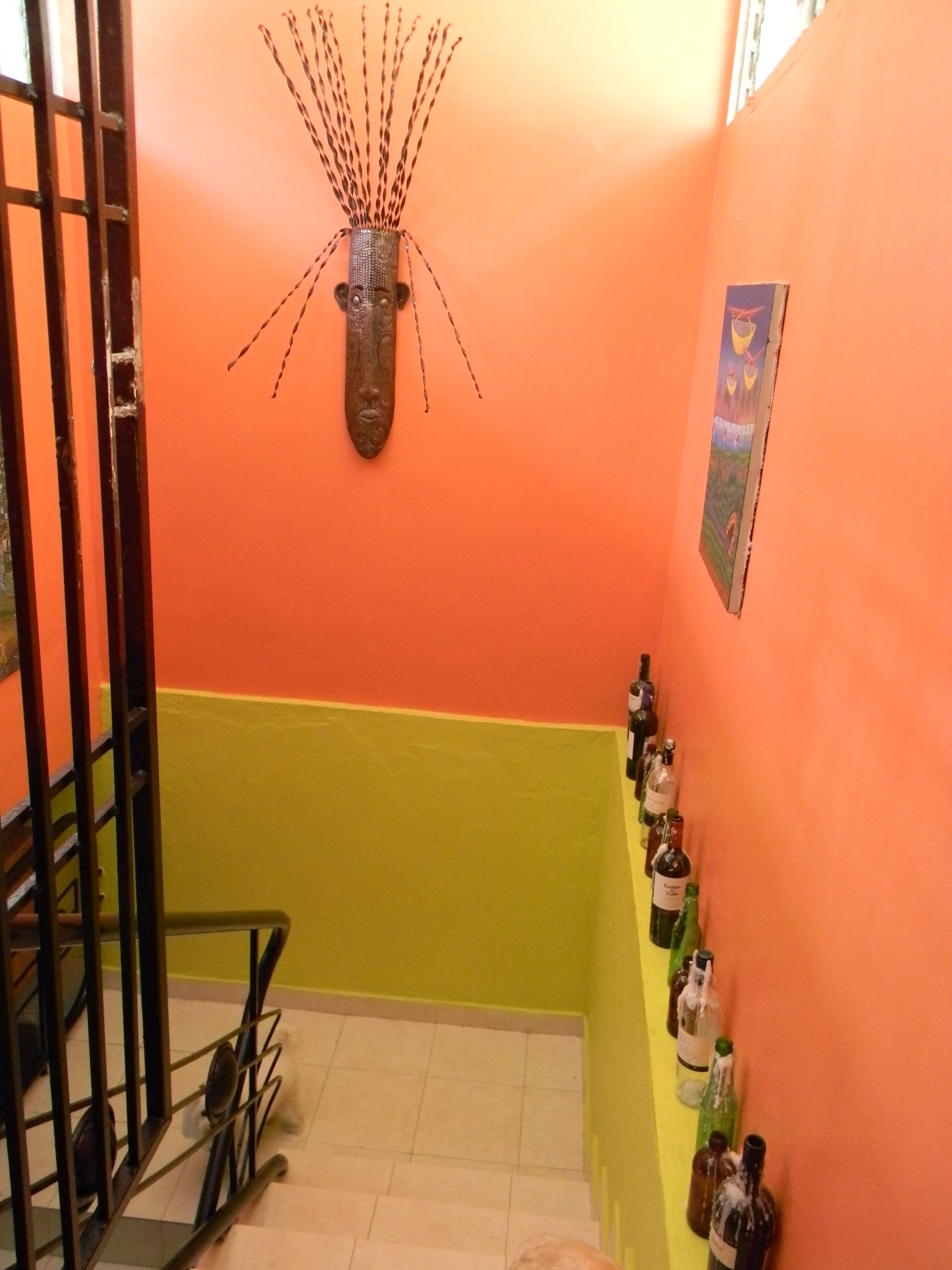
You’ll enter the house itself from the roof, by descending a set of stairs:
From the opposite side of the room, the staircase looks like this:
You’ve entered our main living space—a kitchenlivingdiningroom—what in the US we might call a “great room,” though ours is not so grand.
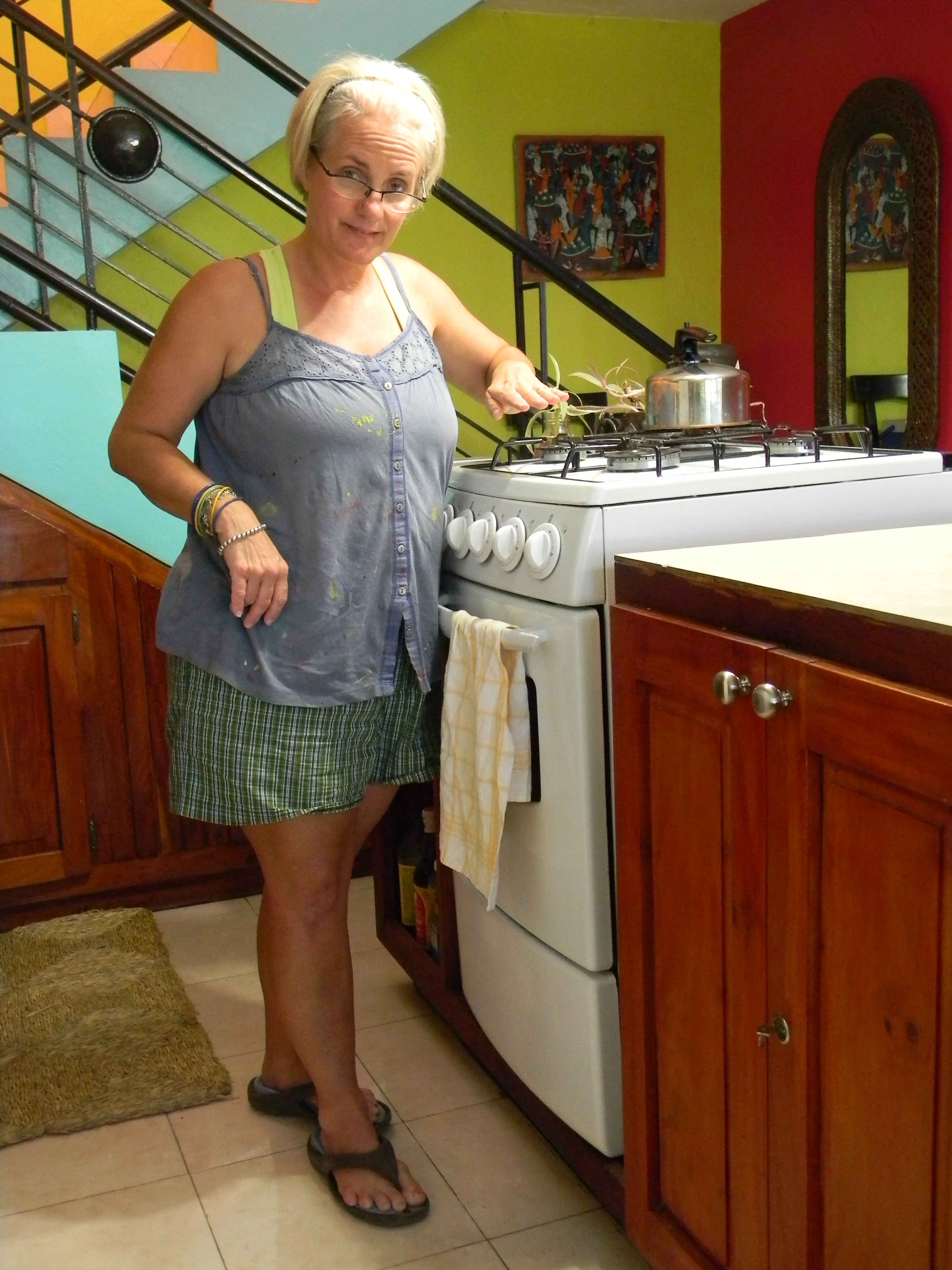
The kitchen looks like this:
smallandcrampedbutweloveit
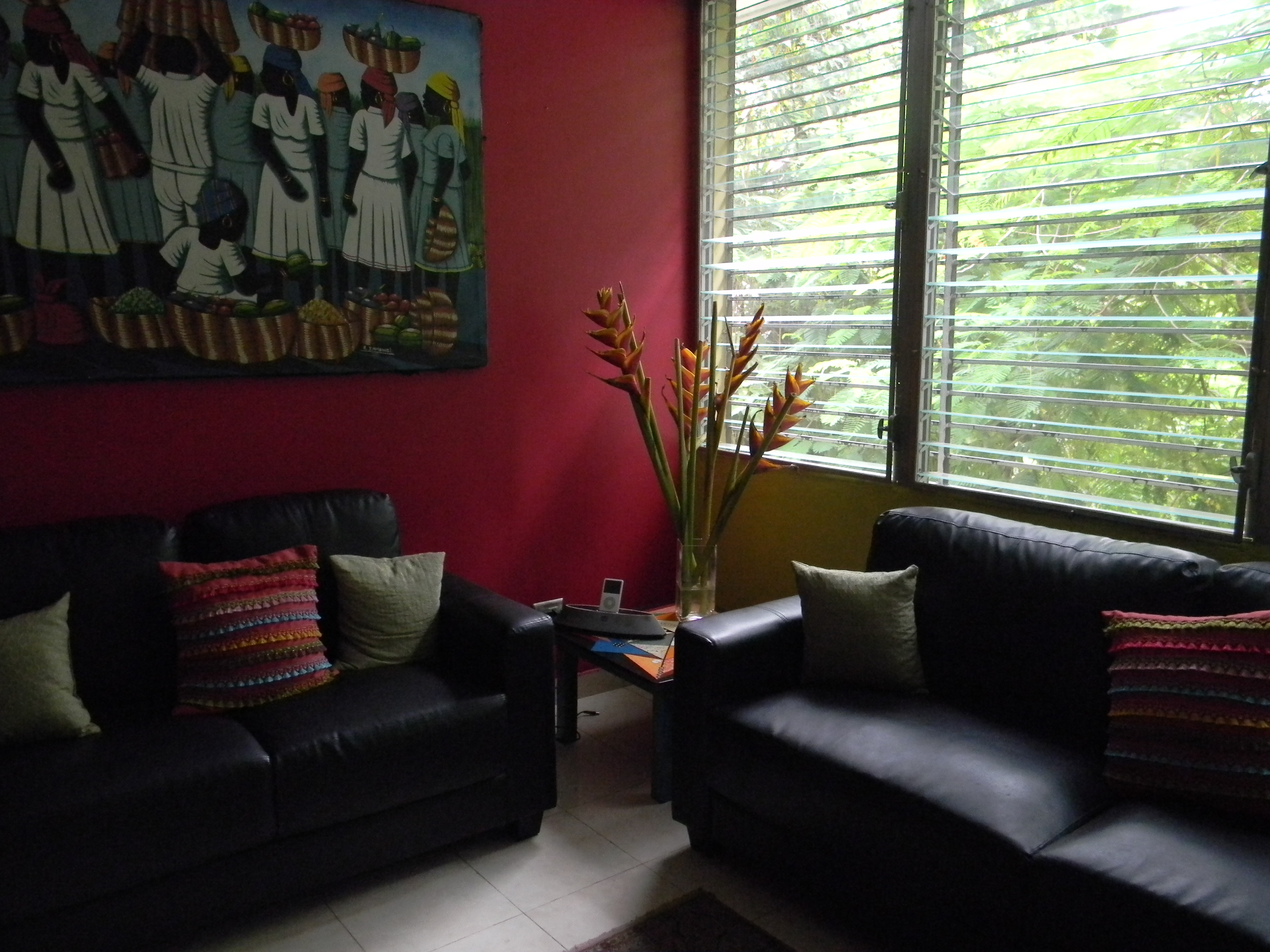
Our main seating area looks like this:
Have a seat. Soak in the color.
On opposite sides of this space, doors lead to two rooms, the master bedroom and bath on one side, the guest room and bath on the other.
The master bedroom looks like this:
And the master bathroom looks like this:
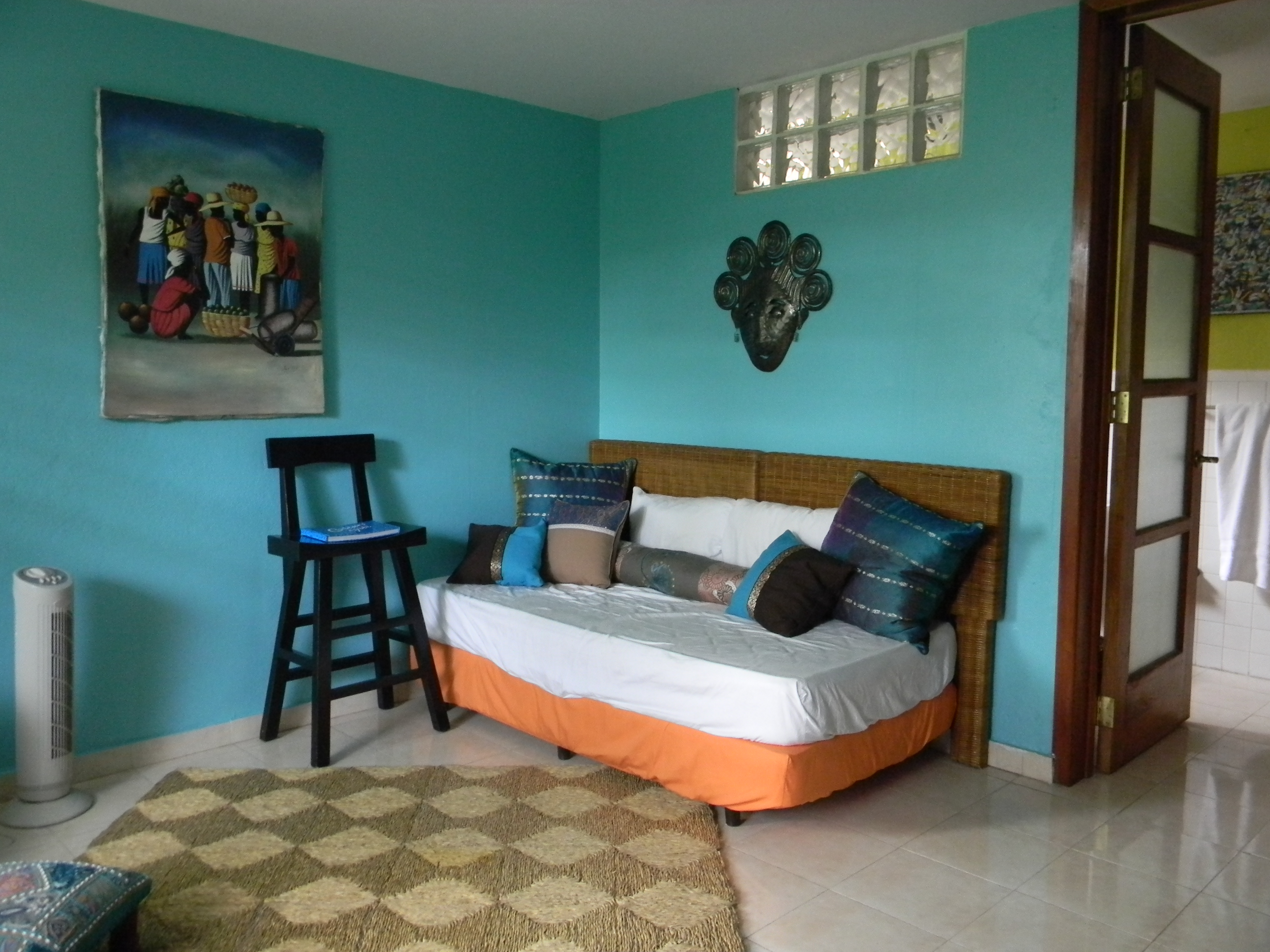
You’ll enter the guest room through this doorway:
This room doubles as Sara’s office, but if you spend the night, you’ll sleep here:
Your bathroom, a mirror image of the master, looks like this:
Another door off the guest room leads to a balcony that looks like this:
And a stairway that looks this:
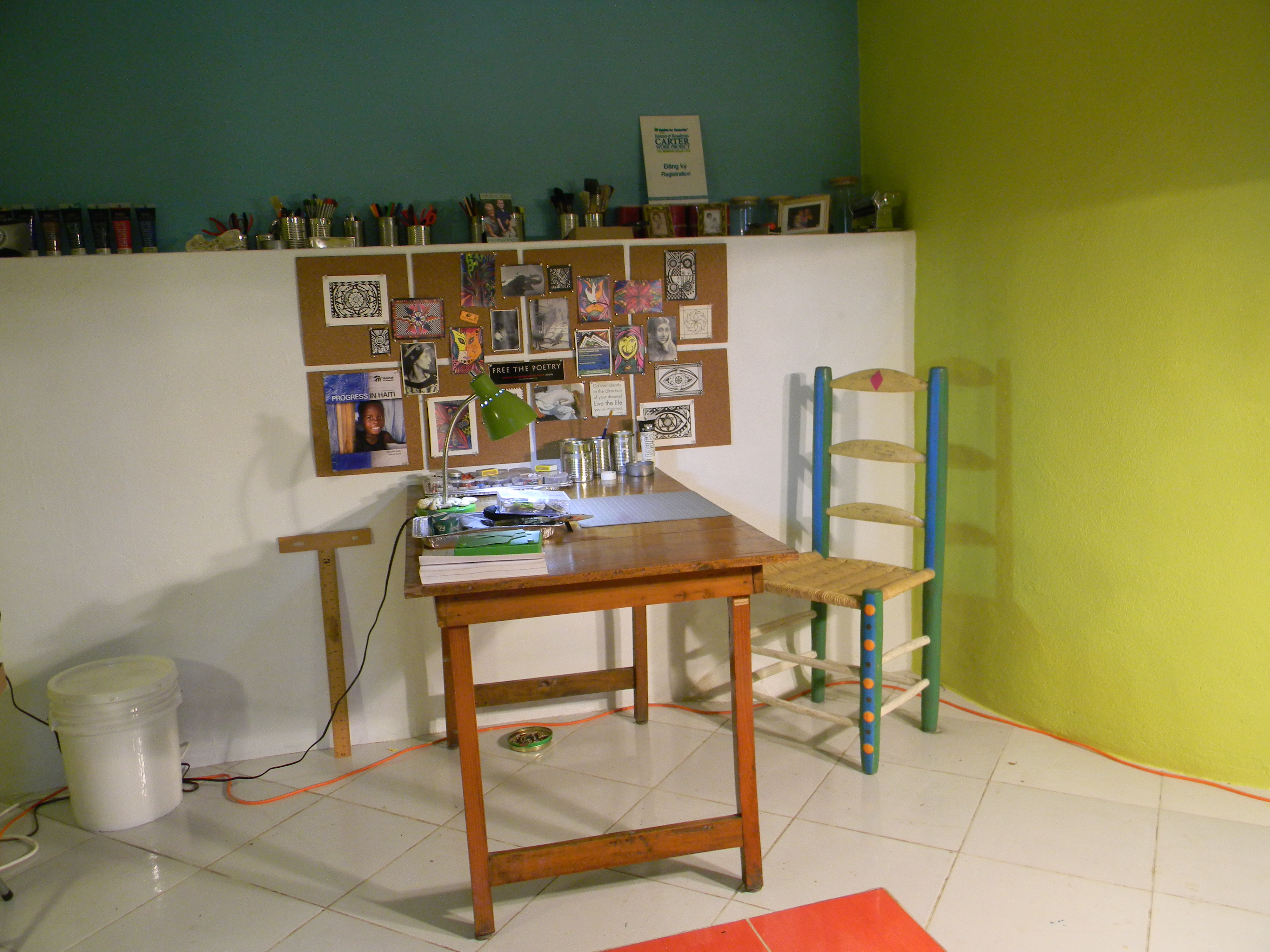
At the bottom of the stairs, another door from the outside opens into my studio and study:
Wait!
Our guard Jean-Jean rushes down the stairs–interupts the tour. He insists the protests have started again. You need to go.
Gosh, darn, you just got here——
We hurry back up the stairs to your car.
Well, at least you’ve gotten a sneak peak at our home in Port-au-Prince, I concede, and as you close the car door, I shout above clatter of gate opening–
Let us know when you can come again, stay a little longer, spend the night.
I’ll send a driver and an armed-escort to meet your flight.
(For a post about madness at the Port-au-Prince airport, click here.)
Happy Valentine’s Day from the heart of our home!
Happy Valentine’s Day–from the (still unresolved) heart of Haiti—————-
Like many Americans, I love HGTV (Home and Garden Television). When I go home to the US, I can’t wait to watch kitchens upgraded, bathrooms remodeled, landscapes transformed.
Whether I’m cooking with the ease of Lean Cuisine, laundering with the convenience of Kenmore, or cleaning with the miracle of Mop & Glo, I appreciate the perky background chatter of “Divine Design” (to learn more about the show click here) and “Design on a Dime” (to learn more about the show click here).
I enjoy segments on how to install bamboo flooring at a diagonal as much the next surface-obsessed, granite-loving, domestic goddess in North America. Even when I’m at our house in Haiti, I complain about our stove, our oven, our cook-top.
It’s so small:
So tall:
—so not the stainless steel I have at home in the States.
But—(and this is a big BUT)
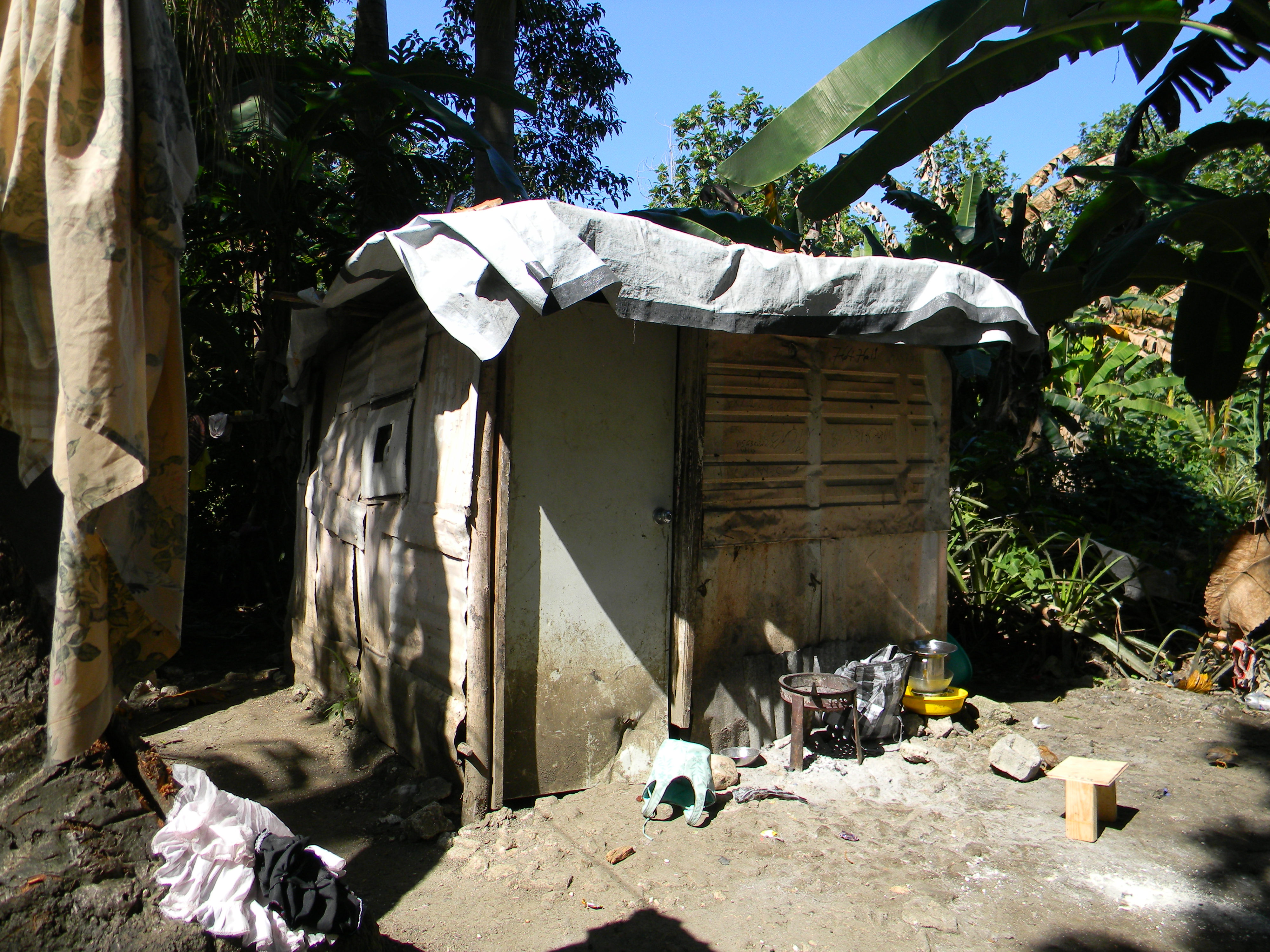
This past week I went with Sara to Leogane, a coastal town about 30 kilometers west of Port-au-Prince, close to the epicenter of the January 12th earthquake. A United Nations assessment team deemed Leogane “the worst-affected area” in Haiti, with 80 – 90% of buildings damaged and nearly all concrete structures destroyed.
Just outside of Leogane I visited a community called Nolivos—
Where the houses look like this:
a "Desperate Space?"
(To learn more about the show, “Desperate Spaces,” click here.)
The washing machines look like this:
doing laundry for a family of 7 children
The kitchens look like this:
a "Sizzling Outdoor Kitchen?"
(To learn more about the show, “Sizzling Outdoor Kitchens,” click here.)
The sinks look like this:
the community well
And the stoves look like this:
a "Kitchen Impossible?"
(To learn more about the show, “Kitchen Impossible,” click here.)
Watching a woman cook dinner for seven on a stove of sticks and stones, I wondered whether Vern Yip would be willing to bring a “Deserving Design” to this mother or another mother in the Port-au-Prince slum of Cite Soleil. (To watch an episode of “Deserving Design” click here.)
I wondered whether David Bromstad would splash some color a little south of Miami. (To watch an episode of “Color Splash: Miami” click here.)
I thought:
Haiti needs to be HGTV’d!(To learn more about the show, “HGTV’d,” click here.)
But, gosh, I’m grateful that Lucy, my dog, and I are in Miami, still in the cozy hotel room where we spent the night. We leave a bit later this morning to travel to Kentucky by way of Chicago. It is an enormous relief to be this much closer to “home”–in this case the place where my family still lives. I miss them!
In the meantime–a few more photos of Haiti, my other home. Hope you enjoy!
"Pancaked" buildings are still a common sight in Port-au-Prince.
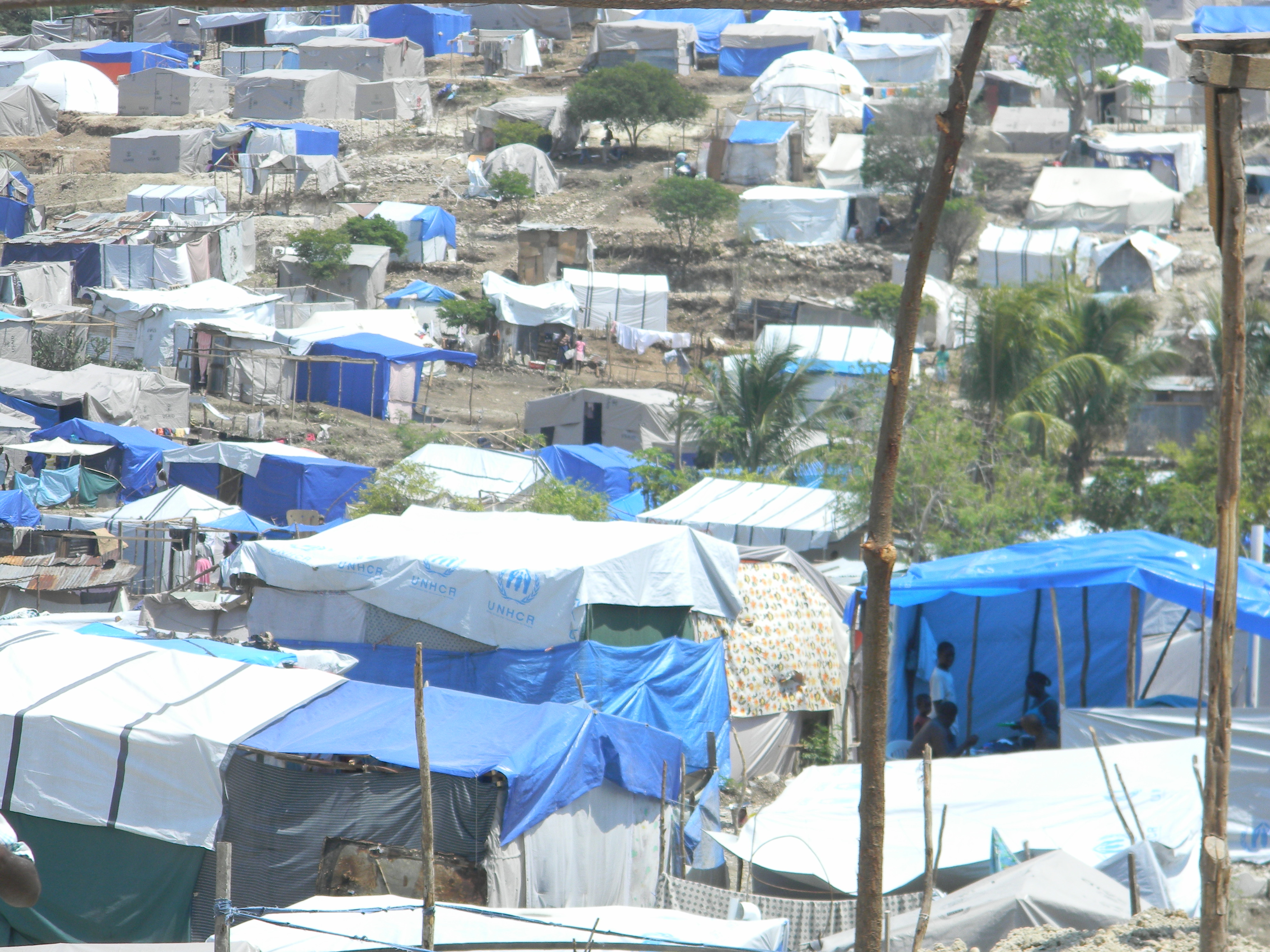
Camps of "internally displaced persons" are equally common. 1.3 million people are still homeless in Port-au-Prince.
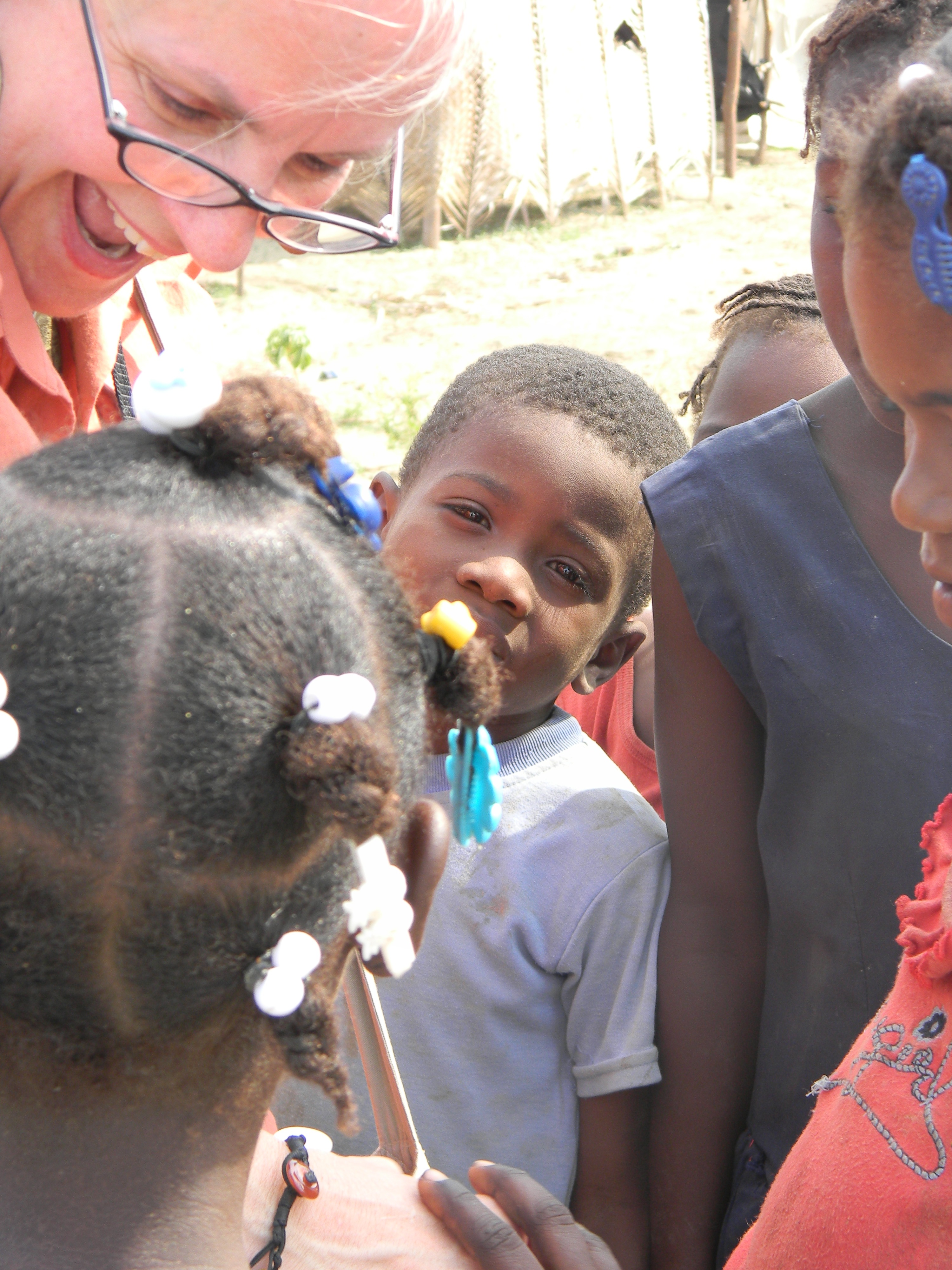
Kathy with children in Cabaret, so excited by images of themselves displayed on the back of the digital camera, they knocked me to the ground at one point in the midst of their enthusiasm.
The view of Port-au-Prince from my other home in Haiti.
Hopefully, Sara will join me soon—home for the Holidays!























 Kathryn M. McCullough