How Television Tells the Story of our Far-from-Average, Disaster-Responding, Lesbian Life


We have weird television habits at our house on Fourth Street.  Sara and I are tunnel-visioned and singularly focused, like my nephews, watching Star Wars incessantly—Hans-Solo-ed and Darth-Vader-ed to death.  Except for us it’s not science fiction we’re obsessed with, but rather all things HGTV for me, and equally everything Food Network for Sara —each of us bleeding decorating and duvets or butter and broth.

For example, when we’ve been home in the US in recent years, my partner has watched entire seasons of “Top Chef”—appetizer to dessert—beginning to end—over and over—till the next-to-last chef packs her knives, and I am able to quote entire dinner dialogs off the top of my head, guest chef judges sound-tracking our complete Christmas visit, critiquing candied carrots and pickled beets till we are out the door again, and back to Port-au-Prince, where, thank God, we were without TV, and Sara was forced to download podcasts on how to cook the perfect omelet, and we ate eggs, well-whisked and gorgeously prepared, morning, noon, and sometimes even night.

Aha, you say, “Top Chef” is not a Food Network series, but that fact conveniently leads to my next television insight—namely that each of us has a secondary network of choice.  And Sara’s second best is Bravo.
“Flipping Out” and “Tabitha’s Salon Takeover,” with their hard-core management styles and bad ass attitudes toward employees  are two of her favorite, which amazes me, as she is kind and mentoring toward her staff and doesn’t generally try taking  over, even at home.  Instead she leaves domestic commandeering and flipping out for me.

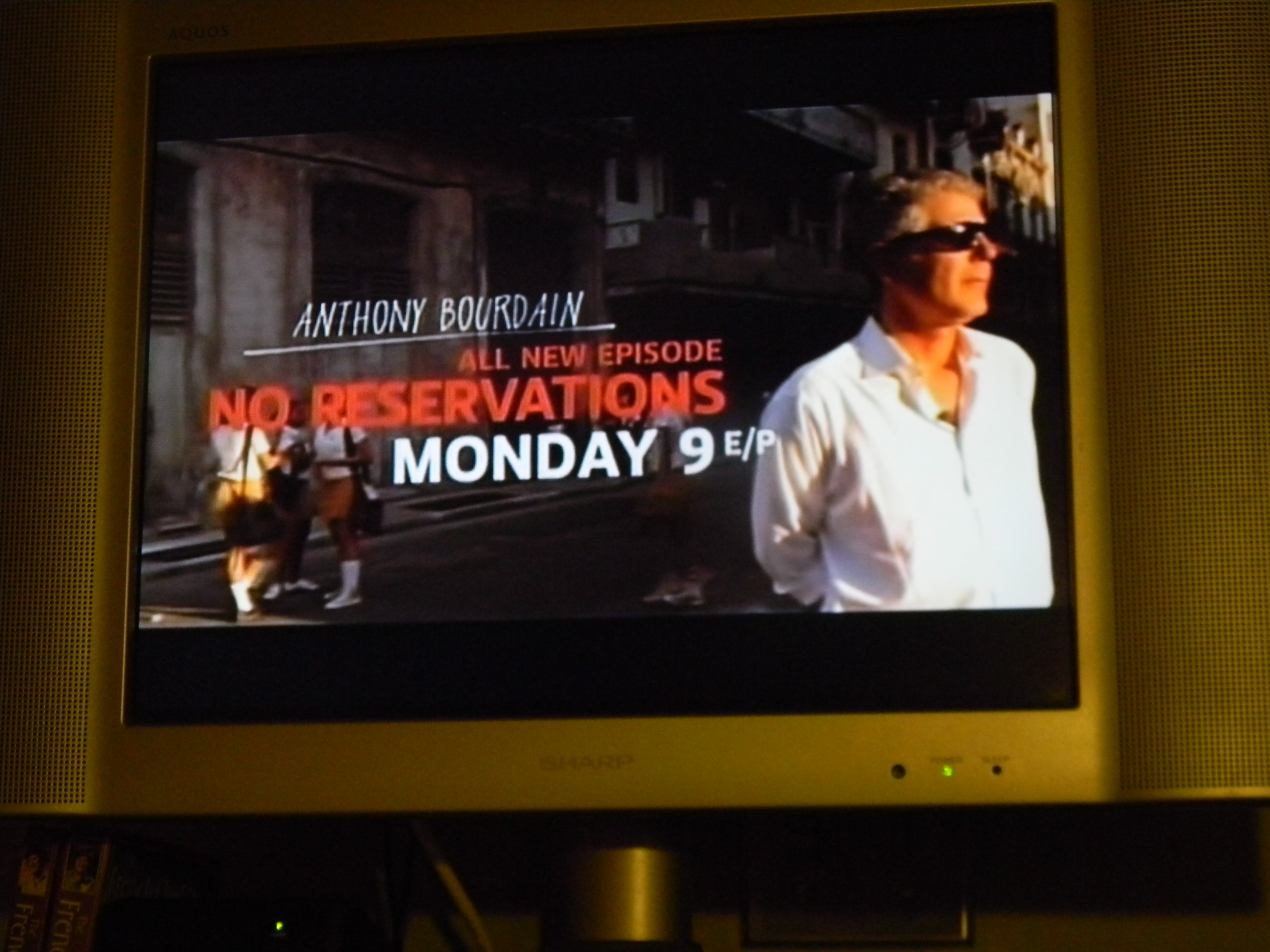
Admittedly, Sara has more well-rounded television interests than I.  She deviates from food-related programming more than I do from HGTV.  In addition to Bravo, she enjoys the Travel Channel, especially Anthony Bourdain’s “No Reservations.”  But then I like Tony, as well.  Somehow his vulgarity adds drama to our aging, early-to-bed, lesbian lives.
Sara also watches “Bizarre Foods”—the series, in which Andrew Zimmern travels to exotic places and eats things most of us would try to avoid in everyday life—things like grasshopper and rattlesnake, cricket and caribou—mostly creepy-crawly things and things with wings.  He eats bats, for example, and tons of testicles, the balls of almost any mammal worthy of having his private parts sautéed in olive oil or lots and lots of butter. 

However, if you knew my taste in television you would understand that I am way, way weirder than Sara—more singular in focus and borderline bizarre—willing to watch only two kinds of programming—those related to homes, and others nearer to news.

I’ve indicated before on this blog that I’m a fan of HGTV.  However, I’ve not yet confessed just how decorating-obsessed I happen to be.  For example, I live to see David Bromstad splash color from one end of Miami to the other—South Beach to Bal Harbor—Dade County dripping—a decorator’s delight.  (To watch an episode of “Color Splash Miami,” click here.) 

By far, however, my favorite HGTV series is “House Hunters International,” as it has, in recent years, paralleled my own ex-pat experience—going abroad, searching for housing, deciding what it takes to settle down domestically in a place far from home.  In some cases, I’m fascinated by cost—or the lack thereof—the hugely affordable urban apartments of Bangkok, the fabulous beach front flats in Ecuador, the Dominican Republic.  I fanaticize.  I dream.  Life by the sea at give-away prices.

an episode of "House Hunters International" in the Dominican Republic

At the same time, however, I’m also a huge fan of cable news—especially CNN—an obsession that kicks in especially during US presidential election years and massive natural disasters.  Largely CNN is for me what Bravo is to Sara—background noise—but in my case, at least not meaningless chatter—rather information and discussion of globally impactful issues—or in my case, regionally focused narratives what will affect me in distinctly global ways.

Since my partner Sara works in disaster response, sometimes stories about earthquakes or tsunamis become personally significant.  The Haiti earthquake, for example, meant leaving Hanoi, the place we called home at the time, and eventually settling in yet another remote location—Port-au-Prince.  Since Haiti has nearly non-existent or non-functioning infrastructure, perhaps, I watch cable news, and even “House Hunters International” to figure out what will make me a happy camper in similar locations, or happy camping, as the case may be.

So, given our globe-trottingly eccentric lifestyle, perhaps, both Sara’s and my programming choices are understandable and not as weird as I’d thought.  In fact, maybe it’s not our approach to television that’s exceptional, but rather our disaster-responding lifestyle that is borderline bizarre—living without screens in malaria-plagued places, surviving without electricity in countries infernally hot, locations where fans, not to mention air conditioning would have made worlds of difference.

But then again, that’s what we want our lives to be.  Living in comfort is second-rate compared to making meaning and making a difference.

And the year we lived in Haiti, we had no television except when we came home on holiday—so maybe that fueled our viewing eccentricities.  “Top Chef” droning non-stop in the background at least gave my partner a break from poverty housing and humanitarian aid, the ups-and-downs of responding to disasters in distant places.

So, maybe, this post is less about television and more about living life on the edge, less about meaningless programming and more about making meaning in a stressed-out, crazy world, where sometimes the earth shakes in places like Haiti, buildings collapse and lives are lost—but sometimes babies are saved, sometimes families survive, sometimes dreams can endure—hope pulled like prayer from the rubble—

—television or not.

Nowhere Near Three Cups of Tea but Neighbors Nonetheless


In 2003 an ice storm paralyzed the city where I still live, taking down power lines, leaving Lexington cold and dark.

At Briarwood, the government-subsidized housing complex I called home, branches bent under the weight of so much winter weather, trees seemed to hang their icy heads in shame, sorry for the light-less, tea-less inconvenience of it all.

The storm moved through the night of February 15th, so we woke up Sunday the 16th with 2 inches of ice coating sidewalks, streets, and trees.  Eventually, most of Lexington was without power, as the storm unexpectedly intensified as it moved through the state, leaving utility companies scrambling to repair power lines downed by fallen trees–trees that, in some instances, smashed cars and damaged roofs.

When I woke up in the wee hours of Sunday morning (2:30 according to my journal), the power was already out in my apartment.  At the time I lamented not having enough light to read or write by, not anticipating then that I would be without for 6 long days and nights to come.

Admittedly, this comes nowhere near the 13 day stretch we went without power in Haiti last summer, but at least in Port-au-Prince I’d grown accustomed to going without.  There we rarely had electricity for more than 8 hours a day, and many Haitians never have any.  They really deal with darkness at night, every night.

However, in the winter of 2003, I hadn’t been to Haiti; I was a newbie when it came to power outages.  And since I had only an electric stove, I had no means of even boiling water, no hot water for those strong cups of hot tea I used to keep me going, ones I could have used to keep me warm, as well.

With no electricity, it was also difficult to get news—no T.V.—no radio.  Eventually, I rounded up enough batteries to power my boom box and began hearing predictions that we might be without utilities for 3 to 7 additional days.

Officially, then, Briarwood was to have been evacuated—residents sent to shelters nearby that generated enough power to keep the heat going and lights on.  Some residents went to stay with family, but for most Lexingtonians, local relatives were also doing without, unless they had managed to secure an hotel room, all of which were booked in the city and surrounding areas once it became clear Lexington could remain cold and dark for days, if not weeks to come.

However, unofficially, many residents remained at Briarwood, especially those with pets, as no animals were welcome at shelters.  To accommodate these folks, the management, maintenance staff, and younger, able-bodied neighbors like myself pitched in, making sandwiches and coffee, which we delivered door to door.  I don’t remember how we made the coffee, especially for so many people, but I have some vague recollection of Terry, the maintenance supervisor securing a small generator that produced enough power to fuel a few of these endeavors.

The second floor craft room in the building where I lived (one I’ve written about before) was a hub of activity carried out in semi-darkness, even during daylight hours, since the room had only one small window.  There we gathered in a spirit of strong, if dimly lit, camaraderie, sharing food we knew we’d lose without refrigeration.  Some residents with grills on their balconies even managed to roast meats that began thawing in freezers—meat that would definitely rot if not eaten—hamburgers, hotdogs, chicken, more and more a carnivore’s delight as the week wore on.

However, with no means of producing heat, our apartments became colder and colder.  Thawing meat meant increasingly freezing temperatures in my living room, until on day four of our ordeal, I was wearing five shirts, three pair of sweat pants, and three pair of socks.  By day five, I was officially miserable.  With no natural light in my bathroom, I struggled to brush my light by candle light and began to crave a long hot bath—not to mention a decent cup of tea.  I lament in my journal about being unable to boil water, even to heat it warm enough so tea would steep before cooling in my increasingly cold, dark kitchen.

But just as the dim half-light was becoming a way of life, power returned late on our 6th day of doing without.

And even if the local utility companies had taken longer than we liked to get things up and going, even if I hadn’t had a single cup of tea, we residents of Briarwood had gotten along.

We’d played board games—Monopoly and Clue.  We’d fed one another, helped one another, drank coffee instead of tea.

We emerged a stronger community than we’d been before the storm stranded us together on those dark and icy February nights.

We cared.  We shared.  We became neighbors all over again.

Lexington, Kentucky, Where Only the Horses Run Fast


Lexington, Kentucky may be known as the “Horse Capital of the World,” but I’m proud to announce that the lovely and amazingly lazy town where I live has also made the Colbert Report.

Recently, Men’s Health Magazine ranked Lexington the most sedentary city in America, inspiring Colbert to award this city-of-sloth the highly coveted “Reacher-Grabber Award.”

So, kick back, grab yourself a big ol’ bag of Lays, and allow Colbert to laugh you into the long, holiday weekend the right way, the lazy Lexington way:

Whether or not you, like Lexingtonians, avoid sweat at-all-costs, tell me–what lazy-ass thing will you do to save yourself a few steps this 4th of July?

Death by Dinner Party


It all started with the rain—

–When we had planned to party on the lawn. 

My partner Sara had been planting and pruning, purposefully piddling in the garden for months.  I had joined in on weekends away from blogging, before participating in full-time party prep last Thursday.

I had cleaned our huge home from almost-top to almost-bottom, omitting only attic and basement from my frenzied scrubbing.

Sara had been reading recipes and planning menus, everything from growing herbs to grocery shopping.

We were exhausted but nearly ready, when we woke up Sunday morning to rain—lots of rain—rivers of rain.  We prepared to launch the ark but decided we’d be better off praying for it to stop and proactively setting up inside instead.  (I exaggerate here only a little.)

Sara continued to cook, while I went into frantic but festive over-drive—rearranging and setting up the indoor option—keeping the outdoor one in place, just in case God decided a ceasefire was in order and our pummeling from heaven should come to a quick and less-wet, happy ending.

Once I’d gotten the inside done, the heavens parted, the rain stopped, and we were whiplashed into outdoor mode once more.

To make a long story more mercifully short, the party proved amazing; the blog has been ignored—our outside party on the lawn a huge success.

But I woke up this morning post-less and sick as my Maltese when Mommy’s gone.  (And I don’t even drink.)

So the blog and all my blogging buddies have been sacrificed to party success and ensuing partied-sickness.

But I promise to get back on track tomorrow—a real mental illness post in my bloodied blogger’s fist or housing piece complete and ready for prime time.

In the meantime—please forgive my break from blogging.

Death by dinner party is more than it’s cracked up to be, and I don’t even have the pictures to prove it.

See you in a less-partied, more stomach-settled day or so . . .


Close Encounters with Well-Wigged Old Women and other Adventures in Government-Subsidized Housing


I mentioned the other day that Briarwood, the government-subsidized housing complex where I lived, had what residents and folks running the place called a “craft-room.”  Actually, there were 4 craft rooms, one in each building, second floor, across from the elevator.

These “craft rooms” were more like little libraries with couches, a few comfortable and very 80s-era blue chairs, an artificial flower or two, and, yes, an equally-80s-styled book-case that housed at least 6 dozen romance novels and a few Chicken Soup for the Soul anthologies—not to mention a good 30 games and close to 50 jig-saw puzzles—all with pieces missing, of course—because what’s a puzzle without a few holes in the Eifel Tower image—Monet’s “Water Lilies” minus a bloom or two?

In Building A, where I lived, the elderly, lady residents gathered in the craft room most afternoons—gossiping, reading, gossiping some more.  Some slept from time to time.  A few even snored.  Mind you, no one assembled there was born after 1920—except for me, of course, D.O.B. 1962.  Yes, I know—generation gap—big time.

On my 40th birthday Briarwood friends sat me in a wheelchair to mark the occasion of my aging. Note: I didn't wear a wig.

Wigs were all the rage in the craft room.  And everyone, besides me in my sweatpants, dressed up.  One woman named Evelyn—92-years-old when I moved into the complex—always wore a wig.  And she was the best dressed of the group—nicely-styled polyester dresses in navy or gray, with crisp white collars and big brass buttons—usually a fake patent leather belt around the waist.

Evelyn engaged in the only remotely craft-like activity ever done in the history of Briarwood craft rooms.  Evelyn crocheted. And she ever only made one thing—over and over.  She had to have produced hundreds, even thousands, of them while I lived there.  Evelyn made doilies.  Usually they were white.  Sometimes they were lavender or baby blue, some coaster-sized, others larger.

And like any good crocheter over the age of eighty, Evelyn liked to give her creations away.  Nothing honored her more than if, at the end of snowy afternoon in February, when she said, “Kathy, would you like to take this home for your coffee table?”  I responded in the reluctant affirmative—but only after declaring I didn’t dare take another.  When I suggested she might like to give that day’s doily to our friend Bea, Evelyn would insist, “Oh but you need a set, dear, especially when you serve sweet tea.”

Bottom line—Evelyn may have doilied me to death, but believe you me, every gray-haired lady in Building A was as well-doilied as me.  When I finally moved from Briarwood in 2005, I found more coaster-sized, crocheted circles and almost circles (as Evelyn aged) shoved in underwear drawers and kitchen cabinets than any self-respecting resident of government housing ought to own.

But our dear friend Bea, on whom I tried to foist doilies from time to time—also frequented the craft room.  Bea, tall and painfully thin, had to have been at least 5’ 9” before osteoporosis and old age shrunk and hunched her to a mere 5’ 6”, and she couldn’t have weighed more than 70 pounds fully dressed and soaking wet. 

Bea, like Evelyn, had obviously, at one time, been a stunningly beautiful woman, a fact betrayed by facial features that shown through despite her age—high cheek bones and big, blue eyes that still twinkled when she smiled.

Bea was one of the few ladies in the group who didn’t wear a wig, and for a woman well into her 90s she had a head of gorgeous, light brown curls.  True her hair was largely gray, but she retained enough of the brown to surprise you, since otherwise she looked so old and borderline antique.

Bea was also one of the ladies who slept most afternoons, waking herself up every few minutes with her own overly-sized snores.

But then again, Bea never stayed more than 30 minutes at a time, as when nicotine called at least twice an hour, she struggled to her feet from the over-stuffed chair, shuffled her pink-slippered feet across the industrial blue carpet, and disappeared into her apartment several doors down, only to reemerge a few minutes later having snuck a cigarette or two, still insisting upon her return that she had had to use the rest room or make a phone call.  Never mind she smelled like smoke over the tic-tac she sucked and the Avon she had sprayed post-puff.

But what’s the point of these craft room portraits?  Why share these old lady images, besides the fact that these grand dames of Briarwood charmed the socks off the too-few men in the building, like sweet Wayne, who, at 60-something, visited the craft several times a week?

Well, the point is this—

These aging ladies utterly obliterate the image most folks have of government-subsidized housing.  These were not crack heads with jeans belted around their knees or welfare moms, screaming, runny-nosed toddlers on either hip.  These were not delinquent teens smoking pot in parking lots or dangling younger siblings from balconies.

These ladies were what 90% of the residents at Briarwood were like, kind, considerate, doily-crocheting grandmas who cared about me and the other neighbors they encountered in the elevator or the wanna-be craft room on the second floor.

These ladies were also, in many ways, the story of my recovery.  Though I never breathed a word to them about bipolar disorder, what they would have called “a problem with [my] nerves.” These ladies loved me and asked nothing more than that I allow them to lavish their doily-making attention on me.

But then that’s a subject for another post—the tale of just how these women worked a psychiatric magic, a mental health miracle, how they did what drugs and doctors failed to do, allow me to leave government housing in 2005 only to become a home-owner in 2006.

So stay tuned over the next several weeks, as I bring you more up-close-and-personal encounters with well-wigged old women, more doilied-adventures in government-subsidized housing.